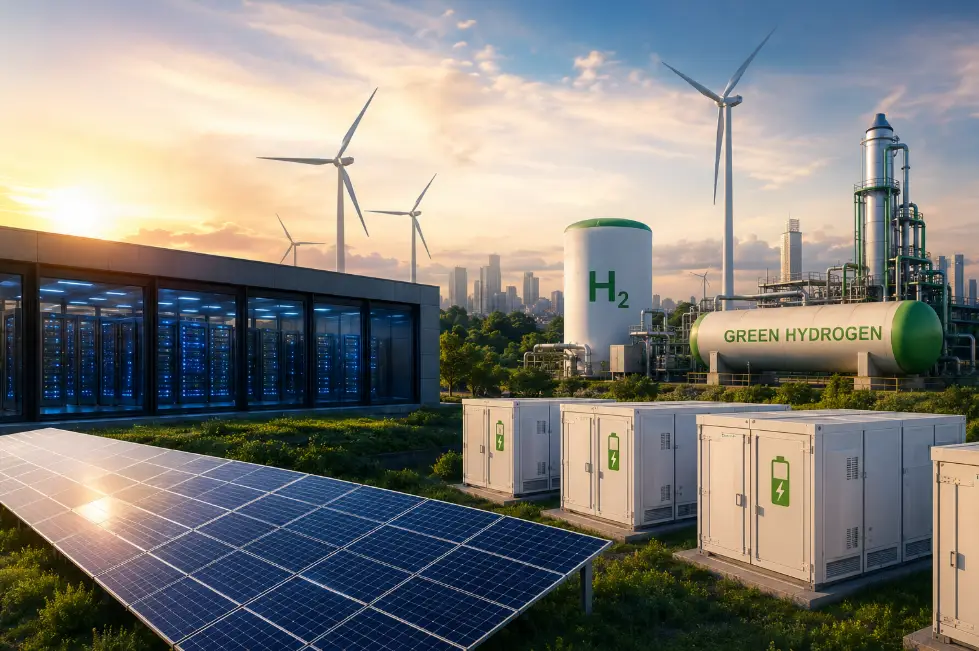
India’s solar energy story is entering a new phase. While renewable energy growth has largely been driven by decarbonisation goals and rising power consumption, a new set of demand drivers such as artificial intelligence-led data centres and green hydrogen could transform the scale of solar deployment over the next decade.
According to a recent report by Nuvama Institutional Equities, India’s solar-driven power sector is poised for “a very strong and sustained base-case demand growth of 22% CAGR over FY26–35E,” driven largely by the emergence of renewable power-intensive data centres and green hydrogen (GH2). The brokerage estimates solar demand growth could accelerate to 25% CAGR in a bullish scenario.
The report further said that the country is witnessing the convergence of two mega trends. On one hand, AI adoption, cloud computing and data localisation requirements are triggering a surge in data centre investments. On the other, India’s ambitions to become a global green hydrogen hub are creating a new source of long-term renewable energy demand.
Data centres become power hungry giants
India’s data centre industry is expected to become one of the largest consumers of renewable power. Nuvama estimates the country’s operational data centre capacity, currently around 1.5GW, could expand to 11.5GW by 2035 under its base case scenario.
“Accelerating adoption of AI, cloud computing and data localisation are expected to drive a sharp expansion in India’s data centre capacity,” the report added. Electricity costs account for 30-40% of a data centre’s operating expenses, making renewable energy an attractive option for operators.
The report estimates that announced data centre projects could require nearly 97 billion units of electricity annually. Assuming solar remains the dominant power source, this would necessitate an additional 45GW of dedicated solar capacity, creating demand for about 63GW of solar modules. In a bullish scenario where India’s data centre capacity reaches 25GW, solar demand linked to the sector could rise to 98GW, requiring 137GW of solar modules.
Major projects announced by Reliance Industries, Google, OpenAI, TCS, AdaniConneX, Sify and others are expected to fuel this expansion. Reliance alone has committed around Rs 10 trillion towards building AI-ready data centres over the next seven years, according to the report.
Green hydrogen adds another growth engine
The second growth catalyst is green hydrogen. Nuvama estimates that green hydrogen production could add another 205GW of solar power capacity by FY35 under its base case. Combined with data centre demand, these two sectors could contribute more than 250GW of incremental solar capacity over the next decade.
“GH2 and AI shall add more than 50% to solar power growth,” the report added.
Cost advantage is central to this opportunity. Nuvama points out that solar installation costs in the country stand at around $525 per kW, about 11% lower than China. This positions the country favourably not only for domestic green hydrogen production but also for future exports of green ammonia.
Solar’s rising share in India’s energy mix
The report forecasts the total power demand to grow at about 6% CAGR over FY26-35. Solar, however, is expected to grow nearly four times faster at 22% CAGR. As a result, solar’s share in India’s power generation mix could jump from 9% in FY26 to 33% by FY35, while coal’s share declines steadily.
Nuvama estimates solar capacity could rise from 150GW currently to 817GW by FY35 in its base case. Data centres would account for around 45GW of this addition, while green hydrogen projects would contribute another 205GW.
For the country’s renewable energy ecosystem, the emergence of AI and green hydrogen could be the equivalent of a new industrial revolution. As data centres and hydrogen plants increasingly seek clean power, solar energy may no longer be driven merely by sustainability goals. It could become the backbone of India’s next wave of digital and industrial growth.