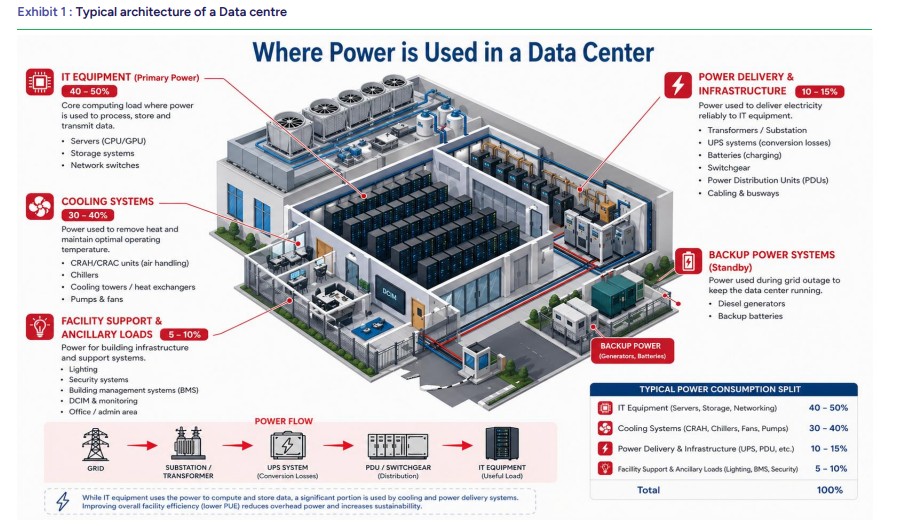
As artificial intelligence, cloud computing and digital services continue to expand globally, data centres are emerging as one of the largest consumers of electricity in the technology ecosystem. A closer look at a typical data centre architecture reveals that power consumption is not limited to servers alone — cooling systems and power infrastructure also account for a substantial share of energy usage.
According to a report by PL Capital, IT equipment such as servers, GPUs, storage systems and network switches consume around 40–50% of the total electricity inside a data centre. These systems perform the core computing tasks, process AI workloads and store massive volumes of enterprise and consumer data.
However, cooling systems account for nearly 30–40% of the overall power consumption, making them the second-largest energy-intensive component. Cooling infrastructure includes CRAC and CRAH air handling units, chillers, cooling towers, pumps and fans that maintain stable temperatures for high-performance computing hardware.
The growing adoption of AI workloads is further increasing cooling requirements. AI servers equipped with advanced GPUs generate significantly more heat than traditional enterprise servers, forcing operators to invest in liquid cooling, immersion cooling and energy-efficient thermal management systems.
Power delivery and infrastructure consume another 10–15% of electricity usage. This segment includes transformers, substations, UPS systems, batteries, switchgear, power distribution units (PDUs) and cabling systems that ensure uninterrupted and reliable electricity supply to critical IT systems.
In addition, facility support and ancillary loads contribute around 5–10% of total energy usage. These include lighting, building management systems (BMS), security systems, monitoring infrastructure and administrative office operations.
The power flow in a typical data centre begins from the electricity grid and moves through substations, UPS systems and PDUs before reaching the IT equipment. Backup generators and battery systems remain on standby to ensure zero downtime during grid failures.
With data centre demand accelerating across markets like India, operators are increasingly focusing on improving Power Usage Effectiveness (PUE) — a key metric used to measure energy efficiency. Lower PUE values indicate that more electricity is being used for computing rather than cooling or infrastructure overheads.
As hyperscalers and AI firms expand aggressively, efficient power management and sustainable cooling technologies are expected to become central to the future of the global data centre industry.