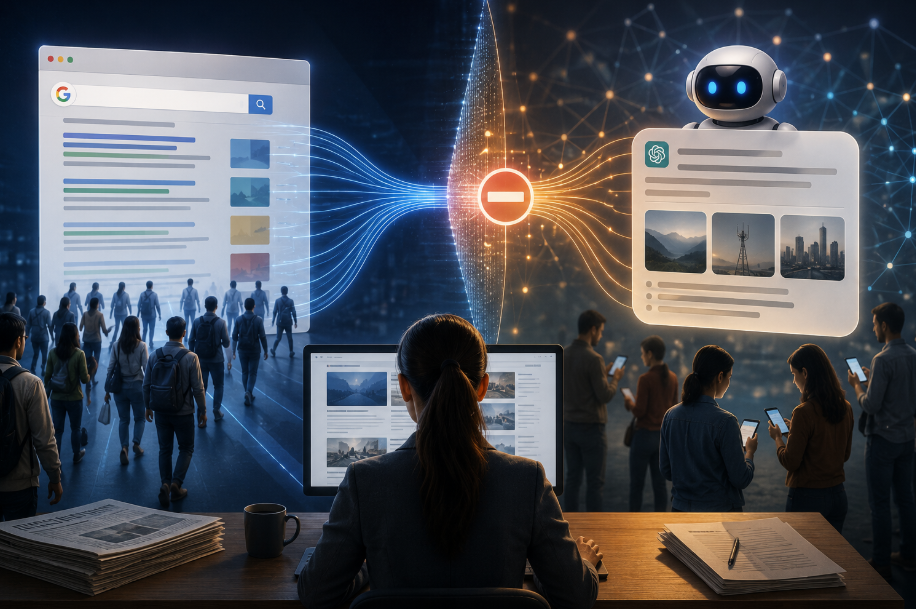
For nearly two decades, Google’s search engine served as the front door to the internet, sending billions of readers to news websites every month. Today, that relationship is undergoing its biggest disruption since the birth of digital journalism.
Artificial intelligence-powered search engines are rapidly replacing the traditional “10 blue links” with instant answers, summaries and conversational responses. As users increasingly get what they need without clicking through to publisher websites, media companies face an uncomfortable question: What happens when Google stops sending traffic?
According to the Reuters Institute’s Journalism and Technology Trends and Predictions 2026, the answer could fundamentally reshape the economics of digital publishing. The report warns that the news industry is entering another major technological shift as “search engines are turning into AI driven answer engines, where content is surfaced in chat windows, raising fears that referral traffic for publishers could dry up, undermining existing and future business models.”
That fear is no longer theoretical.
Publishers are preparing for a world with far less Google
The Reuters Institute surveyed 280 editors, CEOs and digital leaders across 51 countries. Their verdict is striking.
On average, publishers expect search traffic to decline by 43% over the next three years, largely because of AI powered search experiences such as Google’s AI Overviews and conversational assistants like ChatGPT and Gemini.
The report notes that Google’s AI Overviews, already appearing in roughly 10% of US search results, are increasing “zero click searches”, where users receive answers without ever visiting the original source.
Even more worrying is that about one fifth of publishers expect to lose more than 75% of their search traffic if current trends continue.
The decline has already begun
This is not merely an industry prediction.
Using data from analytics firm Chartbeat covering more than 2,500 publisher websites, the Reuters Institute found that Google Search referrals fell 33% globally between November 2024 and November 2025. In the United States, the decline was even steeper at 38%.
Traffic from Google Discover also dropped 21% globally during the same period.
The report says publishers specialising in lifestyle content such as weather, television guides and horoscope pages have been among the first casualties because AI can answer these queries directly.
ChatGPT is growing fast but Google still dominates
Ironically, while AI assistants are becoming an increasingly common gateway to information, they are not yet replacing Google as a traffic source.
The report notes that ChatGPT now has around 800 million weekly active users worldwide, with searching for information becoming one of its most popular use cases.
Yet publishers should not expect ChatGPT to replace lost Google traffic anytime soon.
According to the report, Google still delivers 500 times more referrals than ChatGPT from search alone and 1,300 times more when Google Discover traffic is included. AI generated referrals remain “little more than a rounding error” despite their rapid growth.
Newsrooms are abandoning commodity content
The biggest consequence of AI may not be technological but editorial.
If chatbots can instantly answer questions such as “What’s the weather?”, “What’s on TV tonight?” or “Which phone should I buy?”, publishers have little incentive to compete in those areas.
Instead, the Reuters Institute says publishers are planning a dramatic shift towards journalism that machines cannot easily replicate.
Among surveyed media executives, original investigations and on the ground reporting ranked as the highest editorial priority, followed by contextual analysis, community building, human stories and fact checking. Meanwhile, publishers intend to reduce investment in service journalism, evergreen content and general news, areas increasingly viewed as commodities in the AI era.
As the report puts it, “future success lies in being more distinctive, even if that means losing some overall reach.”
Martin Schori, Head of AI at Sweden’s Aftonbladet, captures the new editorial philosophy: “AI platforms will continue to scrape our websites and repackage our content. The answer to that is probably to focus on journalism that can’t easily be summarised in the three bullet points.”
The next SEO is AEO
Publishers are also preparing for an entirely new optimisation game.
Instead of Search Engine Optimisation (SEO), the report predicts the rapid rise of Answer Engine Optimisation (AEO) and Generative Engine Optimisation (GEO).
These emerging disciplines focus on helping publisher content become visible inside AI chatbots, AI Overviews and conversational search interfaces.
The Reuters Institute expects agencies, analytics firms and specialist consultancies focused on AEO to proliferate as publishers adapt to AI first discovery.
A new business model is emerging
Even as search traffic declines, publishers see one potential opportunity.
Rather than relying entirely on advertising supported clicks, media companies are beginning to negotiate licensing agreements with AI companies.
According to the survey, 69% of publishers expect at least some revenue from AI licensing deals over the next three years. Nearly half believe these payments will make only a modest contribution, while 20% expect them to become a significant revenue source.
Whether those deals compensate for falling search traffic remains uncertain.
The future belongs to journalism that AI cannot replace
The Reuters Institute’s report makes one conclusion unmistakably clear.
Artificial intelligence is not simply changing how people search. It is changing how journalism is produced, discovered and monetised.
For years, digital publishers optimised every headline for Google’s algorithm. Tomorrow, they may optimise for AI answer engines instead.
In the AI era, success may no longer depend on attracting the most clicks. It may depend on creating journalism that is original enough to be cited, trusted enough to be licensed and distinctive enough that no chatbot can fully replace it.
What is AEO and GEO
Google Traffic and AI: Quick Answers
Why are news publishers losing Google traffic?
AI powered search engines increasingly answer user queries directly through AI Overviews and chatbots, reducing the need for users to click on publisher websites. This trend is creating more zero click searches and lowering referral traffic.
What are zero click searches?
Zero click searches occur when users receive complete answers directly on a search results page or inside an AI assistant without visiting the original website.
How much search traffic could publishers lose?
According to the Reuters Institute’s Journalism and Technology Trends and Predictions 2026 report, publishers expect search traffic to decline by an average of 43% over the next three years. Around one fifth expect losses exceeding 75%.
Has the decline already started?
Yes. The Reuters Institute reports that Google Search referrals fell by 33% globally between November 2024 and November 2025, while Google Discover referrals declined by 21% during the same period.
Why is AI affecting news websites?
- AI generates instant answers.
- Users click fewer search results.
- Google AI Overviews reduce website visits.
- Chatbots summarise publisher content.
- Simple informational queries no longer require visiting news websites.
What content is most vulnerable?
- Weather updates
- TV listings
- Horoscopes
- Buying guides
- Evergreen explainers
- Basic informational articles
What journalism performs better in the AI era?
- Exclusive investigations
- Original reporting
- Ground reporting
- Expert analysis
- Fact checking
- Interviews
- Data journalism
- Community reporting
What is Answer Engine Optimisation (AEO)?
Answer Engine Optimisation is the practice of structuring content so AI search engines and chatbots can accurately understand, cite and present answers from a webpage.
What is Generative Engine Optimisation (GEO)?
Generative Engine Optimisation focuses on improving the visibility of content inside AI powered search experiences such as ChatGPT, Gemini, Claude and Google AI Overviews.
Can AI replace Google Search?
Not yet. The Reuters Institute says Google still generates significantly more referral traffic than AI assistants, although AI based discovery is growing rapidly.
How are publishers adapting?
- Producing more exclusive journalism
- Building direct audiences
- Growing subscriptions
- Optimising for AI search
- Exploring AI licensing deals