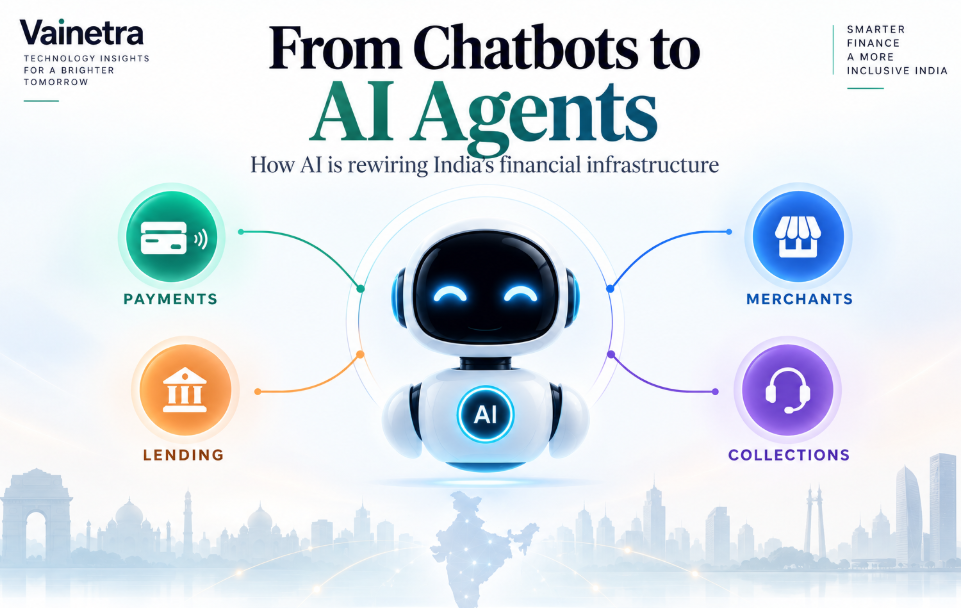
Artificial intelligence in financial services is entering a new phase in India. The focus is shifting from chatbots that respond to customer queries to AI agents that can understand an instruction, interact with multiple systems and execute tasks across payments, lending, collections and merchant operations.
Developments unveiled at the Global Fintech Festival 2026 point to this transition. Fintech companies and financial institutions are increasingly embedding agentic AI into core workflows, while the National Payments Corporation of India (NPCI) is building infrastructure that could allow AI agents to interact with the country’s payments ecosystem.
The shift is significant because it changes the role of AI in financial services. Instead of merely assisting employees or customers, AI is beginning to participate in the underlying processes through which financial products are delivered.
PhillipCapital, in its September 17 report on the NBFC and fintech sector, highlighted several such developments at GFF 2026, including BharatPe’s Agentic AI, NPCI’s AiNxt and AtOM platforms, Gnani AI’s Artha platform and AI based payment solutions from financial institutions.
From answering questions to taking action
BharatPe’s launch offers one of the clearest examples of how this technology is evolving. The company introduced BharatPe Agentic AI, an AI assistant embedded within its BharatPe for Business application. Built on Google Cloud’s Gemini Enterprise Agent Platform, the system is designed to understand merchant requirements and act across more than 60 live systems in real time.
That is different from a conventional chatbot. A chatbot typically provides information or directs a user towards an action. An agentic system is designed to take that action itself within predefined boundaries.
BharatPe is also using AI for credit education through Credit Coach, which uses personalisation and video to help users understand their credit profile and changes in their bureau score.
The company has extended the concept further through My Shop My Ad, where merchants can create personalised advertisements featuring an AI avatar of Rohit Sharma promoting their businesses.
The broader direction is clear: AI is moving from the customer support layer into the operating layer of fintech platforms.
NPCI is building the rails for agentic finance
Perhaps the most important development is coming from NPCI. At GFF 2026, NPCI rolled out AiNxt, an open source, enterprise grade agentic AI platform designed to help developers build, test and deploy intelligent agents. The platform includes AiNxt OS, AiNxt Code, AiNxt CLI and AiNxt Enterprise. It also supports a Bring Your Own Models framework, allowing organisations to deploy AI agents through low code and no code tools.
But the more consequential development could be AtOM, or Agentic Orchestration and Messaging. AtOM is designed to handle complex integration, change management and partner onboarding across UPI. The platform produces digitally signed, machine readable interactions that can create verifiable audit trails for compliance.
NPCI also unveiled a unified agent protocol that could allow AI agents to execute small ticket digital payments without requiring explicit user authorisation for every individual transaction.
That points towards a fundamentally different payments experience. Today, a consumer generally decides to make a payment, opens an application, selects a payment method and authorises the transaction.
In an agentic system, the consumer could provide an instruction and allow an AI agent to determine and execute the required steps within predefined limits. The technology therefore has the potential to make AI agents another interface to India’s digital payments infrastructure.
AI is entering the credit decision
The lending ecosystem is also becoming an important testing ground. Gnani AI has extended its Artha sovereign AI platform to the BFSI sector. The platform offers more than 200 pre-built workflows covering areas such as payment reconciliation, document-based underwriting, loan processing and risk management.
Its lending workflows can process multiple documents, including bank statements, GST filings, identity documents and Account Aggregator data. The system can cross validate information, identify inconsistencies and take a decision to approve, decline or refer an application based on predefined thresholds.
An important feature is the platform’s deployment model. Artha can operate through private cloud or on premise infrastructure, allowing enterprises to retain greater control over their data.
This is particularly relevant for financial institutions, where sensitive customer and financial information is central to lending and risk decisions.
Voice AI moves into collections
AI is also moving into one of the most labour-intensive parts of financial services: customer engagement and collections. Mahindra Finance has expanded its partnership with AI company Sarvam, integrating voice AI into sales, collections and frontline employee engagement across rural and semi urban markets.
Its AI division has developed voice agents powered by Sarvam models across 12 Indian languages. These agents are being used for pre due reminders, debt collection workflows and cross selling across vehicle, SME and housing loans.
The company said the agents have already executed more than 10 million customer calls.
This is significant for India’s financial sector because the next stage of AI adoption is not necessarily going to be limited to English speaking, urban customers. Multilingual voice systems could allow financial institutions to automate interactions across a much wider customer base.
AI could make payments more predictive
Another example comes from Yes Bank and fintech company Open. The two companies have launched i-Mandate, an agentic AI layer designed to identify and prevent recurring payment failures before they happen.
The system analyses historical account behaviour and payment signals to identify potential debit risks. It can then engage customers through voice and WhatsApp and execute authorised corrective actions, such as rescheduling a payment date, switching bank accounts or using an alternative payment method.
The applications extend beyond simple payment reminders. They include loan repayments, mutual fund SIPs and enterprise subscriptions.
This represents another important shift: AI is being used not just to respond after a transaction fails, but to anticipate a problem and intervene before it occurs.
The infrastructure question
The growing deployment of AI agents raises a larger question for India’s financial technology ecosystem.
The first phase of digital finance was about putting financial services online. The next phase was about making those services instant through platforms such as UPI, digital identity and Account Aggregators.
The emerging phase could be about making these systems intelligent and increasingly autonomous.
The building blocks are already appearing across the ecosystem. NPCI is working on agentic infrastructure, fintechs are deploying AI into lending and merchant workflows, and financial institutions are experimenting with voice agents and predictive payment systems.
But this transition also makes governance more important. RBI Governor Sanjay Malhotra, speaking at GFF 2026, highlighted the need for fintech companies to manage AI related risks, treat customer data as a fiduciary responsibility and take greater systemic responsibility as they scale.
That may ultimately determine how quickly agentic finance develops. The defining question is no longer whether financial companies will use AI. It is how much authority they will give AI to act on behalf of customers, merchants and financial institutions.
India’s fintech sector appears to be moving towards that question already. From a merchant assistant operating across dozens of systems to AI platforms capable of underwriting loans and infrastructure being designed for agent-initiated payments, AI agents are beginning to move out of the chatbot window and into the financial machinery itself.
For India’s next generation of digital finance, the interface may not always be an app or a human employee. Increasingly, it could be an AI agent.