

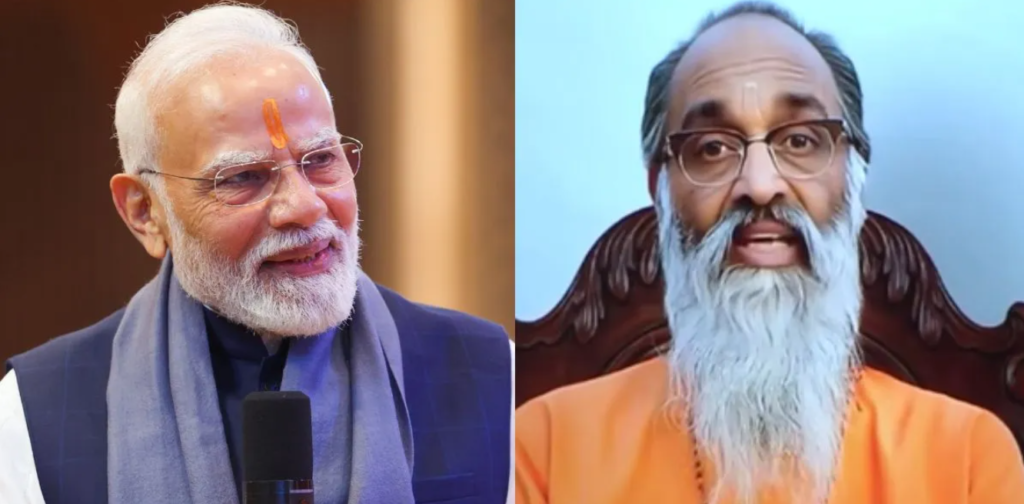
Prime Minister Narendra Modi’s interaction with a digital recreation of Swami Chinmayananda, who died in 1993, has brought a relatively unfamiliar technology into the spotlight. The interaction took place on October 23 at the Chinmaya Amrit Mahotsav Global Sammelan at Bharat Mandapam in New Delhi, where a digital version of the spiritual leader appeared to converse with the Prime Minister.
The technology, called a Holobot, combines a digital representation of a person with interactive capabilities. It can bring together artificial intelligence (AI), voice replication, digital animation and holographic or projection based display systems to simulate a conversation.
Modi recalled his meeting with Swami Chinmayananda in 1993, when he had invited the spiritual leader to attend the centenary celebrations of the Parliament of the World’s Religions in Chicago. The Holobot responded by recalling details of the Vadodara meeting, including Chinmayananda’s reluctance to accept the responsibility because of his age.
“Having the privilege of conversing with his holobot made it feel as though I had travelled 33 years back in time,” Modi said in his address at the event.
The exchange also included references to the spiritual leader’s teachings and a light-hearted mention of shrikhand, making the interaction more personal than a conventional video presentation. The encounter was part of an event marking 75 years of the Chinmaya Mission.
How does a holobot work?
A Holobot is not simply a hologram. A conventional holographic or projection based display creates the visual impression of a person appearing in three dimensions. An interactive Holobot adds a conversational layer that can respond to questions or prompts.
The first component is the digital recreation. Photographs, archived videos and other visual material can be used to reproduce a person’s appearance, facial expressions and movements. Existing voice recordings can also help recreate characteristics of the person’s speech.
The second component is artificial intelligence. A conversational AI system can interpret questions and generate responses using information drawn from speeches, writings, interviews and other records. Speech recognition can convert spoken questions into text, while speech synthesis can turn generated responses into audio.
The final component is the display system, which presents the digital character to the audience. The exact hardware and software used can differ across installations.
Where Can the Technology Be Used?
Holobots have potential applications beyond religious and cultural events. Museums could use digital recreations to help visitors engage with historical figures. Educational institutions could create interactive learning experiences, while businesses could use digital avatars for training, presentations and customer engagement.
The technology also raises questions about accuracy, consent and the use of a person’s likeness after death. An AI generated response may sound authentic without necessarily reflecting what the individual would have said.
A Holobot does not revive a person or reproduce their consciousness. It creates a digital simulation based on available information and the system’s design.
As AI and immersive display technologies advance, Holobots could offer new ways to preserve and communicate historical knowledge. Their credibility, however, will depend on how transparently they distinguish documented statements from AI generated responses.

