A new report by Redseer Consulting says artificial intelligence is fundamentally reshaping the global advertising industry, with Machine Learning, Generative AI and Agentic Systems emerging as three distinct technological layers driving the transformation. According to the report, understanding the differences between these technologies is becoming critical for companies looking to compete in the rapidly evolving digital advertising ecosystem.
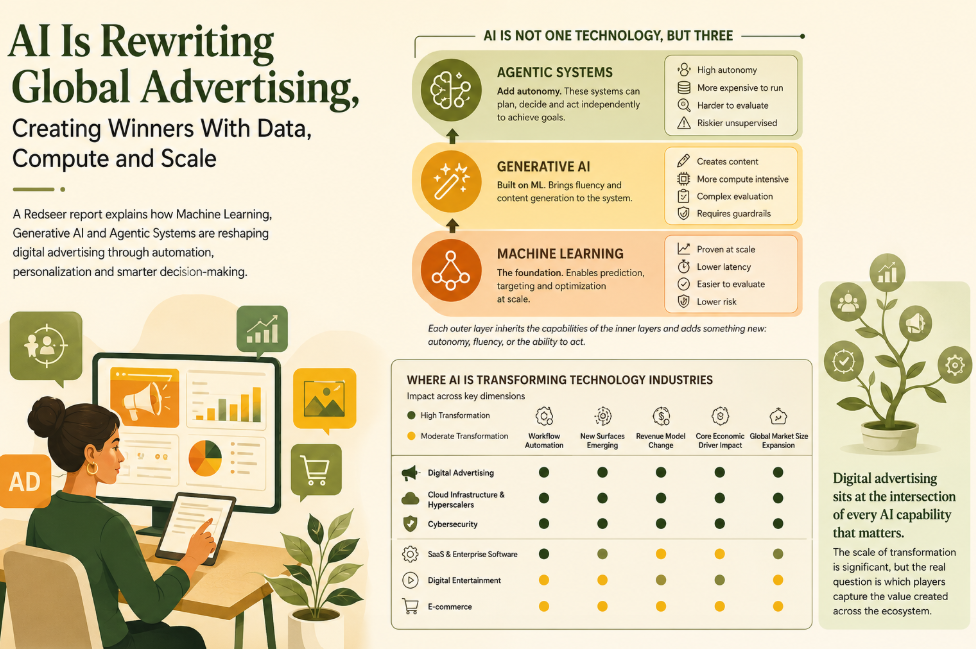
The report explains that AI in advertising is often misunderstood as a single technology, while in reality it operates through three interconnected systems. Machine Learning forms the foundational layer by enabling prediction, targeting and optimisation. Generative AI builds on this by adding fluency and content creation capabilities, while Agentic Systems add autonomy, allowing AI systems to independently execute tasks and make decisions.
As companies move from Machine Learning to Generative AI and further towards Agentic Systems, the systems become more powerful and versatile but also more expensive and difficult to manage. The report notes that the outer layers inherit the strengths of the inner layers while adding new capabilities. However, they also introduce greater operational risks, higher infrastructure requirements and more complex evaluation mechanisms.
According to the study, the impact of AI is not uniform across industries. Instead, a small cluster of sectors including digital advertising, cloud infrastructure and cybersecurity is witnessing large-scale transformation alongside significant market expansion. Other sectors such as SaaS, enterprise software, digital entertainment and e-commerce are seeing relatively moderate disruption.
Digital advertising, however, stands out because AI directly improves its core economic drivers through automation, optimisation, personalisation and decision-making at scale. From creative production and audience targeting to bidding systems and campaign measurement, nearly every layer of the advertising value chain is being rebuilt using AI-driven systems.
The report adds that the benefits of AI-led transformation are unlikely to be distributed evenly across the ecosystem. Since modern advertising increasingly relies on transformer-based AI models that demand large-scale computing power and data infrastructure, companies with superior access to data, compute capacity and consumer distribution networks are expected to capture a disproportionate share of the value creation.
The report believes digital advertising is now among the most AI-disrupted industries globally, making it a key battleground for technology companies in the coming decade.