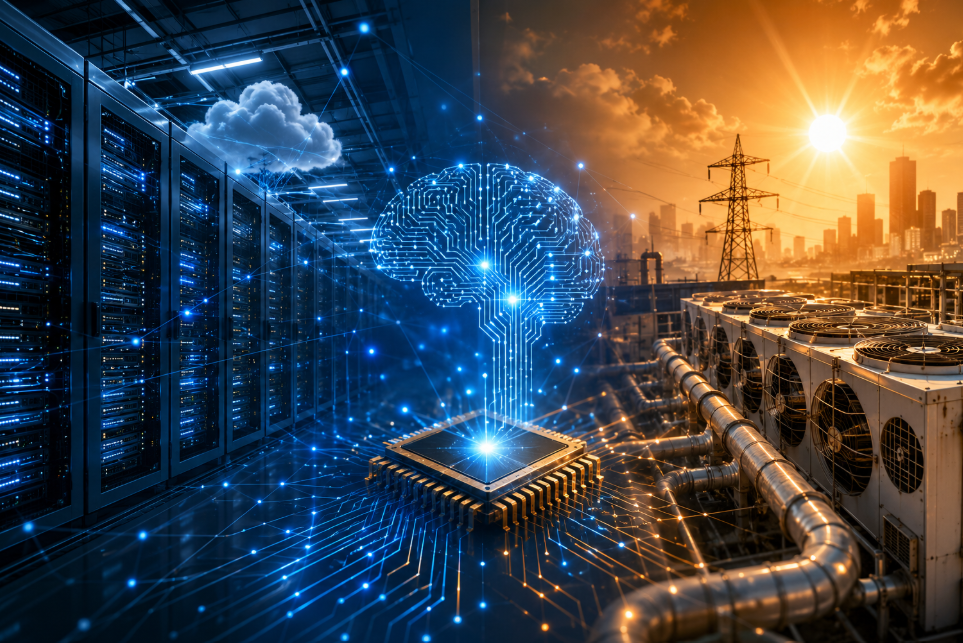
The global data centre industry is entering a new phase of transformation as artificial intelligence rapidly changes infrastructure requirements across the world. While cloud computing and enterprise usage continue to dominate the sector, AI driven workloads are now emerging as the biggest growth catalyst for the industry.
According to the CBRE 2026 Asia Pacific Data Centre Trends & Outlook report, AI currently contributes less than 15% of the total global data centre workload as of 2025. In Asia Pacific, the share is even smaller because most large scale AI demand remains concentrated in the United States.
However, industry experts believe this balance could shift quickly over the next few years as investments in AI development continue to accelerate globally.
“AI demand is far outpacing traditional non AI usage patterns,” the report noted, highlighting the growing pressure on digital infrastructure worldwide.
The report cited Goldman Sachs estimates showing that global AI demand is expected to grow at a compound annual growth rate (CAGR) of 98% between 2023 and 2026. In comparison, hyperscale data centre demand is projected to grow at 14% CAGR while non hyperscale demand may rise only 4% during the same period.
This sharp divergence signals a structural shift in the industry where AI workloads are increasingly driving investment decisions, infrastructure upgrades and expansion plans.
Unlike traditional cloud storage or enterprise computing, AI applications require significantly more computing power. Training large AI models and running inference systems consume enormous energy while generating substantially higher heat levels inside facilities.
As a result, data centre operators are being forced to redesign infrastructure standards.
“At the infrastructure level, AI workloads require substantially higher power capacity, greater rack density and more advanced building specifications than conventional data centre workloads,” the report said.
Cooling systems are emerging as one of the most critical areas of transformation. Advanced liquid cooling technologies, energy efficient ventilation systems and next generation thermal management solutions are now being adopted rapidly across new greenfield projects as well as existing facilities undergoing retrofitting.
The growing AI boom is expected to reshape the future of global digital infrastructure, with data centres evolving from simple storage hubs into highly specialised, power intensive technology ecosystems built to support the next generation of artificial intelligence applications.