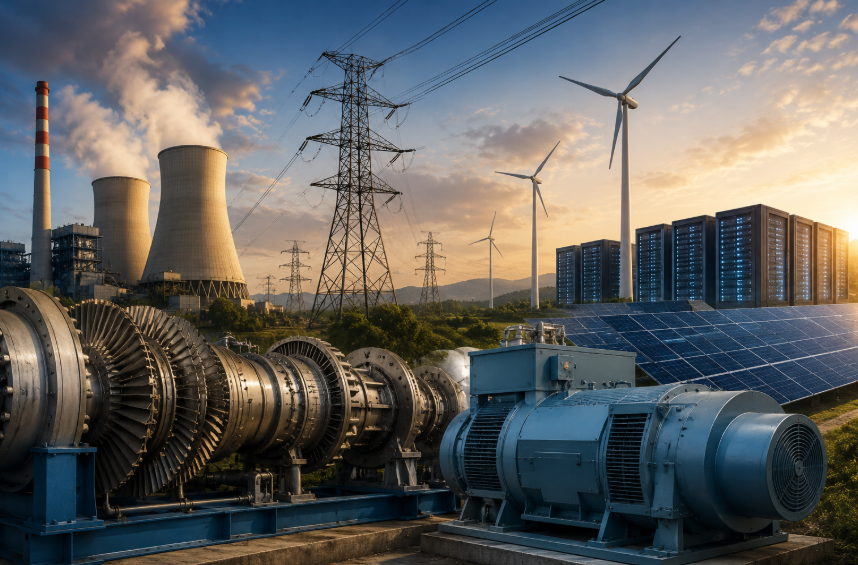
Rising electricity demand is creating an opportunity beyond power producers and utilities in India. The companies making the turbines and generators that turn energy into electricity are emerging as key beneficiaries of the country’s multi-year power infrastructure buildout. Among them, TD Power Systems (TDPS) and Triveni Turbine (TTL) stand out for different reasons.
The Ashika Institutional Equity Research report, dated August 24, 2026, describes both companies as specialised manufacturers positioned to benefit from rising electricity consumption, AI-led data-centre demand, industrial electrification, renewable-energy integration and the growing need for grid stability. The report initiated coverage on both stocks with a BUY rating.
TD Power Systems: Riding the Generator and AI Data-Centre Wave
TD Power Systems operates at the generator end of the power-generation chain. The company manufactures AC generators ranging from a few kVA to more than 200 MVA, supplying applications from diesel gensets to large thermal and hydro power plants.
Its opportunity is increasingly moving toward larger machines and global demand. The report says TDPS has an installed base of 8,000-plus generators across more than 100 countries, supported by long-standing OEM relationships. Revenue grew at a 26% CAGR between FY21 and FY26, with Ashika estimating a 40% CAGR during FY26-FY28E.
The data-centre opportunity could add another growth engine. The report notes that US hyperscalers are increasingly turning to behind-the-meter power because grid connections can take years. A 100 MW data-centre campus using gas engines, for example, could require 10–12 TDPS generators, creating substantial generator content per project.
TDPS is also benefiting from a shift toward exports and larger generators. Its FY26 order book stood at Rs 19.7 billion, while export orders accounted for 80% of inflows.
Triveni Turbine: The Industrial Power and Aftermarket Play
Triveni Turbine occupies the turbine side of the equation. Its portfolio covers 1-100 MW steam turbines, serving industrial cogeneration, waste-heat recovery, biomass, geothermal, waste-to-energy and distributed-generation applications.
The company has a particularly strong position in India’s industrial turbine market. The report calls TTL the second-largest global player in sub-100 MW industrial steam turbines, with more than 6,000 installations across 80 countries and around 55% of the Indian market.
Its other major advantage is the aftermarket business. Aftermarket revenue rose from Rs 193 crore in FY18 to Rs 589 crore in FY26, while aftermarket contributed 39% of order inflow in Q1FY27. The report expects large product deliveries from FY24-FY25 to progressively feed aftermarket revenue over FY26-FY27.
TTL is also gaining exposure to exports, data-centre power and emerging applications such as geothermal. Its Q1FY27 order book stood at Rs 2,180 crore, with the aftermarket order book exceeding Rs 620 crore.
Two Different Ways to Play the Power Boom
The report’s central argument is that TDPS and Triveni Turbine are not simply selling industrial machinery. They occupy two critical points in the electricity-generation chain: TDPS converts mechanical rotation into electricity through generators, while TTL supplies the steam turbines that create that rotation.
As India’s power demand rises and new drivers such as AI data centres, industrial captive power, renewable integration and grid stability increase the need for reliable generation, both companies are positioned to participate in what Ashika describes as a “multi-year investment supercycle.”
For investors, the distinction is clear: TDPS offers exposure to the global generator and large rotating-equipment opportunity, while Triveni Turbine combines industrial steam turbines with a growing recurring aftermarket business. Together, they represent two different ways of participating in India’s emerging power-equipment cycle.