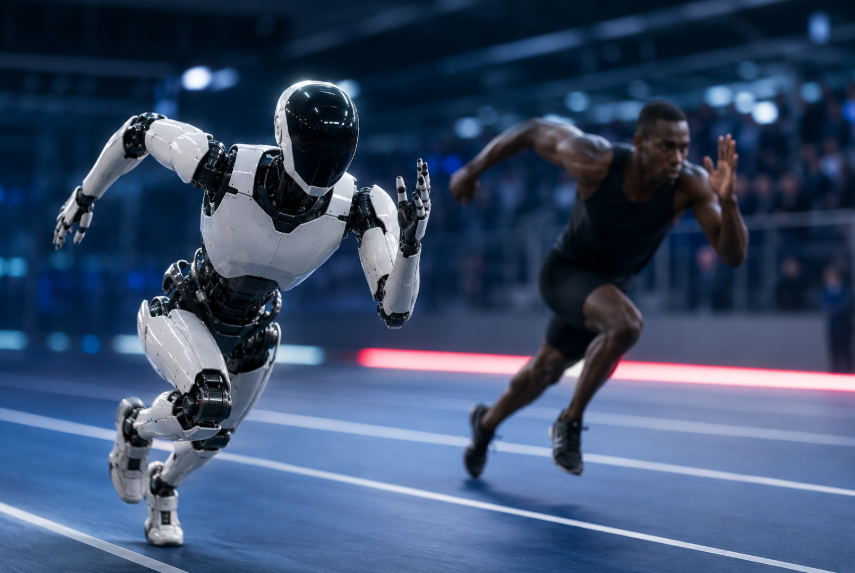
A Chinese humanoid robot just did something that sounded like science fiction a few years ago. It ran 100 metres faster than Usain Bolt.
But the real story here isn’t that a machine can now beat the world’s fastest human over a short sprint. It’s that Beijing is turning humanoid robotics from a flashy tech demo into an industrial strategy, one that ties together AI, advanced manufacturing, batteries, sensors, motors and automation.
At the World Humanoid Robot Games in Beijing, Tiangong Ultra, built by the Beijing Humanoid Robot Innovation Center, finished the 100-metre sprint in 8.86 seconds on August 25. That beats Usain Bolt’s 9.58-second world record, and it’s a big jump from Tiangong’s own 9.39-second run earlier in the same competition.
The headline number is spectacular. The industrial story behind it matters more.
From 21.5 seconds to 8.86 seconds
Look at how fast these robots are improving and you get a sense of how quickly the underlying technology is moving. Tiangong Ultra won the 100-metre event at the first World Humanoid Robot Games with a time of 21.50 seconds. A year later, it’s down to 8.86 seconds.
It’s not just Tiangong either. Honor’s Lightning robot had already clocked a sub-10-second 100-metre time earlier in this year’s games, so the progress isn’t limited to one machine or one company.
That improvement comes from advances stacked across several layers: electric motors, actuators, batteries, sensors, control systems and AI-driven movement. The robot isn’t simply getting faster on its own. The whole ecosystem needed to build a capable humanoid is maturing at the same time. And China happens to have a real edge in that ecosystem.
China’s industrial base
China is the world’s largest industrial-robot market, and it has spent years building up manufacturing capability around motors, batteries, electronics, sensors and precision components. That matters because a humanoid robot isn’t purely an AI product. The intelligence might come from algorithms and increasingly capable AI models, but a commercially useful humanoid still needs hundreds of mechanical and electronic parts working reliably, cheaply and repeatedly. China’s manufacturing base gives its robotics companies a shortcut into much of that supply chain.
Reuters has described China’s robot competitions as evolving from grassroots, academic-style events into a strategic national showcase and a commercial proving ground. Beijing has treated robotics as a priority industry for more than a decade now, and subsidies, tax breaks and fierce competition between companies have only sped things up. Which is really why the Bolt comparison starts to feel beside the point. China isn’t trying to build the world’s fastest robot. It’s trying to build the world’s most scalable robot industry.
The next race isn’t on the track
A 100-metre sprint makes for great footage. But factories don’t pay robots to run. They pay robots to do repetitive, dangerous or physically demanding work, often for thousands of hours at a stretch. That’s why the most consequential events at the Beijing games probably aren’t the ones grabbing headlines. More than 2,000 robots from 666 teams are competing across 51 disciplines, and the lineup goes well beyond sports. There are simulations of household chores, hotel services, emergency response and industrial tasks.
Running is mostly about coordinated movement. Industrial work asks for something harder: perception, dexterity, reasoning, reliability and autonomy, all at once.
That’s the real frontier.
From AI models to physical AI
The humanoid robot race is also reshaping what “AI” even means. The first wave of generative AI was largely digital. Large language models generated text, images and code. The next wave is about connecting that intelligence to the physical world. Humanoid robots are one expression of that shift. An AI system can learn what an object is, in the abstract. A robot has to go further: spot the object in the real world, reach for it, grasp it, judge its position, manipulate it, and recover if something goes wrong.
That’s what people are starting to call physical AI, systems that can perceive and act inside a physical environment rather than just process information about one. China’s robot competitions are effectively becoming test beds for that transition.
Beijing is building the ecosystem, not just the machines
China’s broader policy direction backs this up. The country’s 15th Five-Year Plan, covering 2026 to 2030, puts technological and industrial innovation at the centre of its economic strategy, with a clear push to move emerging technologies out of the lab and into factories.
China has also rolled out a national standard system for humanoid robotics, aimed squarely at speeding up technological iteration, cutting production costs and supporting commercialisation.
This matters because a successful robotics industry needs more than a few impressive prototypes. It needs component suppliers, manufacturing capacity, AI and software talent, testing facilities, standards, financing, training data, customers, and after-sales infrastructure. China is trying to build all of these layers at once, rather than one at a time.
But there’s a real gap between demonstration and deployment
The excitement here comes with a big caveat: commercial adoption is still at an early stage.
A robot that can run 100 metres in 8.86 seconds isn’t necessarily capable of getting through an eight-hour factory shift. The industry still has to answer hard questions about battery life, reliability, maintenance, safety, dexterity, autonomy, and, above all, economics.
There’s also a fair amount of skepticism about how much of China’s current humanoid-robot demand is organic. The Financial Times has reported that training centres and government-linked purchases are propping up demand for robots, and it’s still unclear how much of that reflects genuine, sustainable end-user adoption rather than state-driven buying.
That’s what makes the next phase of this industry so important. The winners won’t necessarily be the companies with the flashiest robot demos. They’ll be the ones that can turn those demos into reliable, affordable machines that customers actually want to deploy at scale.
The geopolitical race is already on
The stakes go well beyond robotics itself. Humanoid robots sit right at the intersection of AI, semiconductors, batteries, advanced manufacturing and automation, all areas already at the centre of the US-China tech rivalry.
The US has already moved to restrict new Chinese humanoid and quadruped robots from entering the American market, a step that reflects growing unease around technology, data and national security. At the same time, China’s manufacturing advantage could make its robots cheaper and easier to produce at scale. Put those two things together and you get a potentially powerful combination: AI intelligence paired with Chinese manufacturing scale and low-cost hardware.
If that combination works, humanoid robots could become the next technology category where China tries to repeat its playbook from electric vehicles, batteries and solar manufacturing.
The real milestone is still ahead
The 8.86-second sprint will be remembered, but it isn’t the number that will decide whether humanoid robots become a major industry. The numbers that actually matter are cost per robot, operating hours, failure rates, useful tasks completed per hour, and return on investment for the customers buying these machines.
When a humanoid robot can walk into a factory, learn a task quickly, work an entire shift without failing, and do it all at a cost lower than human labour or conventional automation, that’s when the technology crosses the real threshold. That’s the point where the humanoid robot story stops being an AI demonstration and starts being an industrial revolution.
For China, that race has already begun. And the finish line isn’t 100 metres away anymore.