

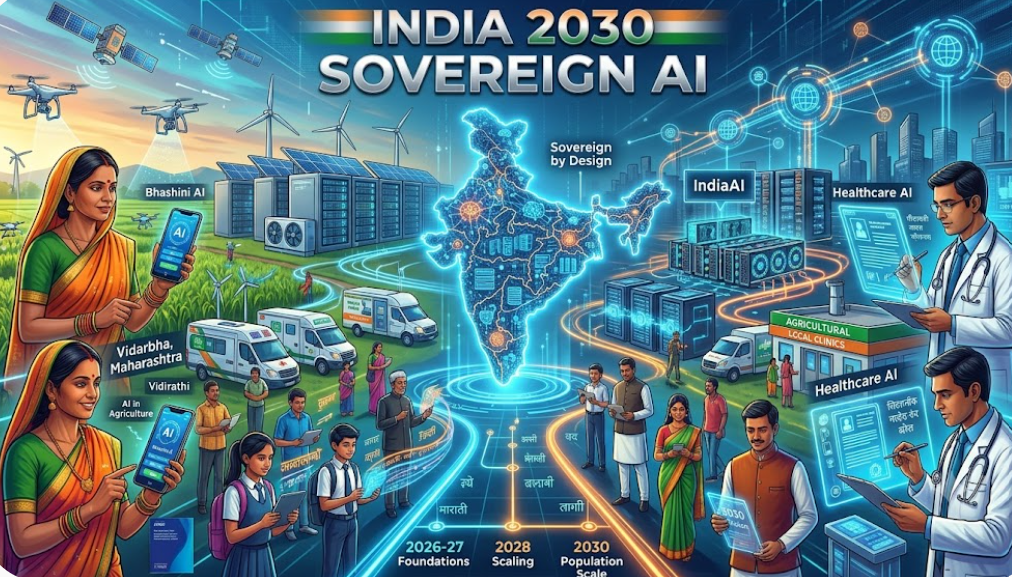
Imagine a farmer in Vidarbha asking her phone in Marathi whether her crop qualifies for insurance after an unseasonal hailstorm. An AI assistant checks satellite imagery, land records and scheme rules before initiating the claim. In Bihar, a doctor dictates consultation notes in Hindi, with AI structuring the patient’s record and flagging a possible drug interaction.
These are scenarios outlined in KPMG India’s October 2026 report, Sovereign by Design: Building India’s Independent, Inclusive and Future-Ready AI. They illustrate how AI could become part of everyday public services by 2030.
But achieving this would require more than building domestic AI models or expanding computing capacity. The report said that India must decide which parts of the AI ecosystem it needs to control, where it can work with global technology providers and which capabilities it can safely procure.
“Sovereignty in AI is not about doing everything ourselves. It is about never being in a position where someone else can switch off our ability to serve our citizens,” says Nilachal Mishra, Head of Government and Public Sector at KPMG in India.
From infrastructure to adoption
India has expanded its public AI computing infrastructure rapidly. More than 38,000 GPUs had been onboarded for common use by December 2025, while another 20,000 were announced in February 2026. The IndiaAI Mission has an outlay of Rs 10,371.92 crore.
The next challenge is turning this capacity into services that can be deployed at scale. KPMG calls for a shift from proof-of-concept projects to AI systems embedded in government budgets, processes and policies. Its vision includes voice-first services in Indian languages, AI applications for agriculture and healthcare, and platforms that work on low-cost devices and limited bandwidth. The report notes that Bhashini already integrates more than 350 AI models and has over 450 active customers.
“Trust is the licence to operate,” the report said, arguing that data and model governance must be built into systems from the beginning. It recommends stronger evaluation, human oversight and clear contractual safeguards covering data residency, audit rights and portability.
The infrastructure challenge
Data centres will be critical to this ambition. The country’s data centre capacity rose from 375 MW in 2020 to more than 1,500 MW in 2025 and could reach 4.5-6.5 GW by 2030, according to KPMG.
However, the report warns that computing capacity is only as dependable as its power and water supply. Data centres consume an estimated 150 billion litres of water annually, with both water and electricity requirements expected to more than double by 2030.
KPMG recommends locating AI computing facilities where clean power and water are assured, alongside regular disclosures of resource consumption.
The road to 2030
The report proposed three stages: establishing foundations in 2026-27, scaling sovereign-controlled and Indian-language models by 2028, and delivering AI-enabled public services at population scale across all scheduled languages by 2030. It also proposed a Sovereign AI Readiness Index to track progress in areas such as domestic computing, AI adoption, Indian-owned intellectual property, talent and sustainability.
For India, the ultimate test will be whether domestic AI companies can secure long-term capital, retain ownership of their technology and win repeat customers beyond pilot projects.
As KPMG puts it, the goal is not isolation from global technology. It is the ability to innovate, deploy and govern AI on India’s own terms.


