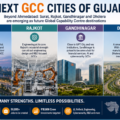
For decades, Gujarat has been known as the land of entrepreneurs, factories and ports. From petrochemicals and pharmaceuticals to automobiles and textiles, the state has built one of India’s strongest industrial ecosystems. Now, Gujarat wants to become something more: a major destination for Global Capability Centres (GCCs).
The Gujarat government’s newly unveiled Global Capability Center (GCC) Policy 2025-30 signals a clear shift in ambition. Rather than competing solely for manufacturing investments, the state is now actively courting multinational corporations looking to establish technology, engineering, finance, research and innovation centres in India.
According to the Gujarat GCC Policy 2025-30, notified by the Department of Science & Technology on February 11, 2025, the state aims to attract at least 250 new GCC units, generate more than 50,000 jobs and mobilise investments of Rs 10,000 crore over the next five years.
From back offices to innovation hubs
The timing is significant. GCCs have evolved far beyond their traditional role as low-cost back offices. Today, they are increasingly responsible for artificial intelligence, cybersecurity, engineering design, product development, analytics, finance and research functions for some of the world’s largest companies.
India has emerged as the global leader in this sector, hosting thousands of GCCs. Yet Gujarat remains a relatively small player. The policy notes that most of the state’s GCC footprint is concentrated in Ahmedabad and Vadodara, creating an opportunity for expansion into newer locations and emerging industries.
The state’s vision is to position itself as a preferred destination for high-value GCC operations by creating a business environment that combines innovation, talent and world-class infrastructure.
Why Gujarat thinks it can compete
Gujarat believes it has several advantages that can help attract multinational companies. The policy highlights the state’s contribution of 8.3 per cent to India’s economy, 18 per cent to industrial output and 31 per cent to national exports. It also points to nearly $64 billion of foreign direct investment received between 2000 and 2024.
The presence of GIFT City, India’s first International Financial Services Centre, along with large industrial regions such as Dholera and Dahej, is expected to strengthen Gujarat’s appeal among global corporations seeking long-term investments.
Equally important is the talent pipeline. The government says the state produces more than 32,000 IT graduates annually and hosts over 5,000 ICT companies, creating a strong foundation for technology-led growth.
Incentives designed for growth
To make the proposition more attractive, Gujarat is offering a mix of capital and operational support. Large GCC projects can receive substantial Capex assistance, while companies can also claim support for lease rentals, cloud infrastructure, internet bandwidth and power expenses. The policy further offers employment-linked incentives, EPF reimbursements and electricity-duty benefits.
Interestingly, the state has placed considerable emphasis on workforce creation. Companies hiring local talent can receive financial incentives, while special benefits have been designed to encourage greater participation of women in the workforce.
A new chapter in Gujarat’s growth story
The significance of the GCC policy goes beyond incentives. It reflects Gujarat’s broader ambition to become a centre for knowledge-driven industries. Artificial intelligence, cybersecurity, financial services, data centres, cloud computing and research-driven enterprises have all been identified as priority sectors under the policy framework.
As multinational corporations increasingly look beyond traditional technology hubs, Gujarat is positioning itself as a state where global companies can build not just offices, but innovation centres that serve worldwide operations.
If the policy achieves its targets, Gujarat’s next growth story may not be written on factory floors alone. It could just as easily be written in research labs, engineering centres and AI development hubs serving customers across the globe.
Key Highlights
1) Gujarat aims to attract 250 new GCCs by 2030.
2) Policy targets over 50,000 new jobs.
3) State seeks Rs 10,000 crore in investments.
4) Focus areas include AI, cybersecurity, data centres and R&D.
5) Companies can avail Capex, Opex and employment-linked incentives.
6) GIFT City and Dholera are expected to play a key role in attracting investments.