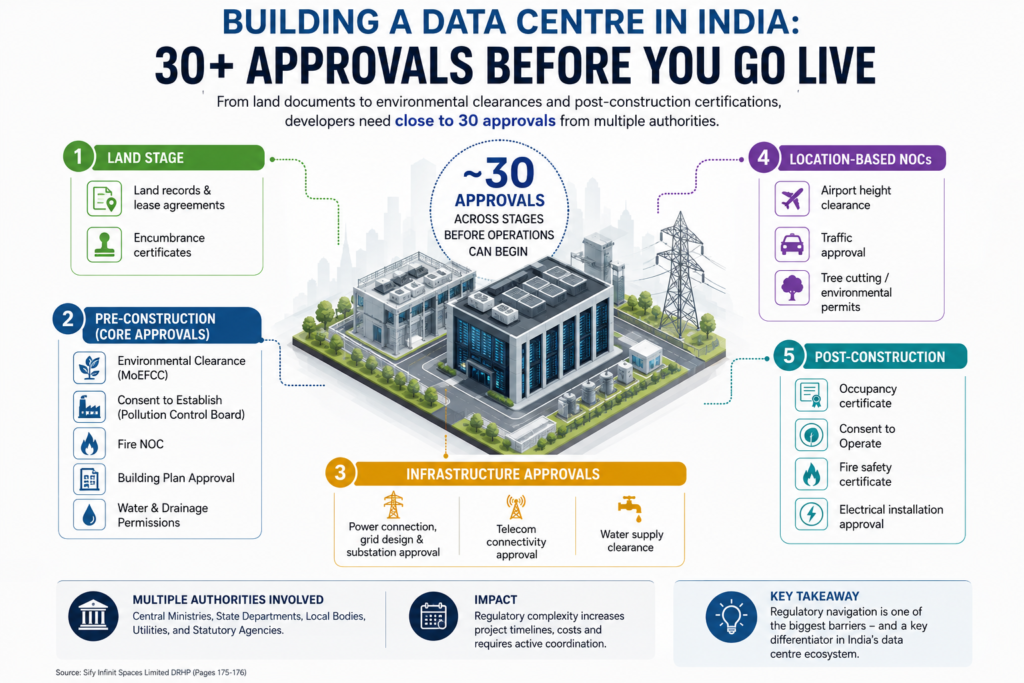
Setting up a data centre in the country looks far more complex than just securing land and power. According to the DRHP filed by Sify Infinit Spaces Limited, once basic land documentation such as land records, lease agreements and encumbrance certificates—is in place, a new data centre require close to 30 separate approvals from central and state authorities before operations can begin.
These approvals span multiple stages—pre-construction, construction and post-construction approvals, making one of the biggest entry barriers in the sector.
At the pre-construction stage, developers must secure foundational clearances. These include environmental clearance from the Ministry of Environment, consent to establish from pollution control authorities and fire safety NOCs. Local planning permissions such as building approvals, drainage permissions and stormwater permits are also mandatory.
Infrastructure-related approvals add another layer. Data centres require high power density, so approvals for power connection feasibility, grid design and substation setup from state electricity boards are critical. Water supply permissions and telecom connectivity approvals are equally essential given the nature of operations.
Location-specific constraints further complicate the process. For instance, height clearance NOCs from the Airports Authority of India are needed for high-rise data centre structures, while traffic and urban planning approvals depend on municipal bodies.
Even after construction, compliance continues. Operators must obtain occupancy certificates, environmental consents to operate, fire safety certifications and electrical installation approvals before going live.
In short, while India offers strong demand and policy support for data centres, the approval ecosystem remains one of the most critical hurdles shaping the industry’s pace of growth.