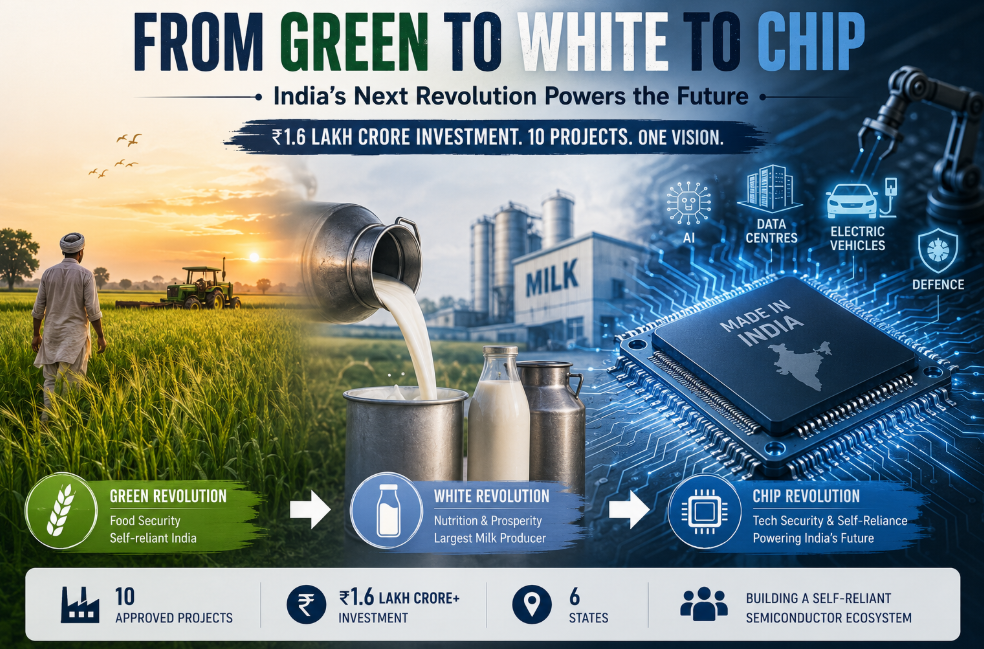
The Green Revolution made India self sufficient in food. The White Revolution transformed the country into the world’s largest milk producer. Today, India is laying the foundation for what could become its next great economic transformation: the Chip Revolution.
In a world increasingly powered by artificial intelligence, electric vehicles, smartphones and data centres, semiconductors have become the backbone of the global economy. Recognising their strategic importance, India has at least approved 10 semiconductor manufacturing projects involving investments of more than Rs 1.6 lakh crore across six states.
At the centre of this push is Tata Electronics’ Rs 91,526 crore semiconductor fabrication plant in Gujarat, being developed in partnership with Taiwan’s PSMC. The facility is expected to produce around 50,000 wafer starts per month. Global memory giant Micron Technology is also investing Rs 22,516 crore in Gujarat to establish an assembly and testing facility with a production capacity of 14 million units per week.
The semiconductor ecosystem is expanding beyond Gujarat. Tata Electronics is setting up a Rs 27,120 crore packaging facility in Assam, while companies such as CG Power, Kaynes Technology, Vama Sundari Investments, SiCSem, 3D Glass Solutions and Advanced System in Package Technologies are building facilities across Uttar Pradesh, Odisha and Andhra Pradesh. Together, these projects span fabrication, packaging, testing, glass substrates and discrete semiconductor manufacturing.
🇮🇳 India’s Semiconductor Revolution
10 Approved Projects | Rs 1.6 Lakh Crore+ Investment | 6 States | One Vision
| # | Company / Entity | State | Investment (₹ Crore) | Project Type | Production Capacity |
|---|---|---|---|---|---|
| 1 | Tata Electronics (TEPL) | Gujarat | 91,526 | Semiconductor Fabrication Facility (with PSMC, Taiwan) | 50,000 wafer starts per month (WSPM) |
| 2 | Tata Electronics (TEPL) | Assam | 27,120 | Semiconductor Packaging Facility | 48 million units per day |
| 3 | Micron Technology Inc. | Gujarat | 22,516 | Assembly & Test Facility for DRAM and NAND Products | 14 million units per week |
| 4 | CG Power and Industrial Solutions Ltd. | Gujarat | 7,584 | Semiconductor Manufacturing Facility (JV with Renesas Electronics & STARS Microelectronics) | Not Disclosed |
| 5 | Vama Sundari Investments (VSIPL) | Uttar Pradesh | 3,706 | Semiconductor Manufacturing Facility | 20,000 wafers/month; 36 million chips/month |
| 6 | Kaynes Technology India Ltd. | Gujarat | 3,307 | Semiconductor Manufacturing Facility | 6.33 million chips/day |
| 7 | SiCSem Private Limited | Odisha | 2,066 | Semiconductor Manufacturing & Packaging Facility | 5,000 wafers/month; 8 million units/month |
| 8 | 3D Glass Solutions Inc. (3DGS) | Odisha | 1,943 | Glass Panel Substrate Production, Assembly & Heterogeneous Integration (3DHI) | 5,800 panels/month; 4.2 million units/month |
| 9 | Advanced System in Package Technologies (ASIP) | Andhra Pradesh | 480 | Semiconductor Packaging Facility | 96 million units per annum |
| 10 | Continental Device India Pvt. Ltd. (CDIL) | Punjab | 117 | High-Power Discrete Semiconductor Device Manufacturing | 158.38 million units per annum |
The ambition is clear: to build a complete semiconductor value chain within India and reduce dependence on imports. Much like the Green Revolution addressed food security and the White Revolution transformed dairy production, the Chip Revolution aims to secure India’s technological future.
The road ahead will require flawless execution, skilled talent and robust supply chains. But if these projects deliver on their promise, India’s next defining revolution may not be in fields or farms, but in clean rooms producing the tiny chips that power the modern world.