The semiconductor industry has become one of the most fiercely contested battlegrounds in the global economy. Governments across the world are deploying billions of dollars in subsidies, tax incentives and infrastructure support to attract chipmakers, strengthen domestic supply chains and secure technological leadership.
According to NITI Aayog’s Future of India’s Semiconductor Industry report, semiconductors are now central to artificial intelligence, telecommunications, defence, electric mobility and digital infrastructure. As a result, countries are no longer leaving semiconductor development solely to market forces.
United States: Betting on Manufacturing Revival
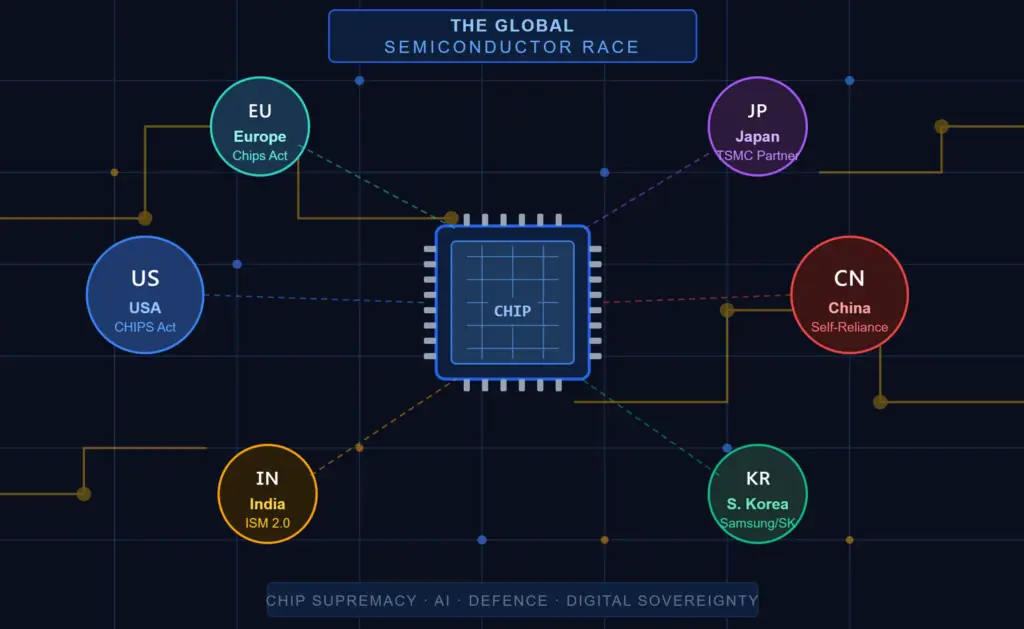
The United States has launched one of the most ambitious semiconductor support programmes through the CHIPS and Science Act. The objective is clear: bring advanced chip manufacturing back to American soil and reduce dependence on overseas suppliers.
The programme combines grants, tax credits and R&D support. It has already attracted major investments from Intel, TSMC, Samsung and Micron, resulting in a wave of new fabrication facilities across the country.
Europe: Building Strategic Autonomy
Europe’s semiconductor strategy is centred on the European Chips Act. The region aims to double its share of global semiconductor production by 2030.
Countries such as Germany, France and Italy are offering direct subsidies, infrastructure support and research funding to attract investments. The focus is not only on manufacturing but also on advanced packaging, automotive chips and semiconductor research.
China: The Biggest Financial Backer
China remains one of the world’s largest investors in semiconductors. Faced with increasing technology restrictions and export controls, Beijing has accelerated efforts to build self-sufficiency across the semiconductor value chain.
The country has provided extensive support to domestic chipmakers through state-backed funds, tax incentives and low-cost financing. The goal is to reduce reliance on foreign technologies and develop indigenous capabilities in design, manufacturing and semiconductor equipment.
Japan and South Korea: Strengthening Existing Leadership
Japan is rebuilding its semiconductor ecosystem through generous subsidies aimed at advanced manufacturing and next-generation technologies. The government has supported projects involving TSMC and domestic semiconductor firms to strengthen its strategic position.
South Korea, home to Samsung Electronics and SK Hynix, continues to provide tax benefits and infrastructure support to maintain its dominance in memory chips and advanced semiconductor manufacturing.
India’s Strategy: Choosing the Right Battleground
India has entered the race through the India Semiconductor Mission and ISM 2.0. Rather than competing directly in every segment, NITI Aayog recommends focusing on areas where India can build sustainable advantages.
The report argues that India should become a global leader in chip design, advanced packaging, compound semiconductors such as Silicon Carbide (SiC) and Gallium Nitride (GaN), and outsourced semiconductor assembly and testing (OSAT). The vision is to build a semiconductor value chain worth $120-150 billion by 2035.
A New Industrial Race
The semiconductor industry has become the defining industrial race of the 21st century. Countries are investing not only for economic gains but also for technological sovereignty and national security. As AI, data centres and advanced computing drive demand for increasingly sophisticated chips, the competition for semiconductor leadership is expected to intensify further over the coming decade.