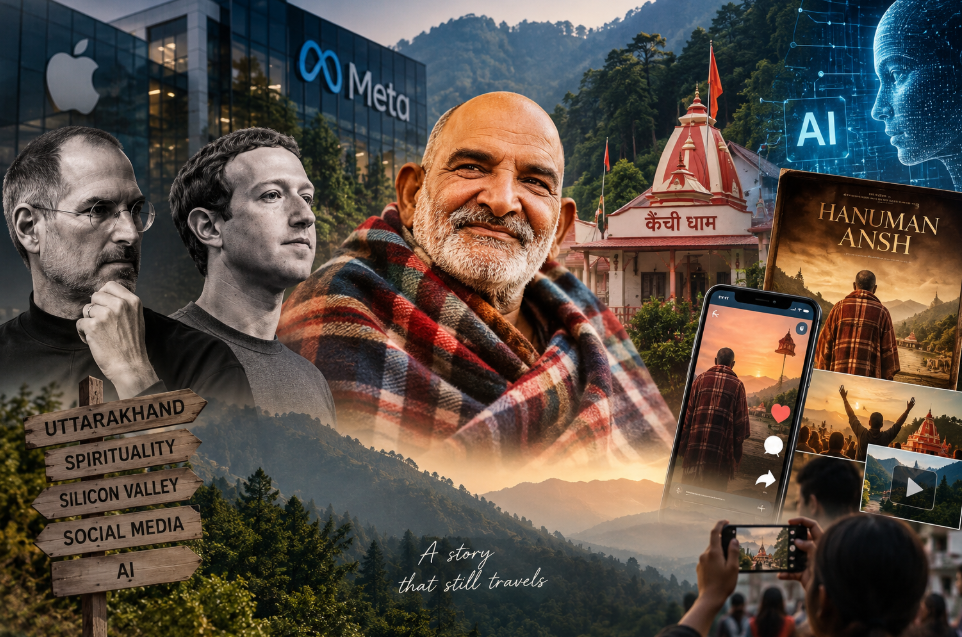
There is a small place in the hills of Uttarakhand that most people would never associate with Silicon Valley. It is quiet, surrounded by mountains and better known for an ashram than for technology. Yet over the years, Kainchi Dham has found an unlikely place in the stories of some of the world’s most influential technology entrepreneurs. At the centre of that story is Neem Karoli Baba, also known as Maharajji.
Among the names connected to Kainchi Dham are Apple co-founder Steve Jobs and Facebook co-founder Mark Zuckerberg. Their journeys to India happened decades apart, but both stories have something in common: a search for clarity at a time when technology and business were not providing all the answers.
That is what makes the Kainchi Dham story so interesting. It is not a story about an Indian guru secretly teaching Silicon Valley how to build technology. There is no evidence to support such a claim. It is a story about something much more human: what happens when people who spend their lives building the future begin looking for answers beyond work.
The story started long before Facebook and Apple
Neem Karoli Baba’s influence in the West grew significantly through Richard Alpert, a Harvard psychologist who travelled to India in 1967. After meeting the guru, Alpert became known as Ram Dass. His 1971 book Be Here Now became an influential work in the Western spiritual movement and introduced a large audience to ideas around Indian spirituality, meditation and yoga. The Love Serve Remember Foundation describes his meeting with Neem Karoli Baba as a turning point in his life.
Kainchi Dham was one of the important places associated with Neem Karoli Baba. The Hanuman temple there was consecrated in 1964, and over the following years the ashram attracted visitors from India and abroad. Among those who would eventually find their way there was a young Steve Jobs.
Steve Jobs arrived too late to meet the guru
Jobs travelled to India in 1974 with his friend Daniel Kottke. He was looking for something, although it is difficult to reduce that search to a single word. Spirituality was part of it. So was a desire to understand himself and the world around him. Jobs wanted to meet Neem Karoli Baba. But by the time he reached Kainchi Dham, the guru had already died. Neem Karoli Baba passed away in September 1973, months before Jobs arrived in India.
Jobs nevertheless spent time travelling around the country and visiting ashrams and religious sites. He eventually returned to America. A few years later, Apple was born.
That sequence of events has helped create one of the most enduring stories around Kainchi Dham: that the ashram somehow shaped Apple. The reality is more complicated. There is no evidence that Neem Karoli Baba directly influenced Apple’s products or business strategy. Jobs never actually met him.
But Jobs did speak about the importance of his India experience and, much later, about intuition, simplicity and connecting experiences that may only make sense in hindsight. In his famous 2005 Stanford commencement speech, Jobs told students to trust their “heart and intuition” and spoke about connecting the dots.
Whether that philosophy came directly from his time in India is impossible to establish. But his India journey clearly remained part of the story of how Jobs understood his own life.
Then Mark Zuckerberg arrived
More than 30 years later, Kainchi Dham appeared again in the story of Silicon Valley. This time, the person involved was Mark Zuckerberg. In 2015, during a conversation with Prime Minister Narendra Modi at Facebook’s headquarters in California, Zuckerberg spoke about a difficult period in the company’s history. Facebook was still growing, but Zuckerberg was questioning its direction. He said there had been discussions around potentially selling the company.
Then he remembered a conversation with Steve Jobs. Jobs had advised him to visit a temple in India that Jobs himself had visited early in his own journey. Zuckerberg followed the advice.
He travelled to India and visited Kainchi Dham. Zuckerberg later said the trip helped him reconnect with the importance of Facebook’s mission and the idea of connecting people. That account is important because it comes from Zuckerberg himself. It also changed the way the outside world looked at a relatively obscure ashram in Uttarakhand. Suddenly, Kainchi Dham was being discussed not just as a spiritual centre, but as a place that had appeared in the journeys of two of Silicon Valley’s biggest names.
Why would technology people go there?
This is perhaps the more interesting question. Silicon Valley is usually associated with engineers, algorithms, venture capital, computers and relentless growth. Kainchi Dham represents almost the opposite. There are no pitch decks. No product launches. No board meetings. No quarterly earnings.
The contrast is striking. Yet Silicon Valley itself has roots in the counterculture movements of the 1960s and 1970s. During that period, many young Americans travelled to India in search of different ways of thinking about consciousness, spirituality and life. Neem Karoli Baba became part of that cultural exchange.
Ram Dass was one of the most prominent Western figures to carry his teachings back to America. Over time, the connection travelled through different generations. The Washington Post reported in 2015 that Kainchi Dham had attracted other people from the technology world, including individuals connected with companies such as Google, Apple and eBay. The result is an unusual cultural bridge between an Indian ashram and America’s technology industry.
Another name in this story
The Kainchi Dham connection does not end with Jobs and Zuckerberg. American physician Larry Brilliant also met Neem Karoli Baba. Brilliant later became involved in the global campaign to eradicate smallpox and went on to lead Google.org. His story adds another dimension to the Kainchi Dham connection.
The people who came into Neem Karoli Baba’s orbit did not all become technology entrepreneurs. They went into medicine, public health, technology and other fields. That makes it difficult to reduce the Baba’s influence to Silicon Valley. For many followers, his teachings were about service, compassion, devotion and simplicity rather than business or technology.
Real connection is not technology
There is a temptation to make the story bigger than it is. Steve Jobs visited India. Mark Zuckerberg visited Kainchi Dham. Larry Brilliant met Neem Karoli Baba. Put those names together and it is easy to construct a story in which an Indian guru somehow became the hidden force behind Silicon Valley. But history rarely works that neatly. The more interesting story is actually much simpler. People who were building some of the world’s most powerful companies also had questions that technology could not answer. How do you know what matters?
What should you build?
Why are you building it? What happens when success does not provide the satisfaction you expected? Those questions are not technological. They are human. And perhaps that is why places such as Kainchi Dham continued to attract people from a world obsessed with innovation.
From Kainchi Dham to the age of AI
There is an almost poetic contrast here. Neem Karoli Baba died in 1973. He never saw the internet. He never used a smartphone. He never witnessed the rise of social media. And he certainly never saw artificial intelligence reshape the technology industry. Yet today, stories about him can travel around the world instantly through the very technologies that Silicon Valley built. A person can watch a video about Kainchi Dham in California, read about Neem Karoli Baba in London or discover his teachings on a smartphone in Bengaluru.
The internet has given the story a new life. And that brings us back to the title of this story. Before AI, before social media and before the smartphone, there was Kainchi Dham. A quiet ashram in the hills became part of the personal journeys of people who would later help reshape the modern technology industry. There is no need to turn that into a miracle story. The facts are interesting enough. Steve Jobs came to India looking for answers and wanted to meet Neem Karoli Baba, but arrived after his death.
Decades later, Mark Zuckerberg came to India after Jobs advised him to visit the temple. Both became hugely successful technology entrepreneurs. And somewhere between those three facts lies a fascinating story about India, Silicon Valley and the human search for meaning. Perhaps that is the real reason Kainchi Dham continues to fascinate the technology world. Not because it taught Silicon Valley how to build the future. But because, for a brief moment, it reminded some of the people building that future to stop and look inward.
Hanuman Ansh: When devotion met AI and social media
There is perhaps no better example of how Neem Karoli Baba’s legacy is travelling into the digital age than the unexpected success of Hanuman Ansh. The film, based on the life of Neem Karoli Baba, opened quietly. Made on a budget of around Rs 2 crore, it collected only about Rs 10 lakh on its opening day and remained below Rs 1.5 crore during its first two weeks. Then something unusual happened. Audiences started talking about it. Videos from theatres began appearing on social media, viewers shared their experiences and word of mouth started doing what a large marketing campaign normally does.
Director Vishal Chaturvedi has himself said the film had very little money for promotion and PR. Instead, audiences effectively became its marketing team, sharing posts and reels and travelling long distances to watch it when the film’s screen count was reduced.
The music gave that momentum another push. The song ‘Parvati’ became a social media phenomenon, crossing 100 million views on YouTube, while users created dance videos, reels and even AI-generated interpretations of the song. In other words, the film was no longer being promoted only by its makers. Its audience was constantly creating new content around it.
The numbers tell the rest of the story. By September 13, Hanuman Ansh had reportedly crossed Rs 236 crore in worldwide gross collections, against a reported production budget of Rs 2 crore. More recent reports put its worldwide collection at around Rs 291 crore by its 40th day.
What makes the story particularly interesting for the technology world is the way the film travelled. A story about a spiritual figure from the 20th century was being consumed through some of the most modern forms of communication: Instagram reels, YouTube videos, creator content and AI-generated visuals.
It is an interesting full circle. Neem Karoli Baba’s teachings travelled from an ashram in the hills to the West through books and personal journeys. Decades later, his story has travelled even further through smartphones, algorithms and generative AI.
The technology did not create the devotion. It simply gave that devotion a much bigger distribution network.