Semiconductors may be invisible to consumers, but they have become one of the most critical building blocks of the modern economy. From smartphones and electric vehicles to defence systems and data centres, chips power almost every technology that drives economic growth. According to NITI Aayog’s latest report, Future of India’s Semiconductor Industry, India’s heavy dependence on imported semiconductors has emerged as a strategic risk that requires urgent attention.
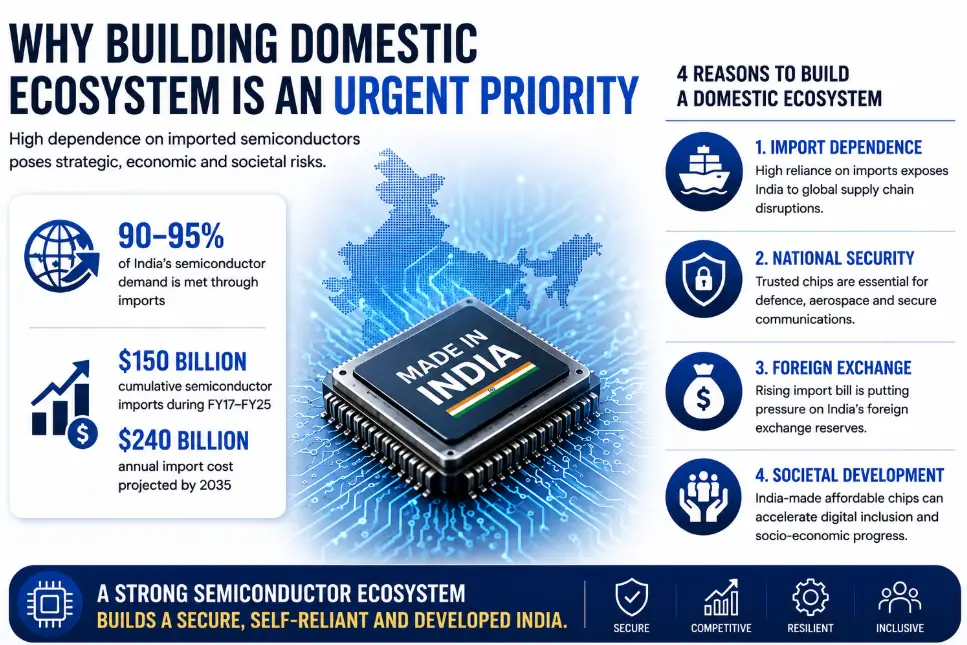
The report identifies four key reasons why India must accelerate the development of a domestic semiconductor ecosystem: import dependence, national security, foreign exchange outflows and societal development.
Currently, nearly 90 to 95 per cent of the country’s semiconductor demand is met through imports. This leaves the country vulnerable to disruptions in global supply chains, as witnessed during the Covid-19 pandemic when chip shortages affected industries ranging from automobiles to consumer electronics. With semiconductors increasingly becoming the backbone of AI, telecommunications, healthcare and industrial automation, such dependence poses a significant economic risk.
The second concern is national security. Modern defence systems, aerospace platforms, drones and secure communication networks rely heavily on advanced semiconductors. Since many of these chips are sourced from overseas suppliers, India’s strategic programmes remain exposed to external risks. NITI Aayog argues that trusted domestic semiconductor capabilities are essential to safeguard the country’s defence autonomy and technological sovereignty.
The economic impact is equally significant. India imported semiconductor products worth nearly $150 billion cumulatively between FY17 and FY25. If current trends continue, annual semiconductor import costs could reach $240 billion by 2035. Such rising dependence places enormous pressure on foreign exchange reserves and highlights the need for local manufacturing capabilities.
The report also highlights the broader social benefits of domestic semiconductor production. Affordable India-made chips can help reduce the cost of 5G and future 6G-enabled devices, accelerating digital inclusion across rural and underserved regions. This could improve access to healthcare, education, precision agriculture and digital public services.
For NITI Aayog, semiconductors are no longer just a technology issue. They are a strategic imperative. Building a strong domestic ecosystem will not only strengthen economic resilience but also support India’s ambition of becoming a developed nation by 2047.