India’s Global Capability Centre (GCC) expansion is emerging as one of the strongest drivers of demand for office space, particularly managed and flexible workspaces. According to management commentary from IndiQube Spaces, GCCs now account for a significant share of demand, with the trend extending well beyond traditional North American technology companies.
The company’s management noted that India’s GCC wave is broadening to include European and East Asian corporations, as well as companies from logistics, healthcare, manufacturing and BFSI sectors. A weaker rupee, now hovering around Rs 96 against the US dollar, has further enhanced India’s attractiveness as a cost efficient destination for global operations.
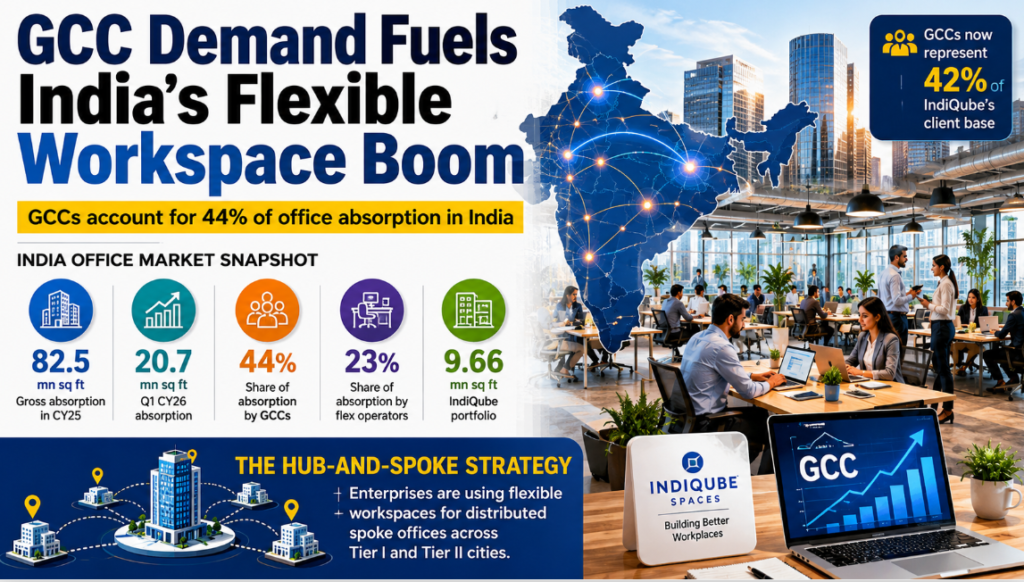
The numbers shows the strength of the trend. The country’s office market recorded gross absorption of 82.5 million sq ft in CY25, while Q1 CY26 absorption reached 20.7 million sq ft, running ahead of the previous year’s pace. Bengaluru continues to dominate with nearly 30% market share. Notably, flex workspace operators and GCCs accounted for 23% and 44% of office absorption, respectively.
GCCs Prefer Hub-and-Spoke Strategy
A major shift is underway in how multinational companies manage office real estate. Instead of relying solely on large headquarters campuses, many GCCs are adopting a hub-and-spoke model. Large firms maintain central hubs while outsourcing smaller satellite offices across Tier I and Tier II cities to managed workspace providers. This has pushed flex workspace penetration in enterprise portfolios from almost negligible levels to 20-25% for several large occupiers.
What is the Hub-and-Spoke Model?
The hub-and-spoke model is a business or operational setup where a company has one central location (hub) supported by multiple smaller satellite locations (spokes).
In the GCC and Office Space Context
IndiQube says this trend is creating a substantial growth opportunity. The company expects to capture 20-25% of a GCC’s overall office portfolio through managed spoke offices, design-and-build contracts and facility management services.
GCCs Form the Core Client Base
The Bengaluru headquartered workspace operator already derives significant business from global corporations. GCCs account for 42% of its client base, while multi-center enterprise clients contributed 44% of revenue in FY26, up from 36% a year ago. The company ended FY26 with 848 active clients.
Its assets under management rose 15% year on year to 9.66 million sq ft spread across 130 centres in 17 cities. Occupancy at mature centres improved to 88%, reflecting sustained demand despite concerns about AI’s impact on future hiring.
Growth Runway Remains Strong
IndiQube believes the demand outlook remains robust as enterprises increasingly seek flexibility and operational efficiency. The company has 3.3 million sq ft of occupancy headroom and an additional 1.82 million sq ft pipeline already backed by signed letters of intent. Management expects to add 1.5-2 million sq ft annually, supporting revenue growth of 25-30% in FY27.
The broader flex office industry is also benefiting. Another workspace operator, Smartworks, noted that GCCs now account for 40-50% of all Grade A office demand in India and expects GCC usage of flexible workspaces to double over the next two years.
Source: Centrum Institutional Research, Nakshatra Investor Conference 2026 Post Conference Note, IndiQube Spaces section.