

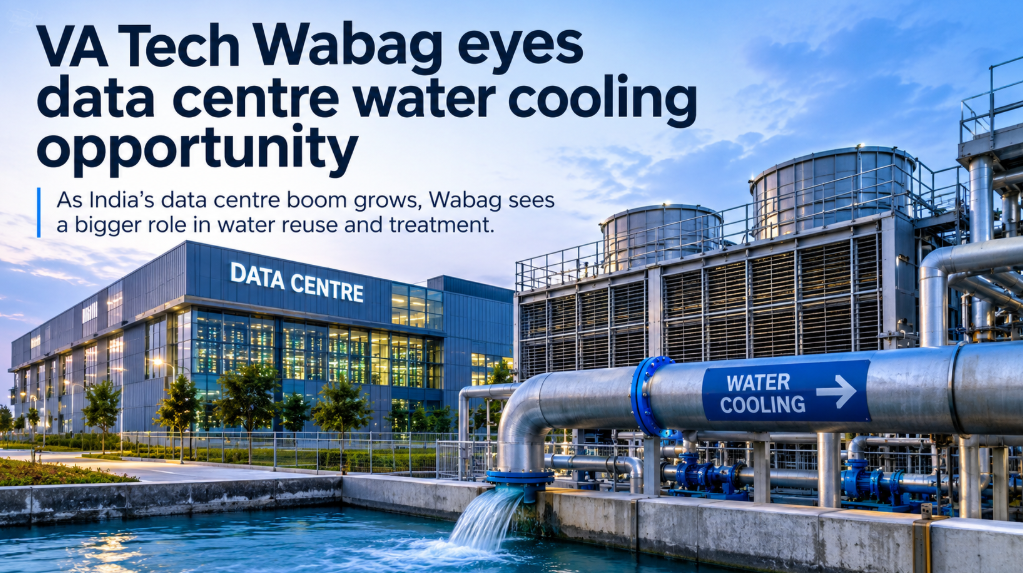
Expanding data centre industry in India could open up a new opportunity for water technology companies, with VA Tech Wabag looking to tap the potential demand for water-cooled systems, recycled water for cooling and ultra-pure water.
The water treatment company believes data centre operators could increasingly consider water-cooled systems as an alternative to air-cooled infrastructure, provided reliable and affordable water supplies are available. The shift could create opportunities for companies offering water reuse and advanced treatment technologies.
Speaking during VA Tech Wabag’s Q2 and H1 FY27 earnings conference call, Rajiv Mittal, Chairman and Managing Director, VA Tech Wabag said the company sees an opportunity to convert data centres that currently use air-cooled air conditioning systems to water-cooled systems.
“There was one trend that they were all going for air-cooled air conditioning system. Now, with our reliability in the technology and the economics of the water, we could convert them into a water-cooled, which from a capital cost point of view and the operating cost point of view, it is definitely much better as long as you have a reliable and affordable water supply,” Mittal said.
Potential clients: Google, Adani, Reliance
The management’s comments point to a potential opportunity beyond the construction of data centre buildings and the installation of computing infrastructure. As operators expand capacity, the availability and management of water could become an important part of the supporting infrastructure.
Bhupesh Chowdary Nagineni, Deputy Managing Director, VA Tech Wabag said the company is identifying the water and utility requirements of high-tech facilities, particularly semiconductor and data centre projects.
“The other part of the question that you asked regarding the high-tech industries or high-tech factories, primarily the semiconductor, data center. So, we are also identifying, which is in terms of the utility of what kind of reuse water that goes for the chilling, or the ultra-pure water,” he said.
The company has already started interacting with potential customers, including Google, Adani and Reliance Industries, to explore opportunities in these segments.
“For that also, we have already started interacting with the potential clients, be it is the Google or Adani or in terms of Reliance. A lot of things are happening in that sector, but actually physically it need to take a shape,” Nagineni said.
He added that Wabag is evaluating the economics of providing an integrated solution to customers.
“So we are also seeing the economics of it so that we give a one-stop solution for them so that they could be able to utilize our technology, which is primarily in the reuse and the ultra-pure water segments, and well placed on that sector also,” he said.
The company’s focus is therefore not limited to supplying water for cooling. Its proposed offering could also include recycled water and ultra-pure water, depending on the requirements of individual facilities.
However, Wabag has not announced any confirmed data centre contracts with the companies mentioned by its management. The interactions are at the potential-client stage, and Nagineni indicated that the opportunities still need to take physical shape.
Scope for repeat business
Mittal said data centres, semiconductor manufacturing, photovoltaic solar and green hydrogen are among the emerging sectors that Wabag is looking to address. However, he cautioned that these opportunities should not be viewed as large-ticket orders comparable with the company’s conventional projects.
“Whatever you are talking about is this new energy, whether it is semiconductor, whether PV solar or data centers, it is of interest,” he said.
“These order sizes are never going to be Rs 5,000 crores or Rs 1,000 crores, a single order. They are going to be much smaller. But the point is, they are modular in nature. Each organization is going to put a number of units as they grow.”
The company sees the possibility of repeat orders as customers add more facilities and expand existing operations.
“So if you got the first one, there is a good chance that the other orders which may come in a year, two or three, you will get the repeat orders,” Mittal said.
He also highlighted Wabag’s technology capabilities, including its portfolio of more than 125 patents and trademarks, as a reason for exploring these high-technology sectors.
“Plus, being a technology Company with more than 125 patents and trademarks, we would like to explore this sector because it demands high tech,” he said.
“As a Company, as your Company, WABAG, is into high tech, we want to play a role in this to give to the clients our best of the technologies for this sector, which is a sunrise sector and it is growing.”
Dedicated team for emerging sectors
Wabag has set up a separate team and vertical to focus on opportunities in these emerging industries. According to Mittal, the decision reflects the relatively smaller order sizes and the need for specialised execution capabilities.
“These are the new sectors which we are focused, and we have a separate team and a vertical which are focusing on it because they are comparatively smaller ticket size orders. So we need to have a specialized team who focuses on it and also executes this order,” he said.
The company expects the gestation period for these orders to be relatively short.
“Because this gestation period of these orders are very small, generally 12-15 months. So we will have to turn around these orders in about 12 months,” Mittal added.
Wabag’s interest in the segment extends beyond data centres. Management also identified semiconductor manufacturing and PV solar as areas where water treatment and reuse solutions could find applications. Green hydrogen is another area the company is tracking, although Mittal indicated that meaningful activity could take a little longer.
“Semiconductor will pick up, and next, maybe in couple of years, hydrogen will pick up when the scale of hydrogen production will go up, the cost will come down,” he said.
Water and data centre infrastructure
The comments underline how water infrastructure is emerging as a potential area of opportunity alongside the power, land and connectivity requirements of data centres. For Wabag, the opportunity lies in bringing its expertise in water reuse and advanced treatment to facilities that may require reliable supplies for cooling and other industrial utilities.
Mittal said he expects India to become a major data centre destination, citing the country’s data centre activity and energy reliability.
“I would say with the kind of data centers and the energy reliability in India, India is going to be a capital for data centers,” he said.
For now, Wabag’s opportunity remains at the engagement and evaluation stage. The company’s ability to convert discussions into orders will depend on project economics, customer requirements and the availability of reliable and affordable water. But its stated strategy indicates that it wants to position itself as a technology partner for the water requirements of India’s expanding high-tech infrastructure.

