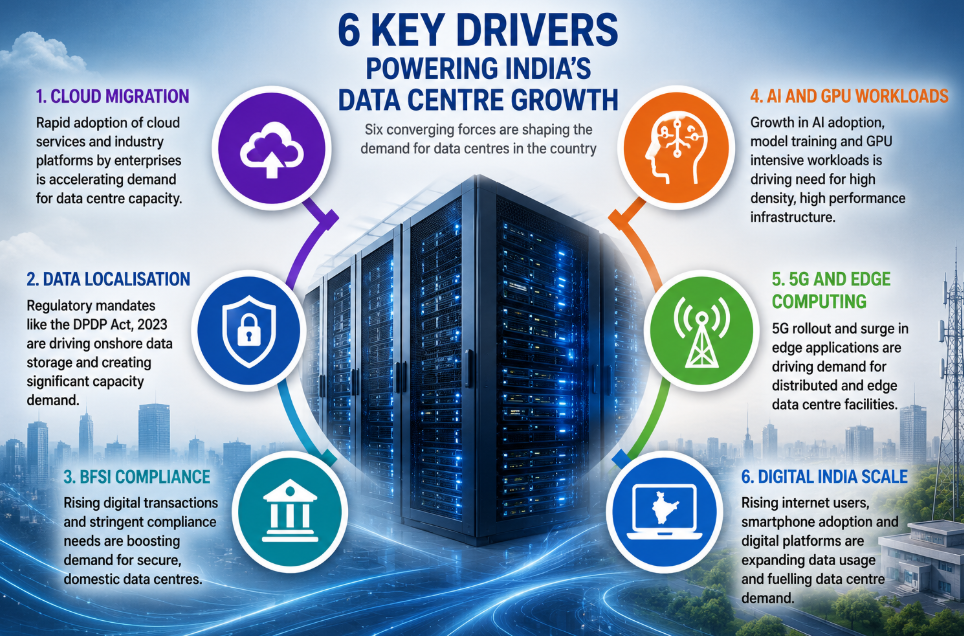
India’s data centre sector is entering a new phase of growth, with six structural trends reshaping demand for digital infrastructure and accelerating investments in high-capacity facilities, according to a report by KPMG.
The report identifies cloud migration, data localisation, BFSI compliance, AI and GPU workloads, 5G and edge computing, and the expanding Digital India ecosystem as the key drivers transforming the country’s data centre landscape.
KPMG said India’s data centre market, once considered underpenetrated, has evolved into a high-growth infrastructure segment, supported by deeper enterprise digitisation, a growing hyperscaler presence and sustained capital inflows. At the same time, the nature of demand is becoming increasingly complex as compute-intensive applications replace traditional enterprise workloads.
The report noted that AI model training, real-time analytics, high-frequency trading, video streaming and large-scale software-as-a-service (SaaS) platforms are pushing operators to build facilities with higher rack densities, stronger power infrastructure and advanced cooling systems. As capacity expands, the market is steadily shifting towards hyperscale deployments capable of supporting AI-driven workloads.
Cloud adoption is expected to remain a major catalyst. India’s cloud market is projected to reach around USD 70 billion by 2032, growing at over 20 per cent CAGR, while more than half of enterprises are expected to adopt industry cloud platforms by 2028.
Data localisation requirements are also expected to boost demand. The report said the Digital Personal Data Protection (DPDP) Act, 2023, which mandates onshore storage of personal data, could generate demand for an additional 1,800-2,000 MW of data centre capacity by 2027.
The BFSI sector remains another key contributor, with over 630 million UPI transactions processed daily requiring domestic hosting and settlement, alongside increasing AI-led applications such as fraud detection, credit scoring and regulatory compliance.
Meanwhile, AI adoption is expected to create significant infrastructure demand. KPMG estimates India’s AI market could reach USD 18-20 billion by 2027, while AI workloads alone may require an additional 400-600 MW of data centre capacity. The report also noted that more than 38,000 GPUs have been onboarded under the IndiaAI Mission.
Growing internet penetration, widespread smartphone usage and the rollout of over 518,000 5G towers are further accelerating demand for edge computing and data centres. According to KPMG, the market is increasingly converging around facilities capable of delivering higher power density, stronger interconnectivity and more rigorous compliance standards, reflecting the strategic importance of next-generation digital workloads.