

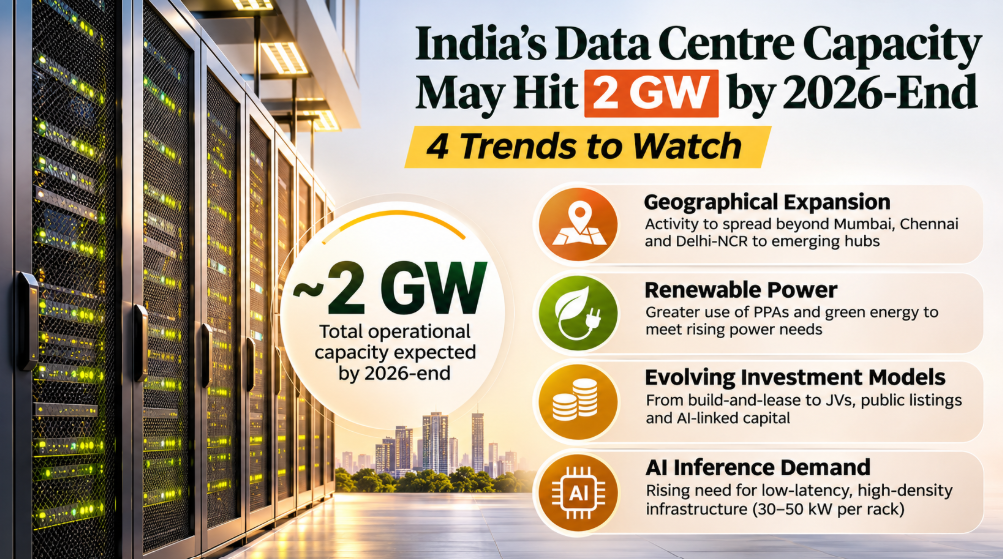
India’s data centre industry is entering a new phase of expansion, with operational capacity expected to approach 2 gigawatts (GW) by the end of 2026 as demand from artificial intelligence (AI), cloud computing and digital services accelerates. The next phase of growth is likely to be shaped by geographical diversification, greater reliance on renewable energy, evolving investment models and the growing importance of AI inference workloads, according to a report by CBRE.
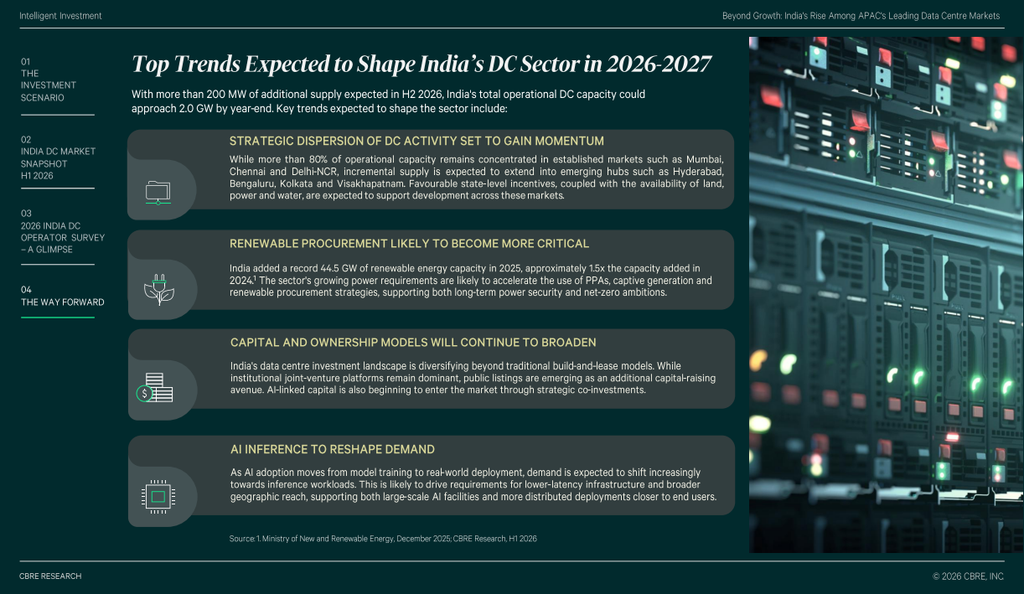
The report, Beyond Growth: India’s Rise Among APAC’s Leading Data Centre Markets, estimates that more than 200 megawatts (MW) of additional data centre capacity could come online in the second half of 2026. This would add to the country’s operational capacity of nearly 1,750 MW at the end of June 2026, following supply additions of around 130 MW during the first half of the year.
CBRE said India’s data centre market has transitioned from the ‘High Growth Market’ category to APAC’s ‘Leading Markets’ category in 2026, joining Japan, Australia and Mainland China. The transition reflects the increasing scale, maturity and strategic importance of India’s digital infrastructure ecosystem.
Emerging cities to gain traction
One of the key trends expected to shape the sector is the geographical diversification of data centre activity. More than 80% of India’s operational capacity remains concentrated in established markets such as Mumbai, Chennai and Delhi-NCR. However, incremental supply is expected to expand into emerging hubs, including Hyderabad, Bengaluru, Kolkata and Visakhapatnam.
Availability of land, power and water, along with favourable state-level incentives, is expected to support development in these markets.
The investment landscape is already showing signs of geographical diversification. According to CBRE, Tier-II cities accounted for 16% of investment commitments in 2024, rising to 27% in 2025. Hyderabad also attracted 23% of commitments in 2024 and 15% in 2025.
Renewable energy to become increasingly important
The growing electricity requirements of data centres are expected to make renewable energy procurement a strategic priority for operators.
India added a record 44.5 GW of renewable energy capacity in 2025, approximately 1.5 times the capacity added in 2024. CBRE expects data centre operators to increasingly rely on power purchase agreements (PPAs), captive generation and other renewable procurement arrangements to secure long-term power supplies and meet net-zero commitments.
The report’s operator survey also highlights the growing importance of renewable energy. Renewables currently meet 30-40% of operational energy requirements for most surveyed operators.
Investment and ownership models evolve
India’s data centre investment landscape is also moving beyond traditional build-and-lease models. Institutional joint-venture platforms continue to dominate, but public listings are emerging as another avenue for raising capital.
AI-linked investments are also beginning to enter the sector through strategic co-investments, reflecting the growing interest in infrastructure supporting AI computing.
AI inference to drive the next phase of demand
The growing adoption of AI is expected to change the nature of data centre demand. As AI applications move from model training to real-world deployment, demand is likely to shift increasingly towards inference workloads.
This transition could increase the need for low-latency infrastructure and geographically distributed facilities located closer to end users.
The shift is also expected to influence data centre design. CBRE’s operator survey indicates that AI-focused hyperscale and neo-cloud occupiers could require IT loads of around 30-50 kilowatts (kW) per rack, compared with approximately 8-10 kW per rack in traditional facilities.
Together, these developments point towards a data centre market that will increasingly compete on power availability, connectivity, location and the ability to support high-density computing infrastructure.

