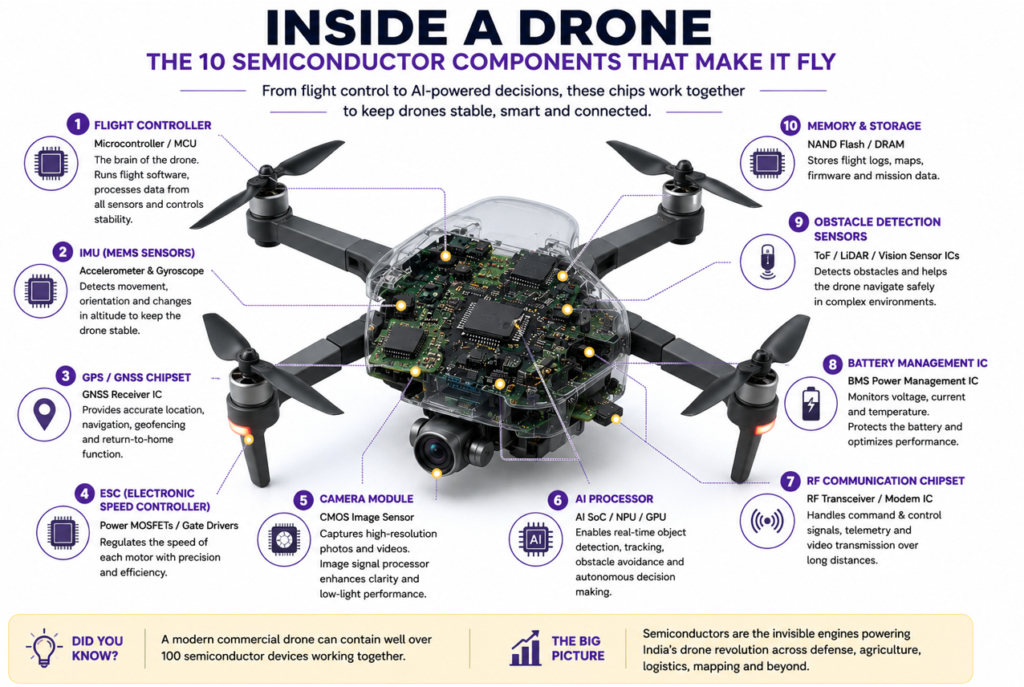
Look at a drone from the outside and it seems almost too simple. Four propellers, a body, maybe a camera bolted underneath. Crack it open though and there’s basically a tiny city of chips in there, all talking to each other, all trying to keep the thing from falling out of the sky. Doesn’t matter if it’s spraying pesticide over a field, checking a transmission line, dropping off a package, or flying over a flood zone for rescue teams. The stuff that actually makes it “smart” is buried in the electronics, not the frame.
Take the flight controller first. Everyone calls it the brain, and honestly that’s about right. It’s a microcontroller reading sensor data nonstop and telling each motor exactly what to do so the drone doesn’t wobble or tip. Sitting right beside it is the IMU, the Inertial Measurement Unit, packed with tiny MEMS accelerometers and gyroscopes that figure out which way the drone is tilting, how fast it’s moving, all that.
Navigation is its own piece of the puzzle. A GNSS or GPS chip tells the drone where it is on the map, keeps it on whatever route it’s been given, and gets it home again if the signal drops or something goes sideways. Then you’ve got the Electronic Speed Controllers, basically small boards built around MOSFETs, that adjust each motor’s speed hundreds of times a second. That’s what gives a drone that smooth, controlled feel instead of jerky movements.
Cameras are where a lot of people’s attention goes, understandably. CMOS image sensors handle the actual photo and video capture. But it’s the AI processors, the Neural Processing Units, doing the heavier lifting now, spotting objects, tracking a moving target, steering around a tree branch, all without pinging a server somewhere. And none of that data goes anywhere without RF communication chips keeping the link alive between the drone and whoever’s flying it, commands going out, video and telemetry coming back.
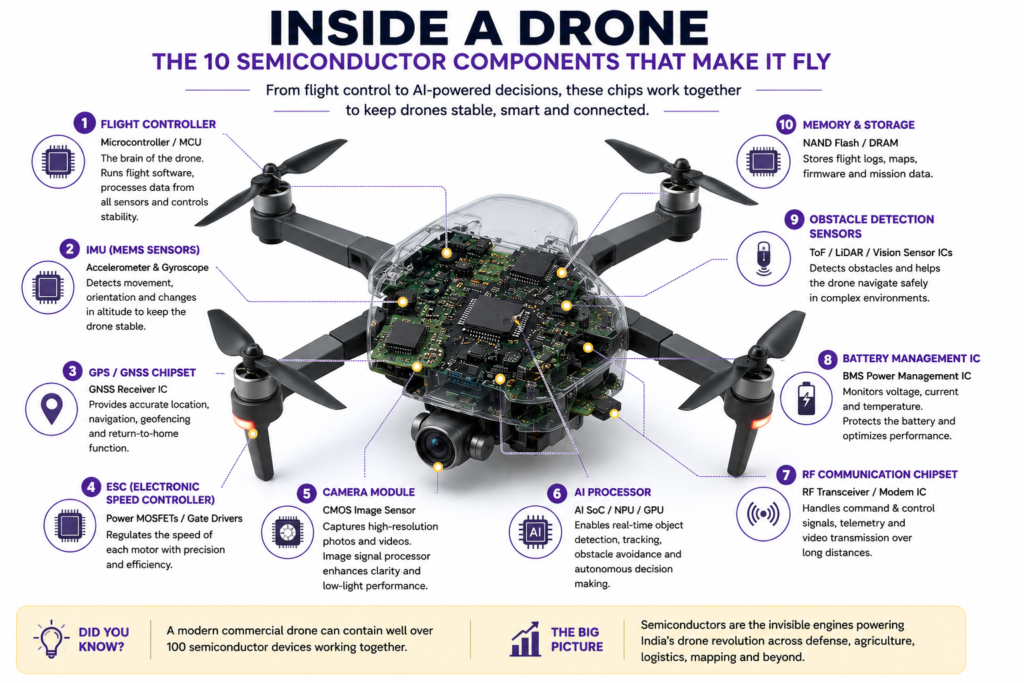
Power is the boring part nobody thinks about until the battery dies mid flight. A Battery Management System watches voltage, current, temperature, the works, trying to squeeze out max flight time without cooking the cells. Drones built for fully autonomous work usually throw in LiDAR or Time of Flight sensors too, so they can “see” obstacles in places where GPS alone won’t cut it. And somewhere in all this, NAND flash and DRAM chips are quietly storing the flight software, saved maps, photos, whatever data the mission generates.
There’s a report out from the Export Import Bank of India called Making India a Global Drone Hub, and it makes a pretty blunt point: India’s still buying most of its drone electronics and semiconductor components from outside the country. The report basically says if India wants a drone industry that can compete on the world stage, it needs to start building this stuff domestically instead of importing it.
So as India pushes to become a big name in drone manufacturing, it’s worth remembering none of it happens without the chips. Every takeoff, every flight path, every safe landing, semiconductors are the part nobody sees. Getting the supply chain for that right is going to matter just as much as designing better drones.