Water is rapidly emerging as one of the most critical — yet least visible — constraints on the expansion of artificial intelligence, according to the World Economic Forum’s report Building Resilient and Scalable AI Value Chains: A Nexus Strategy. While electricity consumption dominates most discussions around AI infrastructure, water plays an equally important role across the value chain, from cooling data centres to power generation and semiconductor manufacturing.
Because many AI facilities rely on freshwater or potable quality water, their expansion is increasingly creating trade offs with households, agriculture and ecosystems. Even relatively small facilities can place significant pressure on local water systems. A one megawatt data centre can consume up to 25.5 million litres of water annually for cooling alone.
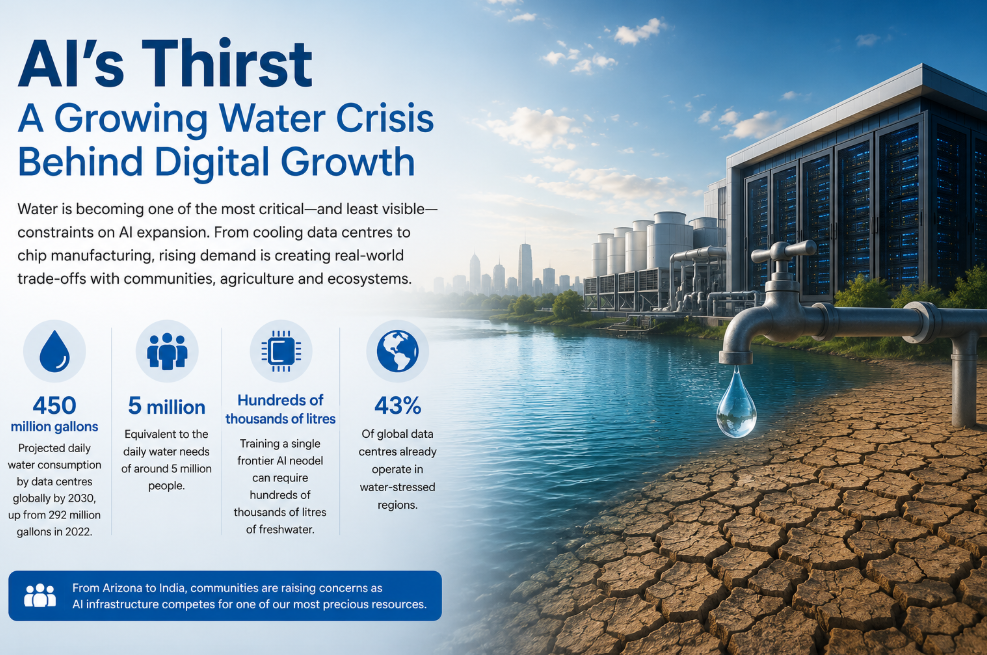
At a global level, the scale is becoming substantial. Data centre water consumption is projected to rise from 292 million gallons per day in 2022 to nearly 450 million gallons per day by 2030 — equivalent to the daily water needs of around five million people.
The primary driver of this demand is thermal management. Training and operating large AI models generate enormous heat, prompting hyperscale facilities to rely heavily on evaporative cooling systems that consume freshwater rather than simply recycling it. Some studies suggest training a single frontier AI model may require hundreds of thousands of litres of freshwater, depending on factors such as geography, cooling systems and electricity sources.
Even AI usage at the consumer level carries a water footprint. Estimates suggest generating 10 to 50 responses from models such as GPT 3 can consume nearly 500 ml of water. While the impact of an individual interaction appears small, billions of daily AI queries can collectively translate into significant resource consumption.
The pressure is also unevenly distributed. Nearly two thirds of data centres in the United States are located in regions already facing high water stress, while 43% of global facilities operate in water scarce areas. Ironically, many of the world’s fastest growing AI infrastructure hubs are emerging in regions where water availability is already under strain.
In the US, Arizona’s Phoenix and Maricopa County have become major data centre hubs despite long standing groundwater depletion concerns and restrictions on new housing due to water shortages. Northern Virginia, home to the world’s largest concentration of data centres, is facing rising concerns over the cumulative impact of hyperscale facilities on regional water and power systems.
In Dalles, Oregon, debates have intensified over large scale water withdrawals from the Columbia river basin for cooling data centre campuses. Similar tensions are emerging globally. In Europe, data centre expansion in Spain’s Aragón and Catalonia regions is accelerating despite recurring drought conditions.
Countries such as Chile and India are also witnessing growing friction between industrial demand and water scarcity, increasing pressure on governments to balance economic growth with resource sustainability.
Large data centres can withdraw millions of gallons of water every day, directly competing with agriculture, households and ecosystems. Excessive extraction risks damaging rivers and aquifers, reducing streamflow and threatening biodiversity. Climate change is worsening the challenge by increasing heatwaves, which further raise cooling requirements while making water supplies more unpredictable.
Public resistance is also growing. In parts of Arizona, municipalities have restricted or banned the use of potable water for data centre cooling after community backlash. Similar policy debates are unfolding in Spain, Chile and India, where governments are beginning to scrutinize water allocation for digital infrastructure more closely.
What was once considered a secondary issue in digital infrastructure planning is now becoming a central operational and social challenge for AI expansion. Without reliable access to water — or widespread adoption of low water and water free cooling technologies — the AI industry could face rising operational risks and increasing opposition from communities worldwide.