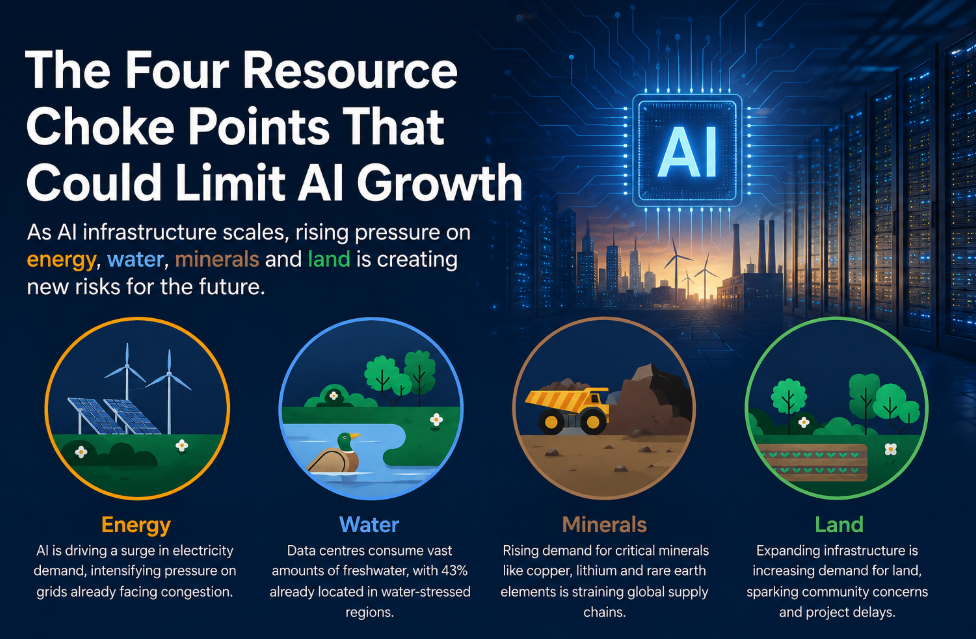
As artificial intelligence scales globally, the infrastructure supporting it is creating mounting pressure on energy, water, minerals and land. According to the World Economic Forum’s report Building Resilient and Scalable AI Value Chains: A Nexus Strategy, the below stresses could emerge as strategic choke points for AI growth if left unmanaged, intensifying trade offs with communities, ecosystems and other industries.
Energy: The most visible bottleneck
AI is driving a sharp rise in electricity demand. The International Energy Agency estimates global data centre power consumption could approach 1,000 TWh by 2030. In the United States, data centres are expected to contribute 40-50% of incremental electricity demand growth this decade.
The rise of AI clusters, which require uninterrupted and high reliability power, is increasing pressure on electricity grids that are already facing congestion. The challenge now is not just generating more power, but ensuring stable and sustainable supply.
Water: Cooling AI comes at a cost
High performance computing infrastructure requires vast quantities of freshwater for cooling. Global data centre water consumption is projected to reach 450 million gallons per day by 2030, equivalent to the daily water needs of nearly five million people.
More critically, 43% of global data centres are already located in water stressed regions, raising concerns over competition for scarce water resources between technology infrastructure and local communities.
Minerals: Supply chains under strain
AI hardware depends heavily on critical minerals used in semiconductors, electrical systems and energy infrastructure. Demand for copper, lithium and rare earth elements is surging alongside AI expansion.
Copper demand alone could rise 30-40% by 2035, while lithium demand may increase five to seven times by 2030. With mining projects often taking more than a decade to become operational and supply chains concentrated in a few regions, the risk of supply bottlenecks is growing.
Land: The next battleground
The rapid expansion of hyperscale data centres and supporting energy infrastructure is intensifying demand for land with access to power, water and network connectivity.
At the same time, local opposition is increasing. Communities are raising concerns over pressure on civic infrastructure, diversion of resources, limited local economic benefits, and pollution and noise from diesel generators. In several regions, such concerns have already delayed or stalled projects.
Together, these pressures underline a critical reality: the material foundations of AI — energy, water, minerals and land — are becoming strategic constraints on the future growth, profitability and sustainability of the AI economy.