The artificial intelligence boom is often described through chips, models and computing power. But behind every AI workload sits a more basic requirement: electricity.
The country’s rapidly expanding data-centre industry is emerging as one of the newest and most important drivers of power demand. The Ashika Institutional Equity Research report describes the data-centre boom as a “newer and less appreciated” driver of India’s power sector, alongside industrialisation and electrification.
The numbers underline the scale of the shift. According to the report, India’s data-centre capacity is expected to rise nearly six-fold, from 1,800 MW in FY2026 to 10.5 GW by FY31. That represents an estimated $80 billion infrastructure opportunity, with around $25 billion of near-term capital expenditure.
And the electricity requirement is only part of the story.
Data centres need power that is not merely available, but reliable. AI workloads operate continuously, making interruptions costly. The report notes that power systems account for about 33% of average data-centre capital expenditure, more than passive IT infrastructure, while backup generation and other energy infrastructure become increasingly important.
This is creating what the report calls a “$3tn AI infra buildout” and a power-equipment supercycle. Globally, data-centre capacity is expected to nearly double to around 200 GW by 2030 from about 100 GW today. In India, the report expects data-centre capacity to reach 4,700 MW by FY30, growing at a 27.4% CAGR.
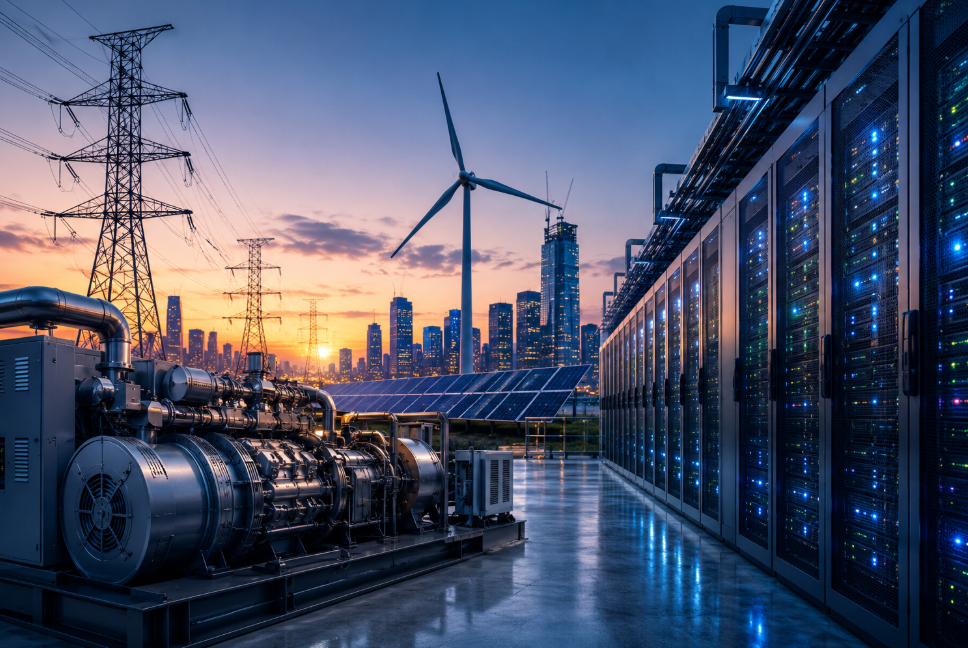
The implication extends far beyond data-centre operators. The AI boom is creating demand for the industrial machinery required to generate and stabilise electricity. The report points to growing demand for backup generation, captive power, gas engines and turbines, generators and electrical infrastructure.
That is where companies such as TD Power Systems (TDPS) and Triveni Turbine enter the story. TDPS supplies generators and rotating electrical equipment, while Triveni manufactures steam turbines used in distributed generation, waste-heat recovery and industrial applications.
India’s AI story, therefore, is also becoming a story about who builds the power behind the servers. As the report puts it, “electricity” is emerging as a major industrial commodity—and the infrastructure required to produce, stabilise and deliver it could become one of the biggest beneficiaries of the AI era.