As anticipation builds around one of Indian cinema’s most ambitious cinematic projects, director Nitesh Tiwari has addressed the swirling speculation regarding the use of Artificial Intelligence in his upcoming magnum opus, Ramayana.
In an era where the film industry is debating the ethics and creative impact of AI, Tiwari clarified the exact parameters under which the technology is being leveraged. Contrary to rumours suggesting generative character modeling or synthesized voice replication, the filmmaker emphasized that AI has been applied with surgical precision for one primary purpose: multilingual lip-synchronisation.
Seamless Multilingual Immersion
Ramayana is designed as a global cinematic spectacle intended to reach audiences worldwide in their native languages. While multilingual releases typically involve dubbing over the original footage—often resulting in a noticeable mismatch between spoken dialogue and actors’ mouth movements—the production team turned to advanced AI algorithms to bridge that gap.
According to Tiwari, the technology is strictly utilised to re-align facial and lip movements so that the film visually appears as if it was originally performed in every target language, making the viewing experience seamless and engaging. The article is generated from the 56 seconds video available on the YouTube channel of AP Entertainment and Associated Press.
The Human Element Remains Untouched
Crucially, the director dispelled notions that AI was replacing human talent in the sound department. All character voices and dubbed audio are performed by professional voice artists and actors.
Tiwari noted that the voice tracks remain entirely human-driven; AI does not generate or synthesise dialogue. Its role begins only after the human performance is recorded, serving purely as a visual calibration tool to match lip movement to speech.
Grounded in Global VFX Craftsmanship
Beyond the lip-sync technology, the visual scale of the epic relies on traditional high-end visual effects pipeline craft. The film’s VFX is spearheaded by eight-time Academy Award-winning creative studio DNEG, featuring contributions from hundreds of digital artists worldwide who are building the world envisioned by the filmmakers from the ground up.
By setting clear boundaries around its AI deployment, the makers of Ramayana appear to be demonstrating a balanced approach—using AI as an assistive post-production tool to elevate audience accessibility, while preserving core creative performances for human artists.
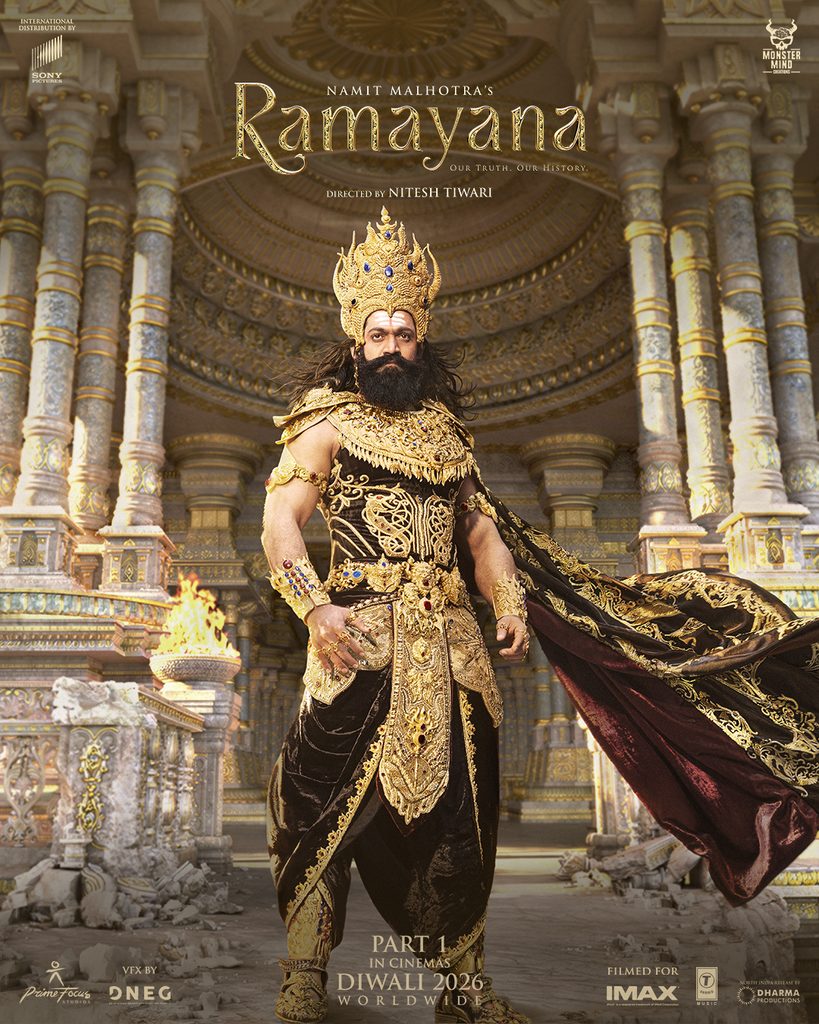
Tiwari’s Ramayana: Part 1 is scheduled to release worldwide in theaters on November 5, 2026. Have look at the poster of the movie.