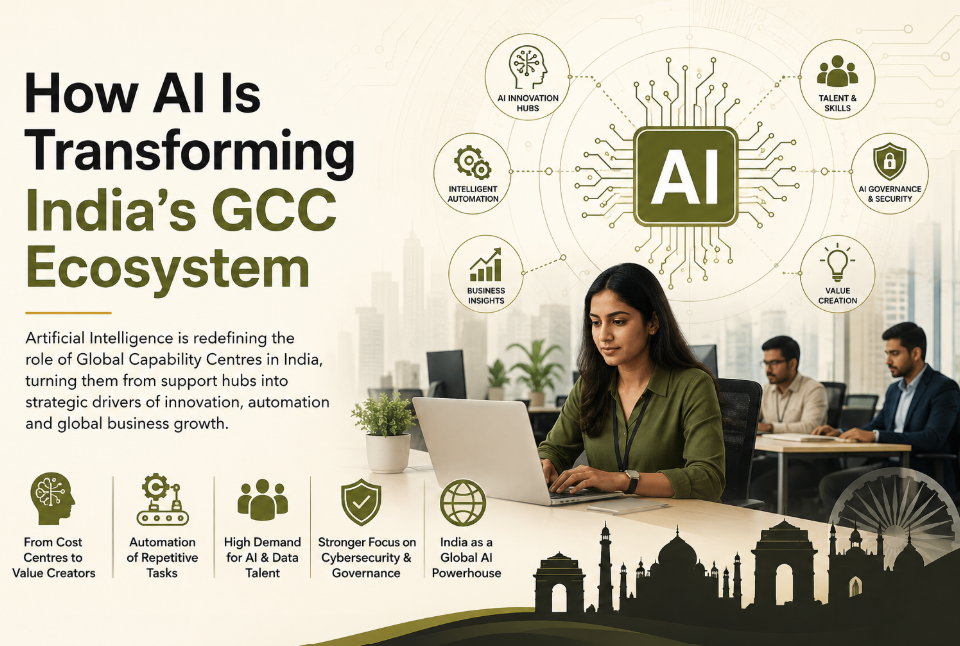
India’s Global Capability Centre (GCC) ecosystem is witnessing a major transformation as Artificial Intelligence (AI) becomes central to global business operations. Once viewed primarily as low cost back office support centres, GCCs are now evolving into strategic hubs for innovation, digital engineering and enterprise decision making.
India currently hosts more than 2,100 GCCs across sectors such as banking, retail, healthcare, manufacturing and technology. These centres employ over 2.3 million professionals and contribute significantly to the country’s technology and services economy. The rise of Generative AI is now accelerating the evolution of GCCs at an unprecedented pace.
From support functions to innovation centres
Traditionally, GCCs handled functions like IT support, finance operations, payroll processing and customer service. However, multinational corporations are increasingly shifting high value work to their India centres.
Today, GCCs are building AI models, developing automation tools, managing cybersecurity systems and driving digital transformation projects for global operations. Many companies are also using India centres for research and development, product engineering and data analytics.
Large corporations including Microsoft, JPMorgan Chase and Walmart Global Tech have significantly expanded AI related work within their India GCCs.
Industry experts believe AI is helping GCCs move from “cost centres” to “value creators.” Instead of focusing only on operational efficiency, GCCs are now expected to contribute directly to business growth and innovation.
AI changing the nature of work
AI powered technologies are automating several repetitive and process driven activities traditionally handled by GCCs. Tasks such as invoice processing, report generation, customer query handling and software testing are increasingly being managed through automation tools.
At the same time, AI is creating demand for new skill sets and specialised roles. Companies are aggressively hiring professionals in areas such as:
- Artificial Intelligence
- Machine Learning
- Data Science
- Cloud Engineering
- AI Governance
- Cybersecurity
Roles like AI engineers, prompt engineers and machine learning architects are becoming critical for GCC expansion strategies.
Experts say this shift is not necessarily reducing employment opportunities but changing the nature of jobs available within the ecosystem. Routine operational roles may decline over time, while demand for advanced technology and analytical talent is expected to rise sharply.
Talent advantage driving growth
One of India’s biggest strengths in the AI driven GCC wave is its large technology talent pool. The country produces a significant number of engineers and digital professionals every year, making it an attractive destination for multinational corporations looking to scale AI capabilities.
Compared to Western markets, India also offers relatively lower operating costs, enabling companies to build large AI and digital engineering teams more efficiently.
This advantage is encouraging global firms to expand their GCC presence across cities such as Bengaluru, Hyderabad, Pune, Chennai and Gurugram. Tier 2 cities are also beginning to attract attention for specialised technology and AI operations.
The road ahead
Industry reports suggest AI could become the biggest driver of GCC growth over the next decade. The focus is expected to shift further toward Generative AI, intelligent automation, cybersecurity and enterprise AI governance.
As global companies accelerate digital transformation, India’s GCC ecosystem is likely to play a larger role in shaping business innovation worldwide.
The next phase of India’s GCC story may no longer be defined by outsourcing alone, but by its ability to power the global AI economy.