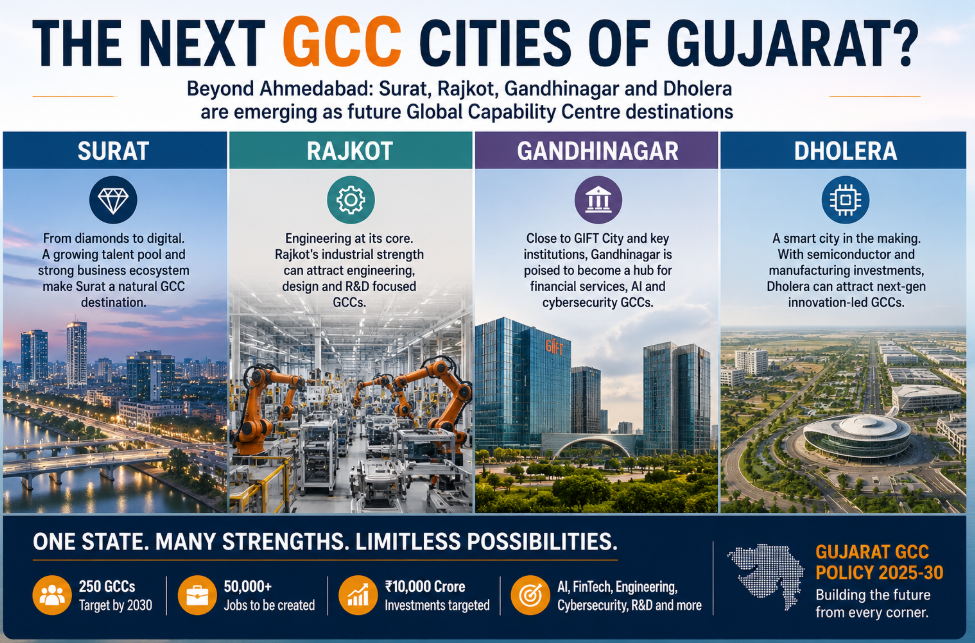
When discussions turn to India’s Global Capability Centre (GCC) industry, cities such as Bengaluru, Hyderabad, Pune and Chennai dominate the conversation. Even within Gujarat, Ahmedabad and Vadodara account for most of the state’s GCC presence. The Gujarat Global Capability Center (GCC) Policy 2025-30 acknowledges this reality, noting that Ahmedabad and Vadodara currently lead the state’s footprint in the sector.
But the bigger question is whether the next phase of Gujarat’s GCC growth could emerge elsewhere.
The policy’s ambition is significant: attract 250 new GCCs, create more than 50,000 jobs and mobilise Rs 10,000 crore in investments by 2030. To achieve those targets, Gujarat may need more than two cities carrying the burden.
Surat’s emerging advantage
Surat has traditionally been known for textiles and diamonds. Yet the city has quietly developed a strong base of entrepreneurs, educational institutions and digital infrastructure.
As India’s GCC industry increasingly looks at Tier II cities to address rising costs in established hubs, Surat could emerge as a compelling destination for technology, fintech and business process operations. Its improving connectivity and growing talent pool make it a natural candidate for expansion.
Rajkot’s engineering strength
Rajkot may be better known as a manufacturing city, but that could become an advantage in the GCC era.
The Gujarat policy highlights Rajkot’s importance as a centre for automotive components and precision engineering. As multinational manufacturers establish engineering and research centres closer to their production ecosystems, Rajkot could attract specialised engineering GCCs focused on product design, industrial automation and advanced manufacturing technologies.
Gandhinagar’s knowledge economy potential
If Ahmedabad becomes the commercial face of Gujarat’s GCC ambitions, Gandhinagar could become its knowledge hub.
The city already benefits from proximity to GIFT City, government institutions and leading educational establishments. As financial services GCCs, cybersecurity firms and AI-driven enterprises expand, Gandhinagar could emerge as a preferred location for high-value knowledge work.
The policy itself identifies financial services, artificial intelligence, cybersecurity and digital transformation as priority sectors for future growth.
Dholera: The wild card
Perhaps the most intriguing possibility is Dholera. The greenfield smart city is being developed as one of India’s most ambitious industrial and technology zones. While much of the attention has focused on semiconductors and advanced manufacturing, global experience suggests that research, design and engineering centres often follow major industrial investments. As semiconductor, electronics and advanced manufacturing projects take shape in Dholera, they could create demand for engineering, R&D and technology-focused GCCs serving global markets.
The next phase of Gujarat’s GCC story
The Gujarat GCC Policy is not merely an investment promotion document. It is a blueprint for economic diversification. While Ahmedabad and Vadodara will remain important anchors, the state’s long-term success may depend on its ability to create a network of specialised GCC destinations. Surat could become a business services hub, Rajkot an engineering centre, Gandhinagar a financial and technology node and Dholera an innovation-led manufacturing ecosystem.
If that vision materialises, Gujarat’s GCC story may eventually be defined not by one city, but by an entire network of emerging technology destinations.