Artificial Intelligence (AI) is rapidly becoming a cornerstone of digital transformation across industries. Once limited to experimental use cases, AI is now deeply embedded in core business operations, helping organisations improve efficiency, automate decision-making, enhance customer experiences and drive growth. From banking and retail to healthcare and manufacturing, AI adoption is accelerating at scale.
BFSI: Strengthening risk management and fraud detection
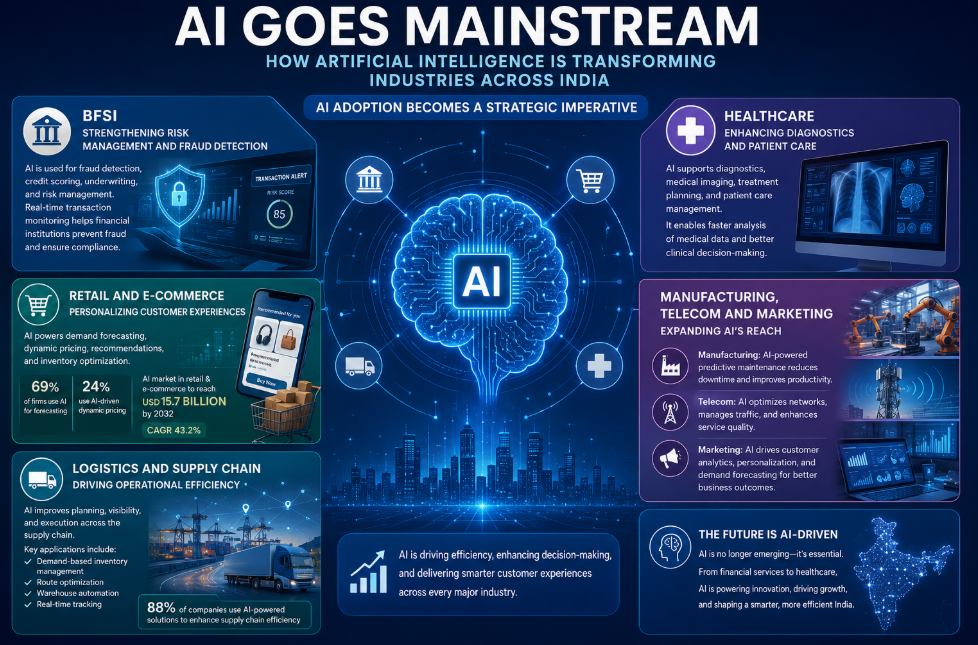
The Banking, Financial Services and Insurance (BFSI) sector is among the most advanced adopters of AI. Financial institutions are deploying AI for fraud detection, credit scoring, underwriting and risk management. Real-time transaction monitoring systems continuously analyse vast amounts of data to identify suspicious activities and prevent fraud.
The sector’s growing data volumes and stringent regulatory requirements are also driving frequent retraining of AI models, increasing demand for both AI training and inference workloads. As a result, AI has become a critical enabler of operational efficiency and regulatory compliance across financial services.
Retail and E-commerce: Personalising customer experiences
Retailers and e-commerce companies are increasingly leveraging AI to improve demand forecasting, optimise pricing strategies and deliver personalised shopping experiences. Around 69% of firms use AI for forecasting, while nearly 24% deploy AI-driven dynamic pricing solutions.
Recommendation engines, customer analytics platforms, and inventory optimisation tools have become key applications of AI in the sector. The growing adoption is reflected in market growth, with the AI market in retail and e-commerce expanding from USD 0.33 billion in 2019 to USD 0.86 billion in 2024. The market is projected to reach USD 15.7 billion by 2032, growing at a CAGR of 43.2%.
Logistics and Supply Chain: Driving operational efficiency
AI is playing a pivotal role in transforming logistics and supply chain operations. According to a NASSCOM survey, the transport and logistics sector leads in transformation-driven AI adoption, with organisations leveraging AI to improve planning, visibility, and execution.
AI applications include demand-based inventory management, route optimisation, warehouse automation, and real-time tracking of fleets and shipments. Nearly 88% of companies in the sector use AI-powered solutions to enhance supply chain efficiency and respond more effectively to changing market conditions.
Healthcare: Enhancing diagnostics and patient care
Industry experts said that the healthcare sector is witnessing rapid AI adoption as providers seek to improve clinical outcomes and operational efficiency. AI is being used to support diagnostics, medical imaging, treatment planning, and patient care management.
By enabling faster analysis of medical data and assisting healthcare professionals in decision-making, AI is helping improve the accuracy and speed of diagnoses. As healthcare systems continue to digitise, AI is expected to play an increasingly important role in delivering quality care at scale.
Manufacturing, Telecom and Marketing: Expanding AI’s reach
Beyond early-adopter sectors, AI is gaining traction across manufacturing, telecommunications, and marketing. In manufacturing, AI-powered predictive maintenance helps companies anticipate equipment failures and reduce downtime. Telecom operators are deploying AI for network optimization, traffic management, and service quality improvements. Meanwhile, marketing teams are leveraging AI-driven customer analytics, campaign personalisation and demand forecasting to improve customer engagement and business outcomes.