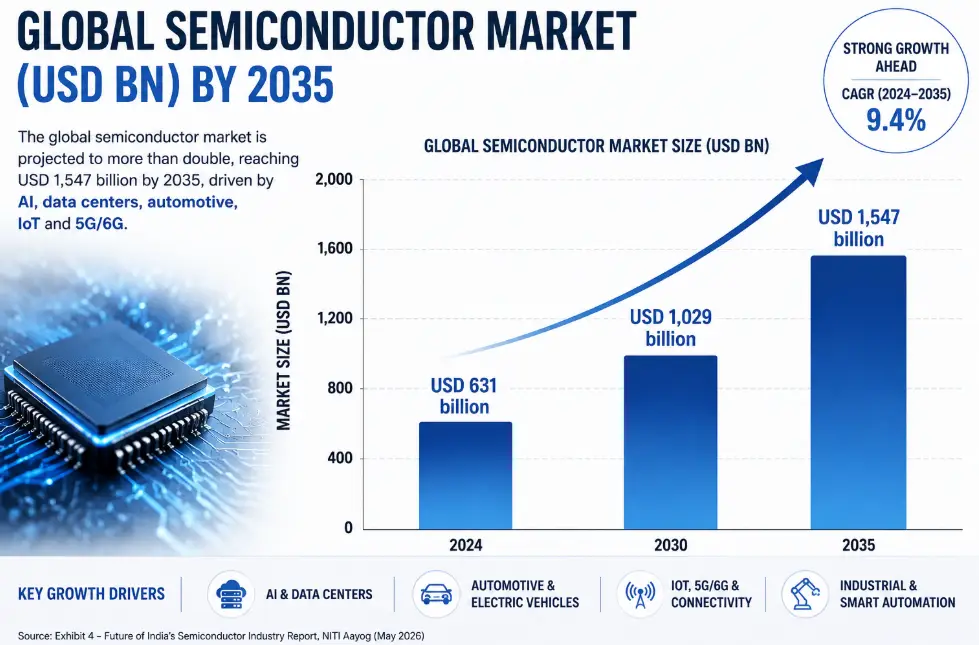
India is aiming for far more than a place in the global semiconductor supply chain. By 2035, the country wants to become an indispensable player in an industry expected to exceed $1.5 trillion globally, according to NITI Aayog’s report Future of India’s Semiconductor Industry.
The report argues that semiconductors have become the foundation of modern economic power, underpinning everything from artificial intelligence and data centres to electric vehicles, telecommunications, defence systems and healthcare. As global technology competition intensifies and supply chains become increasingly fragmented, India’s dependence on imported chips is emerging as a strategic vulnerability. Currently, nearly 90 to 95 per cent of the country’s semiconductor demand is met through imports.
Against this backdrop, the report lays out an ambitious vision for 2035. Rather than attempting to replicate the manufacturing dominance of established semiconductor giants, India should focus on areas where it can create strategic advantages. “India should shift gears and target becoming the ecosystem player that the global semiconductor industry cannot run without,” the report states.
Semiconductors Across Key End Use Sectors
How chips are powering the future economy
🚗 Automotive
📱 Consumer Electronics
📡 Telecom (5G/6G)
🖥️ Computing & Data Centres
🏭 Industrial Manufacturing
⚡ Power & Energy
🛡️ Defence & Aerospace
🏥 Healthcare
The roadmap proposes building a semiconductor value chain worth $120 billion to $150 billion by 2035. It identifies three key pillars of leadership: becoming a top three global destination for outsourced semiconductor assembly and test (OSAT) and advanced packaging, developing world-class expertise in chip design and system architecture, and establishing dominance in mature-node and compound semiconductors such as Silicon Carbide (SiC) and Gallium Nitride (GaN).
Artificial intelligence is expected to be one of the biggest demand drivers. The report notes that AI accelerators, chiplets, high-bandwidth memory and specialised processors will increasingly define future computing systems and data centres. Meanwhile, sectors such as electric mobility, renewable energy, defence, industrial automation and 5G/6G communications will require a new generation of advanced chips.
India’s ambitions are supported by a strong talent base. The country already accounts for roughly 20 per cent of the global semiconductor design workforce and hosts design centres for many of the world’s leading chip companies.
By 2035, NITI Aayog sees India achieving chip self-sufficiency of 35 to 50 per cent of domestic demand while retaining 55 to 70 per cent of the value generated in the semiconductor supply chain. The larger goal is not merely economic. As the report notes, semiconductors are now a matter of technological sovereignty, national security and long-term strategic resilience. For India, the next decade could determine whether it remains a consumer of technology or emerges as one of its architects.