The world’s biggest fortunes are no longer being created in oil, ports or telecom. They are being minted in artificial intelligence. In the recent past, India’s wealth story was defined by two men: Mukesh Ambani and Gautam Adani.
One built a sprawling empire spanning oil, telecom, retail and digital services. The other assembled one of the world’s largest infrastructure groups, with interests ranging from ports and airports to energy and logistics. Both continue to grow richer. Both continue to build businesses that are reshaping India’s economy. Yet, on the global rich list, a different story is unfolding.
While Ambani and Adani are adding billions to their fortunes, a handful of technology founders riding the artificial intelligence boom are adding wealth at a pace that traditional industries simply cannot match. The result is a widening gap between the world’s AI billionaires and even the most successful industrial tycoons.
The AI wealth explosion
The launch of ChatGPT in late 2022 marked more than a technological breakthrough. It triggered one of the largest wealth creation events in modern history. Investors quickly realised that AI could transform everything from software development and healthcare to banking, manufacturing and defence. Trillions of dollars flowed into companies building AI models, AI chips, cloud infrastructure and data centres. The biggest beneficiaries were the founders and early shareholders of those companies.
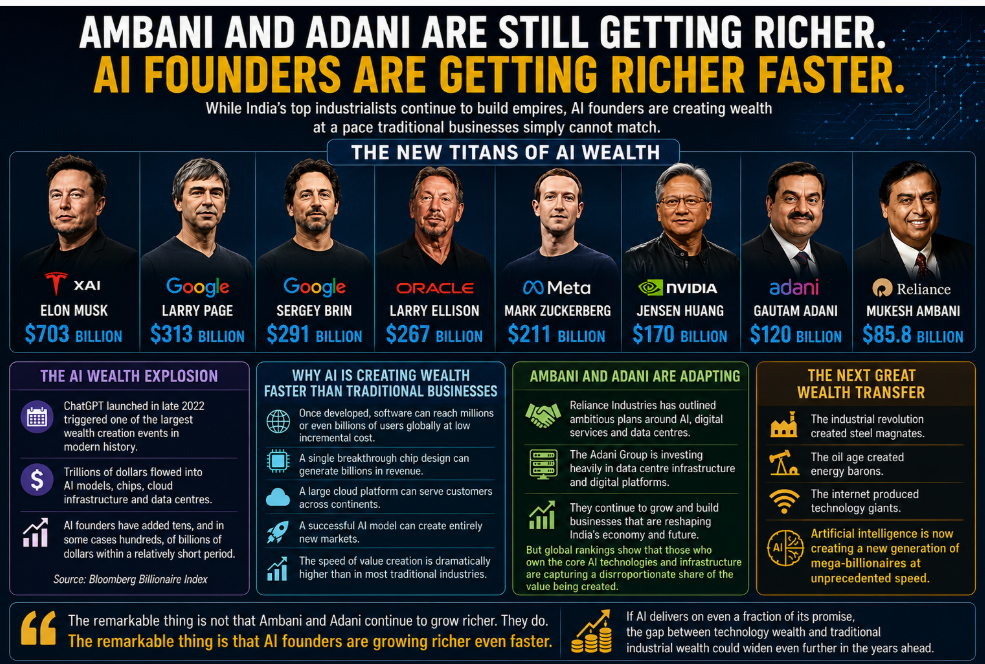
Consider the numbers. While Ambani’s fortune has steadily climbed over the years and Adani has staged a remarkable recovery after the turbulence of 2023, several AI-linked entrepreneurs have added tens, and in some cases hundreds, of billions of dollars within a relatively short period. With a networth of $120 billion, Gautam Adani is the 17th richest individual in the world, whereas Mukesh Ambani ($85.8 billion) is the 23rd richest across the globe, according to Bloomberg Billionaire Index.
The new titans of wealth
At the centre of this transformation is Jensen Huang (Net worth: $170 billion). For decades, Nvidia was known primarily among gamers and technology enthusiasts. Today, its chips are the engines powering the AI revolution. Every major AI model, from ChatGPT and Gemini to Grok and Claude, relies on massive computing power, much of it supplied by Nvidia. As demand for AI computing exploded, Nvidia’s value soared and Huang’s fortune followed.
Then there is Larry Ellison, founder, Oracle ($267 billion). Once associated with enterprise software, Ellison has become one of the biggest winners of the AI infrastructure race as companies rush to secure cloud capacity and data centre resources. Meta’s Mark Zuckerberg ($211 billion) has seen investors reward Meta’s aggressive AI push. Meanwhile, Google co-founders Larry Page ($313 billion) and Sergey Brin ($291 billion) continue to benefit from the company’s deep investments in artificial intelligence. And, of course, there is world’s richest Elon Musk ($703 billion), whose AI ambitions through xAI have added another powerful growth engine to an already vast business empire.
Why AI is creating wealth faster than traditional businesses
The answer lies in scale. Building a refinery takes years. Constructing a port requires enormous capital and regulatory approvals. Expanding an airport network is a long-term project. AI businesses operate under different rules.
Once developed, software can reach millions or even billions of users globally with relatively limited incremental cost. Investors are therefore willing to place extraordinary valuations on companies they believe will dominate the future. The infrastructure supporting AI also enjoys powerful economics. A single breakthrough chip design can generate billions in revenue. A large cloud platform can serve customers across continents. A successful AI model can create entirely new markets. The speed of value creation is dramatically higher than in most traditional industries.
Ambani and Adani are adapting
Importantly, this is not a story about Ambani and Adani falling behind. Both business groups are investing aggressively in the technologies shaping the future. Reliance Industries has outlined ambitious plans around artificial intelligence, digital services and data centres. The Adani Group is investing heavily in data centre infrastructure and digital platforms. They understand where the world is heading. But the global wealth rankings reveal an important reality: those who own the core AI technologies and infrastructure are currently capturing a disproportionate share of the value being created.
The next great wealth transfer
Every era creates its own billionaires. The industrial revolution created steel magnates. The oil age created energy barons. The internet produced technology giants. Artificial intelligence is now creating a new generation of mega-billionaires at unprecedented speed. The remarkable thing is not that Ambani and Adani continue to grow richer. They do.
The remarkable thing is that AI founders are growing richer even faster. And if AI delivers on even a fraction of its promise, the gap between technology wealth and traditional industrial wealth could widen even further in the years ahead.
The AI Billionaires Pulling Ahead
The founders and executives capturing the biggest gains from the artificial intelligence boom.
Elon Musk
xAI
AI infrastructure, robotics and large language models
Jensen Huang
Nvidia
AI chips powering the global generative AI ecosystem
Larry Ellison
Oracle
AI cloud services and hyperscale data centres
Mark Zuckerberg
Meta
Meta AI, Llama models and AI powered platforms
Larry Page & Sergey Brin
Gemini, DeepMind and the broader Google AI ecosystem
Jeff Bezos
Amazon
AI demand accelerating growth in AWS cloud infrastructure