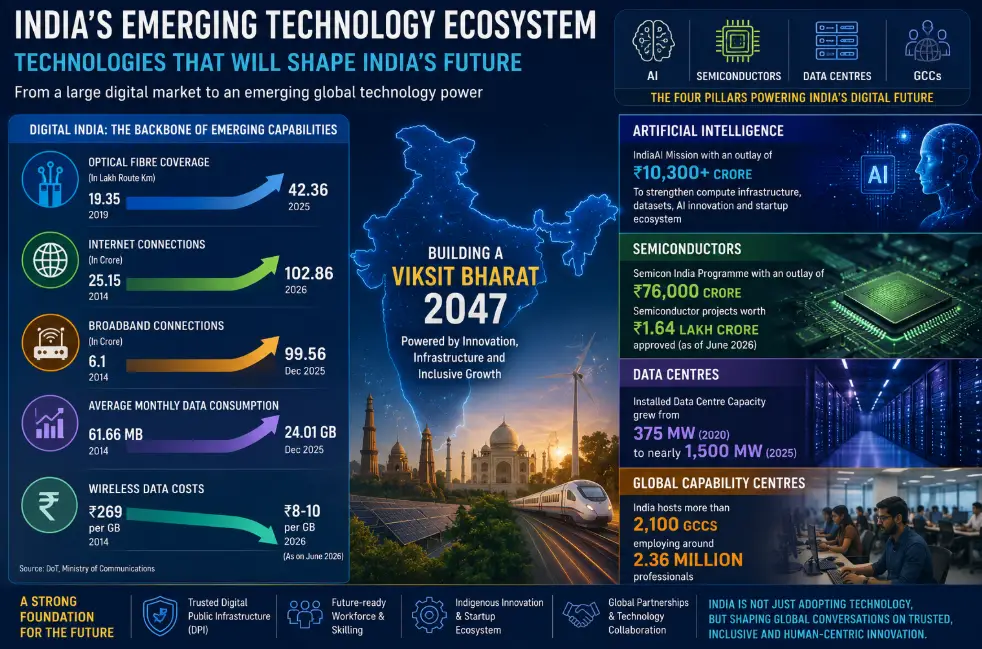
The country’s rise as a global economic power will increasingly be defined by its technological capabilities. Over the next two decades, technologies such as artificial intelligence (AI), semiconductors, data centres and Global Capability Centres (GCCs) are expected to become the pillars of economic growth, industrial competitiveness and digital sovereignty.
What makes this transformation unique is that India is no longer just a consumer of technology. The country is steadily emerging as a creator of digital infrastructure, a hub for innovation and a preferred destination for global technology investments.
AI moves from experiment to economic engine
Artificial intelligence has rapidly moved from research laboratories into boardrooms, factories and government offices. From automating customer service and improving healthcare diagnostics to enabling predictive maintenance in manufacturing, AI is reshaping the way businesses operate.
India is betting heavily on this opportunity. The government’s IndiaAI Mission aims to create a robust ecosystem by expanding access to computing infrastructure, datasets and advanced AI tools. According to the latest PIB report on India’s emerging technology ecosystem, India has built one of the world’s fastest growing AI ecosystems, supported by a large digital talent pool and strong digital infrastructure.
The next phase of AI growth will likely be driven by enterprise adoption, sovereign AI models and sector specific applications across healthcare, agriculture, education and financial services.
Why semiconductors matter more than ever
Every modern technology depends on semiconductors. Smartphones, electric vehicles, defence systems, telecom equipment and AI servers all run on chips. The global chip shortage during the pandemic highlighted the strategic importance of semiconductor manufacturing. In response, the country launched the Semicon India Programme to develop domestic chip fabrication, packaging and design capabilities.
The country’s ambitions go beyond manufacturing. India is positioning itself as a complete semiconductor ecosystem that includes research, design, testing and advanced packaging. Large investments announced under the India Semiconductor Mission are expected to create a domestic supply chain while reducing reliance on imports.
As AI adoption accelerates, demand for advanced chips will increase exponentially, making semiconductors one of the most critical technologies for India’s future.
Data Centres: The digital backbone
If semiconductors are the brains of the digital economy, data centres are its nervous system. Every digital activity, whether streaming a video, processing an online payment or training an AI model, depends on data centre infrastructure. As businesses generate massive volumes of data, demand for storage and computing power is rising sharply.
India’s data centre industry has witnessed remarkable growth over the past few years. A PIB report notes that installed capacity expanded from around 375 MW in 2020 to nearly 1,500 MW by 2025. New facilities are being developed across Mumbai, Hyderabad, Bengaluru, Noida and emerging locations such as Jamnagar.
The rise of generative AI is expected to further accelerate investments in hyperscale and AI-focused data centres, making digital infrastructure one of India’s most attractive investment themes.
GCCs evolve into global innovation hubs
Perhaps one of India’s most significant technology success stories is the evolution of Global Capability Centres.
What started as back office operations for multinational companies has transformed into a sophisticated ecosystem driving innovation, engineering, cybersecurity, AI and product development.
India now hosts more than 2,100 GCCs employing over 2.3 million professionals. Increasingly, global companies are using their India centres not only for operational support but also for developing next generation products and technologies.
Many of the new GCCs established in recent years have been built around AI, cloud computing, analytics and digital transformation. This reflects growing confidence in India’s talent base and innovation capabilities.
The Power of Convergence
The real story is not about any one technology. It is about the convergence of AI, semiconductors, data centres and GCCs.
AI requires massive computing power. Computing power depends on advanced chips. Chips and applications generate enormous volumes of data that require data centres. GCCs provide the engineering talent and innovation capabilities needed to build and scale these technologies.
Together, they form a self-reinforcing ecosystem capable of driving investment, creating high value jobs and accelerating economic growth.
Building the Foundation for Viksit Bharat
India’s technology ambitions extend beyond economic growth. They are closely linked to the vision of Viksit Bharat 2047. Government initiatives, rising private sector investments and a thriving startup ecosystem are helping create a future-ready technology infrastructure. As global companies diversify supply chains and seek new innovation hubs, India is increasingly emerging as a trusted technology partner.
The technologies that will define the next decade are already taking shape. Artificial intelligence, semiconductors, data centres and GCCs are no longer emerging themes. They are becoming the foundation upon which India’s future digital economy will be built.