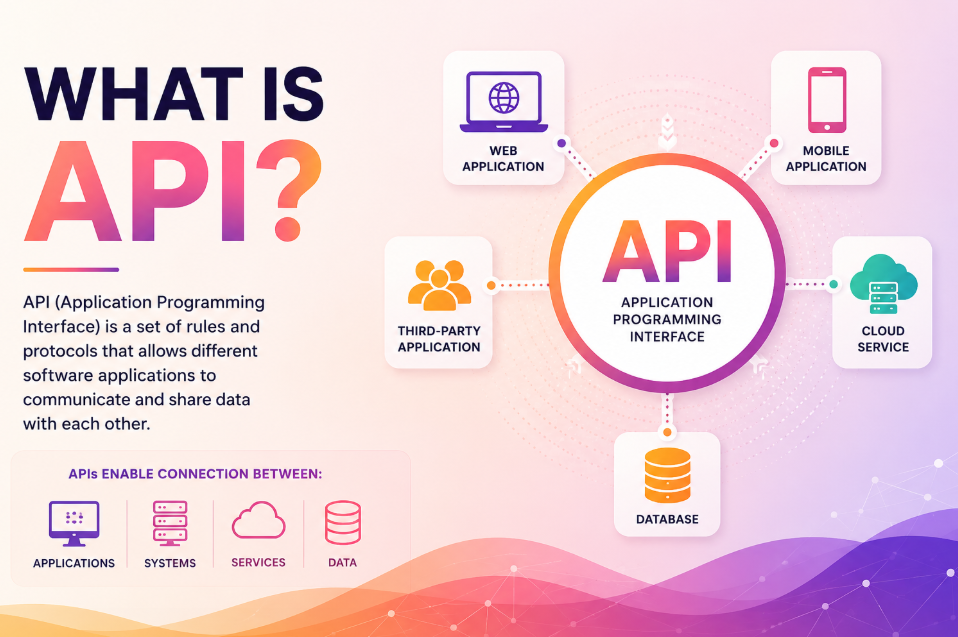
An API, or Application Programming Interface, is a set of rules and protocols that allows different software applications to communicate with each other. APIs act as intermediaries that enable systems, applications, and services to exchange data and functionality efficiently.
For example, when a mobile app displays weather information from another service, it uses an API to fetch the data. Similarly, payment gateways, maps, login systems, and social media integrations all rely heavily on APIs.
APIs are extremely important in modern software development because they help developers build applications faster without creating everything from scratch. Companies expose APIs so that third party developers can connect with their platforms and services.
There are several types of APIs, including REST APIs, SOAP APIs, GraphQL APIs, and Web APIs. REST APIs are currently the most widely used because they are lightweight, scalable, and easy to integrate.
In AI systems, APIs are used to connect applications with AI models and cloud services. For example, developers can integrate AI features like text generation, image analysis, speech recognition, and translation using AI APIs from providers such as OpenAI, Google, or Microsoft.
In cybersecurity, APIs must be properly secured because weak APIs can become entry points for hackers. API security involves authentication, encryption, access control, and monitoring.
Data centres and cloud computing environments also depend heavily on APIs for infrastructure automation, monitoring, orchestration, and workload management.
APIs are central to digital transformation because they enable seamless integration between enterprise systems, cloud platforms, applications, and devices. Businesses increasingly adopt API first strategies to improve scalability and interoperability.
As companies continue adopting cloud services, AI tools, and digital platforms, APIs have become the backbone of the connected digital ecosystem.