For the past three years, NVIDIA has been synonymous with the artificial intelligence boom. Its graphics processors have become the backbone of AI infrastructure, powering data centres operated by technology giants, cloud providers and startups worldwide.
Now, the company is setting its sights on a new frontier: personal computers.
The launch of RTX Spark is not merely a product announcement. It represents a strategic move by NVIDIA to extend its dominance beyond data centres and establish itself as a major player in the rapidly emerging AI PC market.
Historically, NVIDIA’s success has been driven by graphics processors used in gaming, professional visualisation and, more recently, artificial intelligence training and inference. Demand for its AI chips has surged as companies race to build generative AI capabilities, making NVIDIA one of the world’s most valuable technology companies.
However, AI workloads are gradually shifting from cloud environments to local devices. Consumers increasingly want AI features that are faster, more private and available without constant internet connectivity. This trend is creating a significant opportunity for AI capable laptops and desktops.
RTX Spark is NVIDIA’s answer.
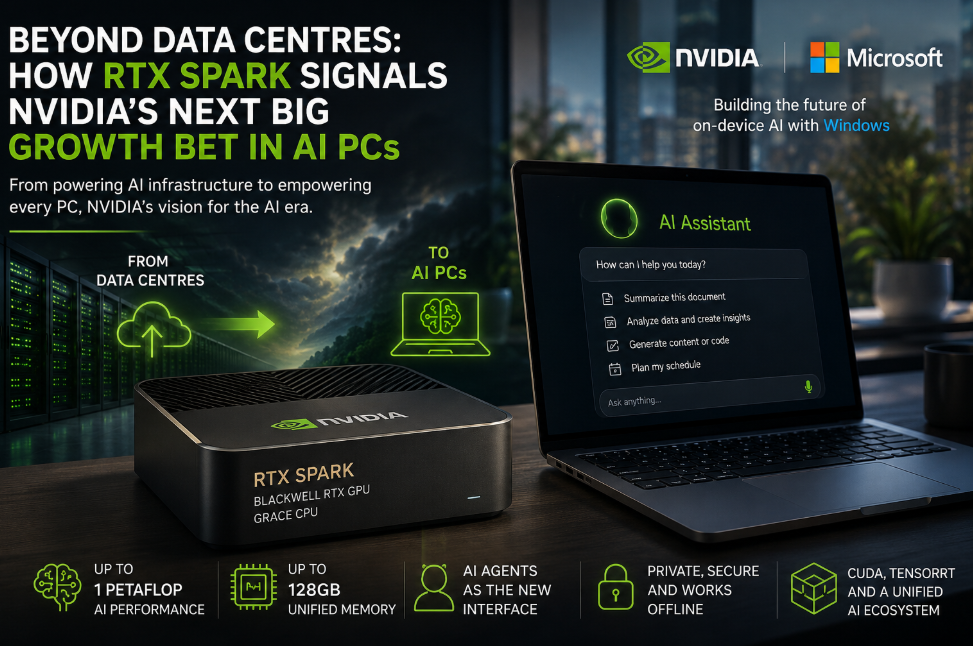
The platform combines a Blackwell RTX GPU with a Grace CPU, delivering up to one petaflop of AI computing performance and support for up to 128GB of unified memory. More importantly, it is designed to run sophisticated AI models and agents directly on personal computers.
This strategy places NVIDIA in direct competition with established PC processor makers such as Intel, AMD, Qualcomm and even Apple, which has positioned its own silicon as a foundation for AI powered computing.
Unlike traditional PCs, NVIDIA believes AI agents becoming the primary interface between users and computers. Instead of navigating multiple applications, users could simply ask an AI assistant to complete tasks, analyse information or generate content.
The company’s partnership with Microsoft further strengthens its ambitions. Together, the two firms are building a Windows ecosystem capable of supporting secure, on device AI agents.
For NVIDIA, the opportunity extends far beyond hardware sales. By bringing CUDA, TensorRT and other software technologies to personal computers, the company can create a broader AI ecosystem that spans data centres, cloud services and edge devices.
RTX Spark therefore represents more than a technological upgrade. It is a strategic attempt to ensure that as AI moves from the cloud to the desktop, NVIDIA remains at the centre of the computing revolution.
If successful, the company could replicate in personal computing the dominance it has already achieved in AI infrastructure.