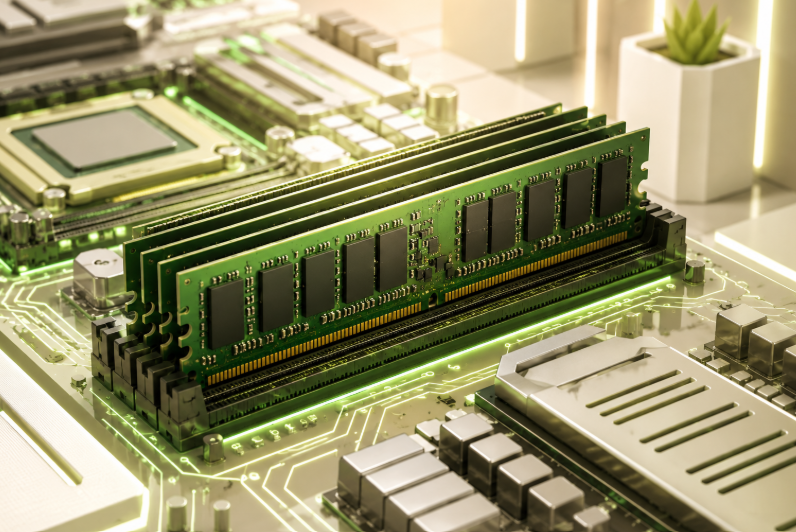
DRAM (Dynamic Random Access Memory) is a type of semiconductor memory used by computers, smartphones, servers, graphics cards and artificial intelligence (AI) systems to temporarily store data that the processor needs for fast access. Unlike permanent storage devices such as SSDs or hard drives, DRAM loses all stored data when the power is turned off, making it a form of volatile memory.
DRAM acts as the system’s short term working memory. Every application you open, website you browse or AI model you run uses DRAM to hold active data while it is being processed. The more DRAM a system has, the more tasks it can handle simultaneously without slowing down.
Why is DRAM Important?
Modern AI applications require enormous amounts of memory to process billions of calculations every second. Training and running large language models (LLMs) such as ChatGPT, Gemini or Claude require servers equipped with high capacity, high bandwidth DRAM alongside powerful GPUs.
As AI adoption accelerates, demand for DRAM has surged across data centres worldwide. Cloud providers, hyperscalers and enterprises are investing heavily in AI servers, making DRAM one of the fastest growing segments of the semiconductor industry.
How does DRAM work?
A DRAM chip stores each bit of data inside a tiny capacitor and transistor. Since the electrical charge gradually leaks away, the memory must be continuously refreshed thousands of times every second to retain data. This refresh process is why it is called Dynamic Random Access Memory.
DRAM vs NAND
Although both are semiconductor memory technologies, they serve different purposes.
| DRAM | NAND Flash |
|---|---|
| Temporary (volatile) memory | Permanent (non volatile) storage |
| Very fast read and write speeds | Slower but retains data without power |
| Used as system memory (RAM) | Used in SSDs, USB drives and smartphones |
| Loses data when powered off | Stores data permanently |
Major DRAM manufacturers
The global DRAM market is dominated by three companies:
- Samsung Electronics
- SK hynix
- Micron Technology
Together, these companies account for the vast majority of worldwide DRAM production.
Why DRAM matters for AI
The AI boom has transformed DRAM from a traditional PC component into a critical part of AI infrastructure. High bandwidth memory (HBM), an advanced form of DRAM, is now widely used with AI GPUs from companies such as Nvidia and AMD to power generative AI applications.
As investments in AI data centres continue to rise, demand for DRAM is expected to remain strong, making it one of the most important technologies underpinning the global AI revolution.
Read more AI, semiconductor and data centre insights on Vainetra.com.
Note: Do follow us on X @VainetraAi