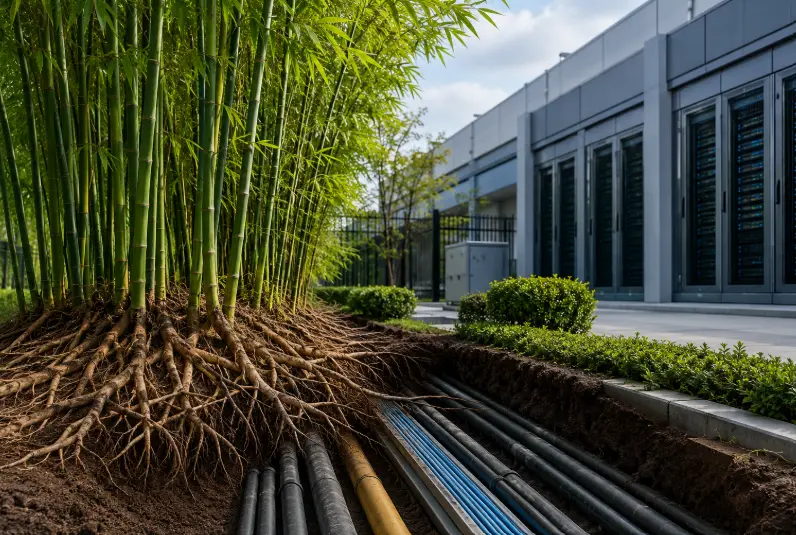
Data centres keep the digital world running. Banks process transactions through them. AI models train inside them. Businesses of every size depend on them staying online, around the clock, without interruption. So when it comes to the land surrounding these facilities, every decision matters including what gets planted in the ground. Bamboo, for all its visual appeal, is one plant that has no business being anywhere near critical infrastructure.
Roots Spread
Most ornamental plants stay roughly where you put them. Bamboo does not. Certain species push underground rhizomes outward over significant distances, and those roots are not delicate. They exert real pressure on whatever they encounter — buried fibre optic cables, power lines, water pipes, drainage runs. None of that is built to withstand a determined root system. When something finally gives, you are not looking at a gardening bill. You are looking at service disruption and a very difficult conversation with your clients.
According to the University of Maryland Extension, running bamboo uses fast spreading underground rhizomes that can travel horizontally and continue expanding over large areas, requiring physical barriers or repeated removal efforts to prevent further spread.
Growth Unchecked
Bamboo can add several feet of height in a matter of weeks. What seems manageable in spring becomes a serious obstruction by summer. Access roads get narrowed. Emergency exits get screened off. Security cameras develop blind spots. Physical surveillance of the perimeter — something no data centre can afford to compromise — becomes harder by the month. Fast-growing vegetation around a secure facility is not a feature. It is a liability.
Fire Risk
Green bamboo holds moisture well enough. The dry leaves and dead stalks it sheds underneath are a different matter entirely. That debris accumulates at the base of every mature stand and, during a prolonged dry spell, becomes combustible material sitting directly beside your building. Operators spend considerable sums getting fire prevention right. Bamboo quietly works against that effort every season.
Pests Arrive
Dense bamboo is attractive habitat — birds, rodents and insects all make themselves at home in it. The problem is that those same creatures do not stay in the bamboo. They chew through cable insulation. They nest inside outdoor equipment. They find gaps in building envelopes that nobody knew existed. Pest management is already a routine operational cost. There is no sensible reason to plant something that draws more of the problem directly to your boundary fence.
Drainage Fails
Bamboo roots work their way into drainage channels over time, blocking them or redirecting flow in ways that were never part of the original site design. The result is water pooling in places it should never reach — near generators, near electrical infrastructure, near foundations. Water intrusion is one of the costliest risks a data centre faces. Your landscaping should not be adding to that risk.
Plant Smarter
None of this means the campus has to look bare. Native shrubs with shallow, non-invasive root systems work perfectly well. Ornamental grasses offer texture and movement without the aggressive lateral spread. The principle is simple: choose plants that stay where you put them and do not quietly undermine the infrastructure they surround. As data centres grow more central to how economies function, the decisions that seem smallest often carry the longest consequences. What goes in the ground outside the building matters just as much as what runs inside it.