The journey of data centres mirrors the evolution of modern computing itself. What began as dedicated rooms housing massive mainframe computers has transformed into highly sophisticated digital infrastructure powering cloud computing, artificial intelligence (AI), streaming platforms, financial transactions and enterprise applications. Over the past eight decades, data centres have continuously evolved to meet the growing demand for computing power, storage capacity and faster data processing.
Each phase of this transformation has been shaped by technological breakthroughs and changing business requirements. Early computing systems required specialised facilities with dedicated power and cooling, while the rise of personal computers and enterprise networking led organisations to build their own on premises server rooms. The internet revolution and rapid growth of cloud computing then shifted the industry towards hyperscale facilities capable of serving millions of users worldwide with high reliability and security.
Today, the emergence of AI represents the next major turning point. Unlike traditional computing workloads, AI applications require significantly greater processing power, specialised hardware and advanced cooling technologies. As a result, modern data centres are evolving into intelligent, high density digital infrastructure designed to support the next generation of AI driven innovation. The evolution of data centres reflects not only advances in computing technology but also the growing importance of digital infrastructure in powering the global economy.
The era of mainframe computing (1940s 1960s):
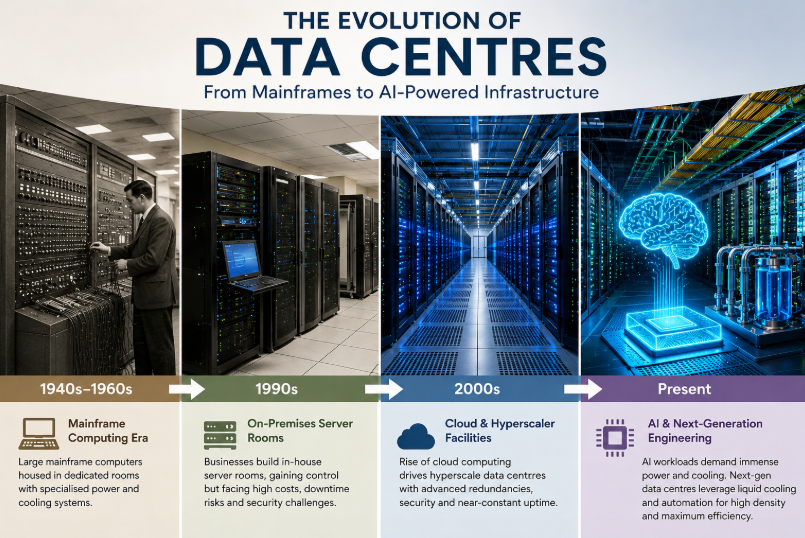
The foundations of the data centre architecture were established in the mid-20th century. Early computing systems were massive, requiring dedicated physical spaces equipped with specialised power and cooling systems. The earliest iteration of this concept emerged in 1945 at the University of Pennsylvania with the Electronic Numerical Integrator and Computer (ENIAC). By the 1960s, technological advancements introduced smaller, more cost-effective mainframes featuring expanded memory and storage capacities. This allowed organisations to integrate dedicated ‘computer rooms’ directly into standard office buildings.
On-premises server rooms and infrastructure challenges (1990s):
The maturation of personal computing and networking in the 1990s made IT infrastructure essential for businesses of all sizes. To manage email servers, databases, and file storage, companies began establishing internal, on-site server rooms. While this provided direct control over data, on-premises setups introduced significant operational challenges, including high capex, frequent downtime risks, and vulnerable physical security.
Rise of cloud and hyperscaler facilities (2000s):
The expansion of the internet backbone during the dot-com era laid the groundwork for modern cloud computing. Following the dot-com market correction in the early 2000s, the demand for cloud services surged, driving the construction of large data centres. Strategically located near reliable power grids and major fibre-optic routes, these hyperscaler facilities introduced enterprise-grade redundancies. They integrated backup power systems, advanced fire suppression, sophisticated cooling technologies, and strict physical security protocols to ensure near-constant uptime.
The modern frontier AI and next-generation engineering (present):
Today, the data centre industry is experiencing accelerated transformation driven by the rapid adoption of AI. AI workloads demand immense computational power and generate unprecedented thermal loads. Consequently, the industry is pivoting towards highly engineered, next-generation data centres that utilise advanced liquid cooling systems and intelligent automation to maximise efficiency and support high-density computing.