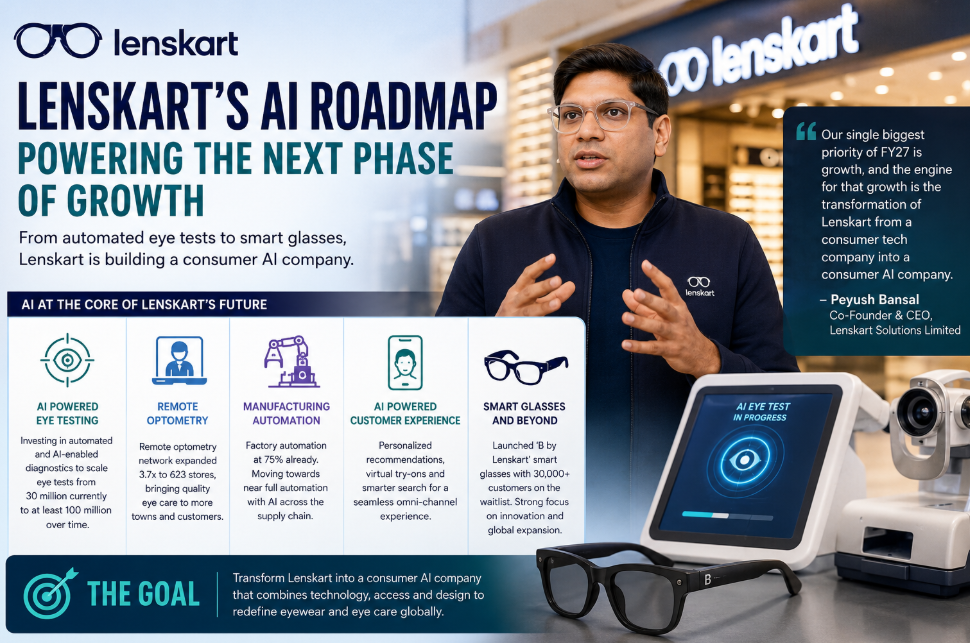
Eyewear retailer Lenskart is sharpening its focus on artificial intelligence, smart eyewear and automated eye testing as it enters what founder Peyush Bansal called the company’s “consumer AI” phase. The company outlined its aggressive AI roadmap during its Q4 FY26 earnings call, signalling that technology and automation will drive the next leg of growth.
“Our single biggest priority of FY27 is growth, and the engine for that growth is the transformation of Lenskart from a consumer tech company into a consumer AI company,” Peyush Bansal, Co-Founder and CEO of Lenskart, said during the earnings call.
The company plans to deploy AI across functions ranging from eye testing and manufacturing to customer experience and inventory planning. According to Bansal, Lenskart wants to embed “AI at every level and function” while stepping up hiring of AI talent and increasing investments in research and development.
A major part of the strategy revolves around automating eye tests. Lenskart said it aims to scale eye tests from the nearly 30 million annually to at least 100 million over time, especially amid a global shortage of optometrists. The company is investing heavily in remote optometry and AI-enabled diagnostics to widen access in smaller towns and underserved markets.
The retailer’s remote optometry network expanded 3.7 times over the last year to 623 stores. Management said technology is helping the company deliver more output with the same resources.
“We will step up our investments in R&D this year for automating eye testing and also accelerating new customer acquisition through innovation in products, formats, access points, pricing, and offers,” Bansal said.
Lenskart is also betting on smart eyewear as a future growth engine. During the quarter, the company launched “B by Lenskart”, its premium smart glasses brand, which has already attracted more than 30,000 customers to its waitlist.
“Smart glasses have opened an entirely new dimension over and above, and AI has given us wings we didn’t know were possible,” Bansal said.
The company believes its vertically integrated ecosystem, large store network and prescription lens expertise provide a structural advantage in the emerging smart glasses category. “Eventually these glasses are going to be sold through an optical network,” Bansal noted while responding to analyst queries on growing competition in the segment.
Alongside AI-led transformation, Lenskart is also expanding manufacturing automation. Factory automation levels have already reached 75%, and the company aims to move towards near-full automation while integrating AI across the supply chain.
The AI push comes at a time when Lenskart delivered strong FY26 numbers. Revenue for Q4 grew 41% year-on-year to Rs 2,516 crore, while EBITDA rose 61% with margins expanding to 21.3%.