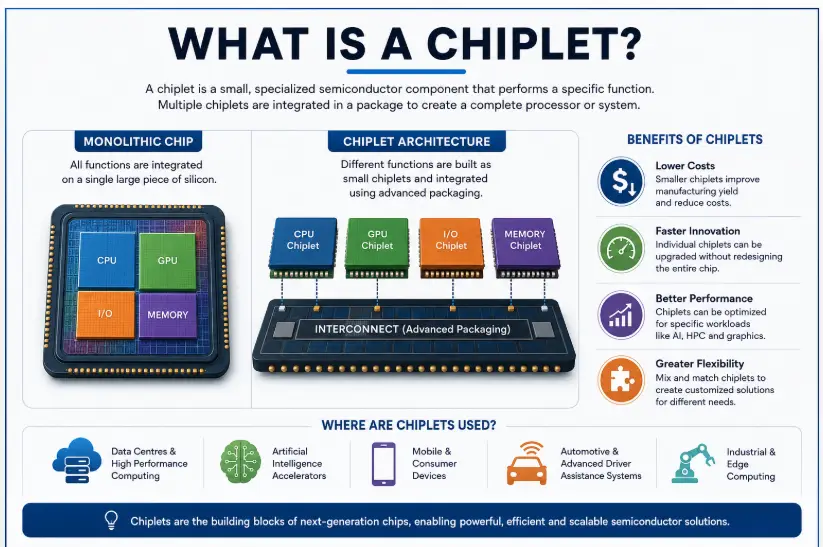
A chiplet is a small, specialised semiconductor component that performs a specific function and can be combined with other chiplets to create a complete processor or system. Instead of manufacturing a large monolithic chip that integrates all functions onto a single piece of silicon, chiplet architecture divides the design into smaller modules that are connected within the same package.
Chiplets are becoming increasingly popular in the semiconductor industry as manufacturers seek to improve performance, reduce costs and accelerate innovation. Companies such as AMD, Intel and Nvidia are investing heavily in chiplet based designs for processors used in artificial intelligence, data centres and high performance computing.
How does a chiplet work?
Each chiplet is designed for a specific purpose. For example, one chiplet may handle computing tasks, while another manages memory, graphics or input and output functions. These chiplets are then connected using advanced packaging technologies that enable them to communicate at high speed.
This modular approach allows semiconductor companies to mix and match different chiplets rather than redesigning an entire chip for every new product generation.
BENEFITS OF CHIPLET ARCHITECHTURE
Lower manufacturing costs:
Large chips are more prone to manufacturing defects. By producing smaller chiplets, manufacturers can improve production yields and reduce costs.
Faster innovation
Chiplets enable companies to upgrade individual components without redesigning the entire processor, helping accelerate product development.
Better performance
Chiplets can be optimised for specific workloads such as AI training, cloud computing or graphics processing, resulting in higher performance.
Greater flexibility
Different chiplets can be combined to create customised processors for various applications, including smartphones, data centres and automotive systems.
Why are Chiplets important?
As semiconductor designs become more complex, traditional chip manufacturing approaches face technical and economic limitations. Chiplets offer a scalable solution that enables continued performance improvements while controlling costs.
The growing demand for AI applications, high performance computing and advanced data centres is expected to further accelerate the adoption of chiplet based architectures. Many industry experts believe chiplets will play a central role in the next generation of semiconductor innovation.
In simple terms, a chiplet is a building block of modern chips, allowing manufacturers to create more powerful, efficient and flexible semiconductor products.