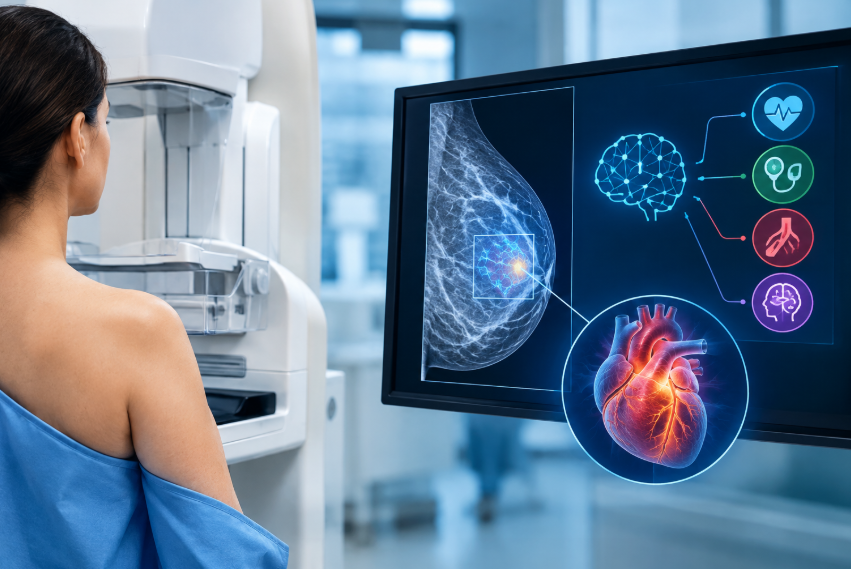
Artificial intelligence (AI) analysis of mammograms could potentially help detect common cardiovascular diseases (CVDs) in women, according to a study to be presented at ESC Congress 2026.
The study, led by Dr Viana Copeland of Chaim Sheba Medical Center and Tel Aviv University, Ramat Gan, Israel, explores whether mammograms routinely performed for breast cancer screening could also provide insights into cardiovascular health.
Explaining the need for new approaches to detecting CVD in women, Dr Copeland said cardiovascular disease remains the leading cause of death among women worldwide but is often underdiagnosed and undertreated. By the time many women seek medical attention for cardiovascular symptoms, the disease may already be advanced.
At the same time, large numbers of women undergo routine mammography even without cardiovascular symptoms. The researchers therefore investigated whether AI could extract cardiovascular information from these existing images and potentially support earlier detection and preventive intervention.
The retrospective cohort study analysed data from 29,921 women who underwent a total of 97,364 mammography examinations. The women had a median age of 54 years. Researchers used clinical records, medication prescriptions, procedural data and imaging findings to identify three common cardiovascular conditions: hypertension, ischaemic heart disease, also known as coronary artery disease, and stroke.
Hypertension was present in 16% of the cohort, while ischaemic heart disease and stroke each affected 2.5% of the women.
Researchers then trained a deep-learning model to identify patterns in mammograms associated with these cardiovascular conditions. The model’s performance was assessed using the area under the receiver operating characteristic curve (AUROC), a measure of how effectively a model distinguishes between people with and without a particular condition. An AUROC of 0.5 represents random guessing, while 1.0 indicates perfect discrimination.
The initial model produced AUROCs of 0.79 for hypertension, 0.78 for ischaemic heart disease and 0.86 for stroke. The results remained consistent after accounting for cancer status and age.
According to Dr Copeland, the findings suggest that mammography could potentially become a more versatile screening tool. Since mammograms are already widely used, analysing the same images for cardiovascular indicators could provide additional information without requiring women to undergo another imaging examination. Mammography also reaches a large population of women during midlife, a period when identifying and managing cardiovascular risk can be particularly important.
However, the technology remains at the research stage. The researchers are working to improve the model’s performance and reduce both false-positive and false-negative results. They also plan to examine whether mammograms can be used to identify other cardiovascular conditions.
Associate Professor Elena Arbelo, a member of the ESC Communication Committee, described the concept as promising, noting that mammograms could potentially provide a broader view of women’s health beyond breast cancer screening.
The key challenge, however, will be demonstrating that AI-based cardiovascular detection from mammograms is sufficiently accurate and reliable for use in clinical practice. Further validation will be needed before such technology can move from an experimental research setting to routine screening.