

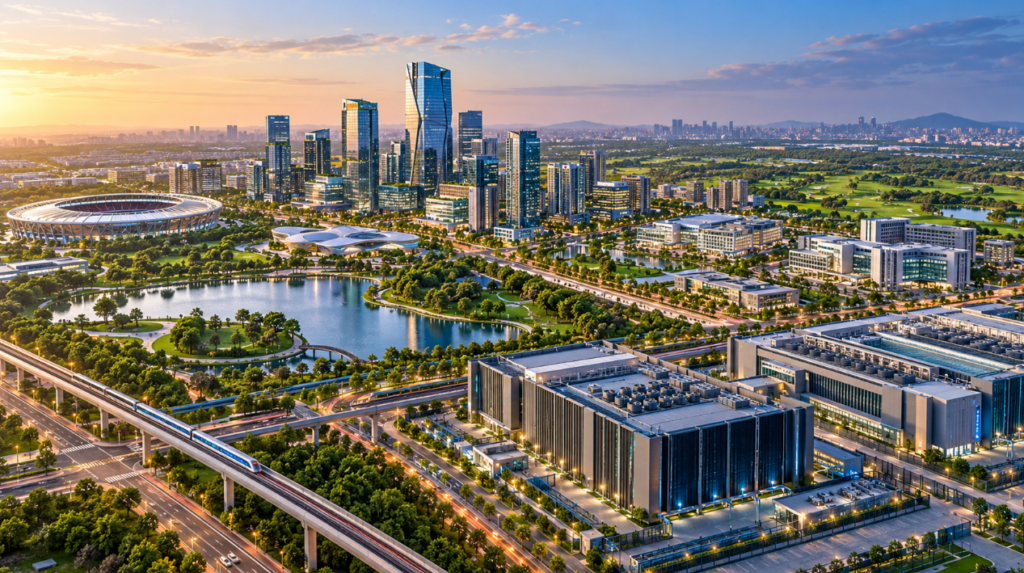
Hyderabad is preparing for a major expansion beyond its traditional IT corridors. At the centre of that ambition is Bharat Future City, a proposed 30,000-acre greenfield development that Telangana wants to turn into a new hub for artificial intelligence, data centres, healthcare, education, life sciences, manufacturing and global businesses.
The project is being developed under the Future City Development Authority (FCDA) and is planned by the Telangana government as a net-zero, smart and sustainable city built around the principles of “Work, Live, Learn and Play.”
What is Bharat Future City?
Bharat Future City is not simply another technology park or a data-centre cluster. The Telangana government is planning an entirely new urban-economic zone in the southern part of the Hyderabad region. The broader Future City Development Authority area covers about 765 sq km, with the government projecting that the area could eventually accommodate 25–30 lakh people.
Within Bharat Future City itself, the government has identified several specialised zones. The proposed Central Business District will include: AI City (300 acres), Health City (200 acres), Education Hub (500 acres) and Life Sciences Hub (3,000 acres)
The plan also includes an entertainment district with a proposed international cricket stadium, an 18-hole golf course, eco-trails, theme parks and resorts.
This makes the project significantly broader than an AI or data-centre development. Telangana’s stated objective is to create an integrated economic ecosystem where technology, business, education, healthcare, manufacturing and urban infrastructure develop together.
Why AI and data centres are becoming central to the project
One of the biggest changes in the technology economy is the growing infrastructure requirement behind artificial intelligence. AI models require enormous computing capacity, which in turn requires specialised data centres, high-density GPU infrastructure, large quantities of electricity, advanced cooling systems and high-speed connectivity. Telangana has therefore positioned data centres and AI infrastructure as important components of Bharat Future City.
In June 2025, the Telangana government directed officials to specifically earmark land for companies seeking to establish new data centres in Future City, noting Hyderabad’s growing position as a data-centre hub. The strategy has since begun translating into large projects.
AWS puts Bharat Future City on the data-centre map
Amazon Web Services has already taken a significant step in the development. AWS broke ground on a new data centre in Hyderabad at Bharat Future City, with Telangana Chief Minister A Revanth Reddy participating in the groundbreaking ceremony.
Amazon said the project represents an expansion of the AWS Asia Pacific Hyderabad Region as demand for cloud computing and AI infrastructure grows.
Amazon also said it plans to invest more than $21 billion in cloud infrastructure in India between 2026 and 2030. The investment will expand AWS data-centre capacity in Hyderabad and Mumbai.
By the end of 2025, Amazon said it had already invested more than $1.3 billion in cloud infrastructure in the AWS Hyderabad Region.
The Telangana government has described the AWS facility at Bharat Future City as a significant early investment that could encourage more businesses and investors to establish operations in the new city.
TCS-backed HyperVault plans a 1 GW AI campus
The scale of the next project shows why Bharat Future City is increasingly being linked with AI infrastructure.
HyperVault, a subsidiary of Tata Consultancy Services, has secured 264 acres to develop an AI data-centre campus in Hyderabad with capacity of up to 1 GW.
TCS said the campus will be purpose-built for frontier AI companies and hyperscalers, supporting high-density GPU deployments for AI training, inference and advanced computing.
The company plans to develop the campus in phases according to customer demand and technology requirements.
The infrastructure will use liquid cooling, direct-to-chip cooling, high rack density, green power and water-neutral design principles.
TCS said HyperVault, along with its partners, is being built toward capacity exceeding one gigawatt.
The Telangana government has put the investment associated with the project at around Rs 70,000 crore, while estimating around 7,000 direct and indirect jobs.
The project therefore goes beyond the traditional concept of a data centre. It represents the infrastructure layer required for large-scale AI computing.
Another 100 MW AI data centre is planned
Bharat Future City’s AI infrastructure ambitions are not limited to AWS and HyperVault. In January 2026, Telangana announced an agreement with the UPC–Volt joint venture for a 100 MW AI data centre at Bharat Future City. The project involves an announced investment of Rs 5,000 crore over five years. A dedicated 100 MW renewable-energy plant is also planned to meet the data centre’s power requirements. The government said the project could generate around 3,000 direct and indirect employment opportunities during construction, with another 800 jobs expected after the data centre becomes operational.

