

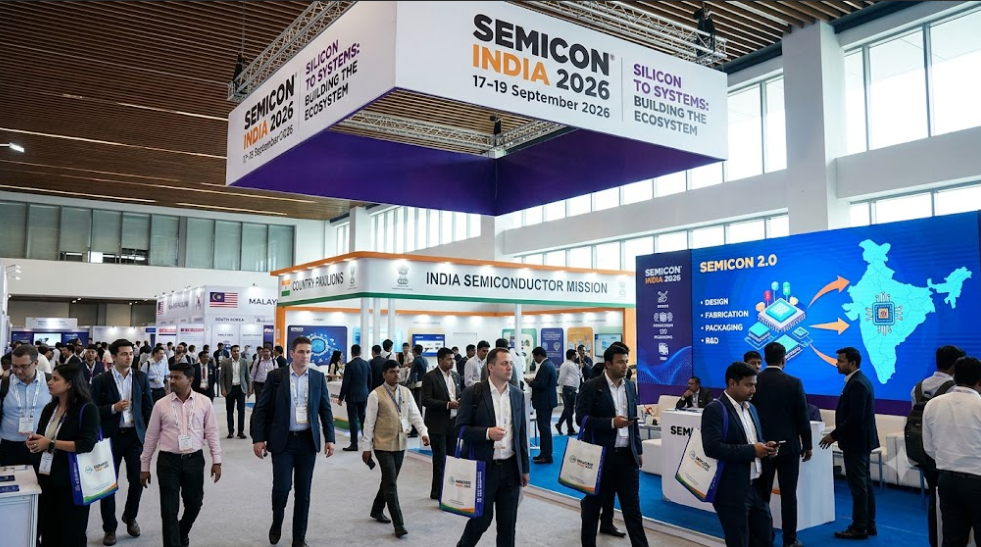
India’s semiconductor ambitions moved decisively from policy discussions to active factory floors this week as SEMICON India 2026 concluded its fifth edition at Yashobhoomi, New Delhi. Centered on the theme “Silicon to Systems: Building the Ecosystem,” the three day gathering drew over 40,000 visitors, 150 speakers, and 600 exhibitors, including 300 international firms representing 52 nations.
Inaugurating the summit, Prime Minister Narendra Modi marked a turning point for domestic manufacturing by virtually launching commercial lines at CDIL Semiconductor in Mohali and Suchi Semicon in Surat. This brings the total number of operational facilities under the initial Semicon 1.0 initiative to five.
Looking forward, the Prime Minister detailed the launch of Semicon 2.0. Backed by an outlay of Rs 1,27,500 crore, this next phase targets the entire value chain through six core pillars: chip design, machines and materials, new fabrication units, advanced packaging, applied research, and talent pipelines. Over the course of the event, companies, research hubs, and government bodies signed 56 strategic agreements and investment pacts spanning AI, high performance computing, equipment logistics, and workforce training.
Union Minister Ashwini Vaishnaw built on this roadmap during Day 2, pointing out that sustainable semiconductor independence requires far more than cleanrooms and silicon wafers. Real resilience, he noted, depends on mastering specialized inputs, from precision tools, ultra pure chemicals, and gases to indigenous intellectual property and engineering talent.
Global integration remained central to the discussions. Roundtables with partners from the United States, Japan, Singapore, Europe, South Korea, and Malaysia tackled supply chain bottlenecks, cross border investments, and shared research. Talks with Malaysia zeroed in on integrating its established packaging and assembly expertise with India’s rapidly growing engineering base.
The summit closed with a strong spotlight on homegrown innovation and the next generation of engineers. The Digital India RISC V Grand Challenge engaged over 5,000 participants building on native VEGA and SHAKTI processors. Alongside, student hackathons run by KLA, Synopsys, Lam Research, and CeNSE IISc drew over 3,800 teams from 900 colleges, awarding winners internships, software tools, and compute credits.
As the curtains came down, SEMICON India 2026 demonstrated that the country is no longer merely projecting demand. It is laying down the physical infrastructure, nurturing local talent, and sealing global partnerships to build an integrated silicon ecosystem.


