

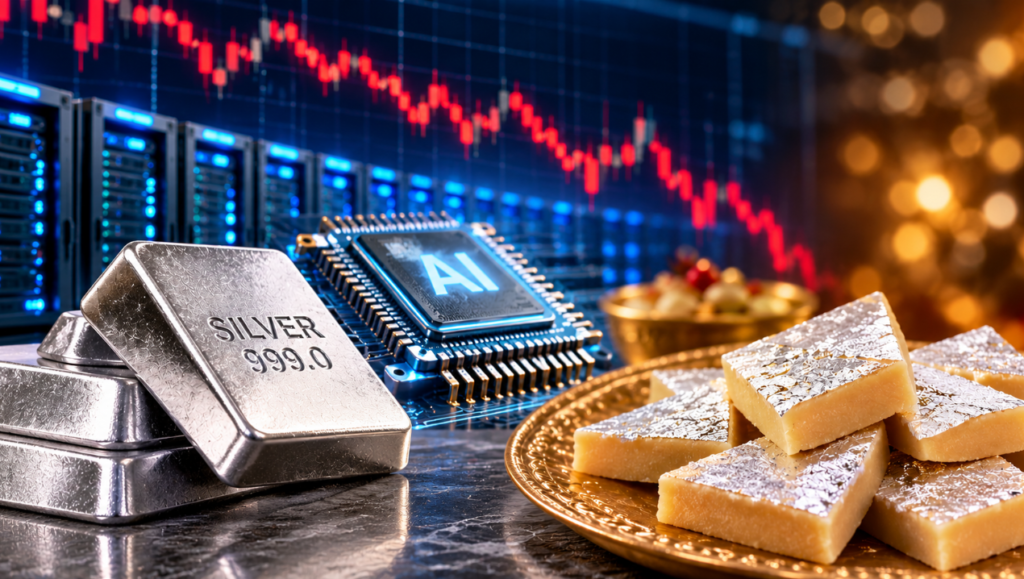
Silver has found an unlikely place in the artificial intelligence (AI) boom. Once seen largely as a precious metal used in jewellery, utensils and investment products, it is now attracting attention for its role in electronics, electrical equipment and the infrastructure supporting AI data centres. But with silver prices falling sharply and technology stocks facing a correction, questions are emerging over whether the AI-driven demand story had become too optimistic.
In India, silver has always had a more familiar association. It finds its way into jewellery, utensils, religious articles and even the thin edible foil covering a piece of kaju katli. But over the past year, the metal has increasingly been discussed in the context of semiconductors, data centres and the global AI infrastructure buildout.
That narrative is now facing a reality check. Silver prices on the Multi Commodity Exchange (MCX) have fallen from a record high of more than Rs 4 lakh per kg in January 2026 to below Rs 1.55 lakh per kg in November. The decline reflects a combination of profit-booking, forced liquidation of leveraged positions, a stronger US dollar, expectations of higher US interest rates and concerns over industrial demand.
The question is whether the excitement around AI infrastructure had pushed expectations for silver demand too far ahead of what the industry can actually consume.
The AI connection: Why silver matters
The growing investment in AI infrastructure has brought renewed attention to the metals needed to support it. Silver, known for its high electrical conductivity, is used in electrical contacts, connectors, conductive pastes and several electronic components.
Building a large data centre involves much more than installing servers and advanced chips. It requires extensive electrical infrastructure, including power distribution systems, circuit protection equipment, connectors and other electronic components. Silver is used in some of these applications, making it relevant to the wider AI infrastructure ecosystem.
However, its role needs to be seen in perspective. Silver is not a primary material used in silicon semiconductor wafers. Its importance lies largely in the electronics and electrical systems that support computing infrastructure.
As technology companies commit billions of dollars to data centres and advanced computing capacity, investors have increasingly looked at metals such as silver as potential beneficiaries of this spending cycle.
Why is the silver rally losing momentum?
The recent correction suggests that the industrial demand story alone may not be enough to support prices when broader financial market conditions turn unfavourable.
Rajeev Sharan, Head of Research at Brickwork Ratings, said, “Metals (including silver, gold and copper) faced a steep selloff last week as growing expectations of US interest rate hikes, a firmer US dollar, and US bond yields crossing 5% triggered broad selling.”
There are also concerns about demand from some of silver’s traditional industrial users. In the solar industry, manufacturers are working to reduce the amount of silver used in solar cells through improvements in technology and material substitution. A slowdown in parts of China’s solar and electric vehicle industries has added to these concerns.
The Silver Institute’s 2026 demand estimates, cited in recent market reports, also point towards a decline in global silver consumption, with industrial demand expected to contract.
This matters because silver has two distinct identities. Unlike gold, it is not just held as an investment or a store of value. A significant part of its demand comes from industrial users. Any slowdown in manufacturing or a shift towards technologies that require less silver can affect the metal’s price outlook.
From AI infrastructure to Indian households
The price correction could also influence how Indian consumers approach silver purchases.
The sharp rise in prices had made silver increasingly expensive for households buying jewellery, coins, utensils and traditional silver articles. Many consumers have responded by opting for lighter jewellery and smaller products. Investment demand for coins and bars has also faced pressure as buyers wait for prices to stabilise.
Jewellery demand, however, has been relatively more resilient, with consumers adjusting their purchases rather than abandoning them altogether.
Silver’s place in Indian households goes well beyond investment. From jewellery and puja articles to the chandi ka vark used on sweets such as kaju katli, the metal has a long-standing cultural and consumption base.
But cheaper silver does not necessarily mean an immediate revival in purchases. Consumers also consider whether prices could fall further, along with household budgets and broader spending priorities.
Is silver’s AI story over?
Not necessarily. A fall in prices does not mean silver has lost its relevance to the technology industry.
AI infrastructure, semiconductor manufacturing, electronics, electric vehicles and electricity networks will continue to require a range of industrial materials. The expansion of data centres could support demand for silver-containing electrical and electronic components over the longer term.
The bigger question is whether the actual quantity of silver required by these industries will match the expectations built into prices during the recent rally.
The correction also shows how quickly the market narrative around a commodity can change. Silver was being discussed as a beneficiary of the AI revolution, but when technology stocks came under pressure and investors began unwinding positions, the metal was not spared.
Perhaps silver does not have to choose between semiconductors and kaju katli. Both will remain part of its demand story. What investors need to figure out is how much of its recent rally was supported by actual industrial consumption and how much was driven by expectations around the AI boom.
For now, the journey from semiconductor chips to the sweet box may be less about silver returning to its traditional uses and more about the market reassessing how much of the AI opportunity was already priced in.
Do follow us on X @VainetraAi.

