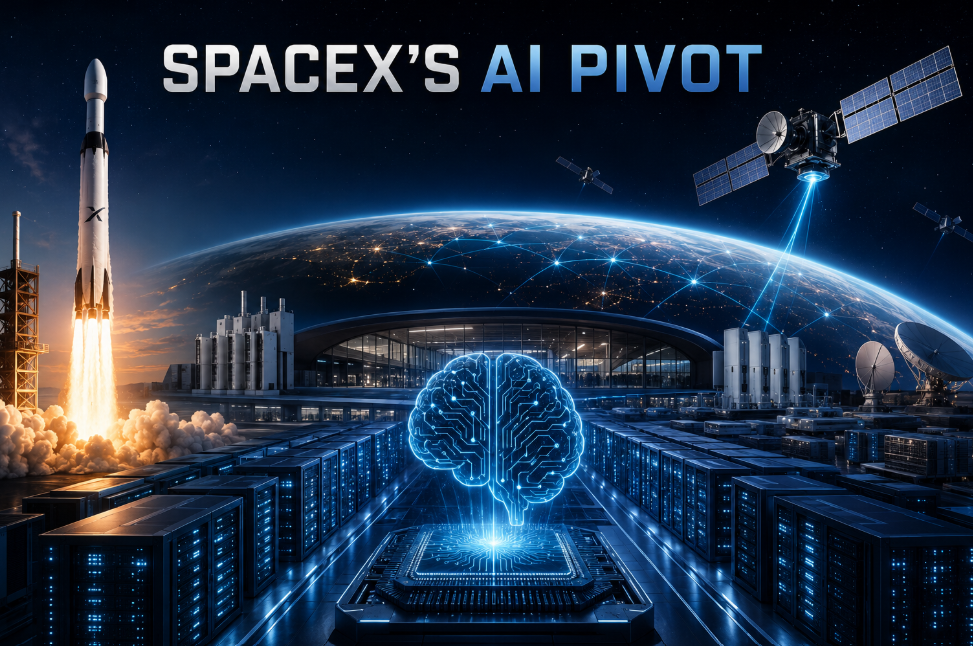
For more than two decades, SpaceX has been synonymous with reusable rockets, satellite launches and humanity’s ambition to become a multiplanetary species. But if its latest roadshow presentation is any indication, Elon Musk’s company is preparing investors for a new identity: an AI infrastructure giant.
The shift is striking. While SpaceX continues to highlight its leadership in launch services and satellite connectivity, artificial intelligence occupies a central role in its long-term growth strategy. The company estimates the total addressable market for AI at $26.5 trillion, dwarfing the opportunities in space transportation and satellite connectivity.
At the heart of this strategy is a belief that the next wave of AI innovation will be constrained not by algorithms, but by infrastructure.
Building the AI backbone
SpaceX claims to have built the world’s first gigawatt scale AI training cluster and the largest coherent supercomputer, supported by a compute draw of approximately 1 gigawatt. The company argues that its expertise in manufacturing, energy systems and large scale engineering gives it a unique advantage in building AI infrastructure faster and cheaper than rivals.
Unlike traditional AI companies that rely on third party cloud providers, SpaceX is pursuing vertical integration across the entire stack. Its AI ecosystem includes compute infrastructure, proprietary models such as Grok, real time data from X, cloud computing services and future chip development.
The strategy mirrors the company’s playbook in rockets and satellites: control as much of the value chain as possible.
Why rockets matter to AI
Perhaps the most intriguing aspect of the plan is how SpaceX links its aerospace capabilities to artificial intelligence.
The company argues that reusable rockets and Starlink satellites are not separate businesses but foundational assets that can support future AI infrastructure. Lower launch costs, high launch frequency and advanced satellite manufacturing could eventually enable deployment of AI compute platforms in orbit.
SpaceX believes that terrestrial AI data centres will increasingly face constraints related to power availability, cooling requirements and regulatory approvals. As AI demand explodes, these limitations could become a major bottleneck.
Its proposed solution sounds like science fiction: orbital AI compute satellites powered by solar energy and connected through the Starlink network. The company is targeting initial deployment as early as 2028.
Monetising intelligence
SpaceX is already laying the groundwork for monetisation. The company highlights Grok subscriptions, enterprise AI offerings, cloud computing services and partnerships such as its arrangement with Cursor. It also points to X’s more than 550 million monthly active users as a source of real time data and distribution.
The objective is simple: sell both compute and intelligence.
That places SpaceX in direct competition not only with aerospace companies, but also with technology leaders such as OpenAI, Anthropic, Google and Amazon.
Beyond Mars
For years, investors viewed SpaceX primarily as a launch and satellite communications company. The latest presentation suggests a broader ambition. SpaceX wants to become the infrastructure layer of the AI economy, combining rockets, satellites, power systems, data and compute into a single platform.
If successful, the company’s most valuable destination may not be Mars. It may be the rapidly expanding market for artificial intelligence itself.