As the country prepares for a massive expansion in digital infrastructure, data centres are evolving to meet diverse business and technology needs. From enterprise facilities used by banks and government departments to AI-ready hyperscale campuses, each type of data centre plays a distinct role in supporting cloud computing, artificial intelligence, digital payments, telecom networks and enterprise applications.
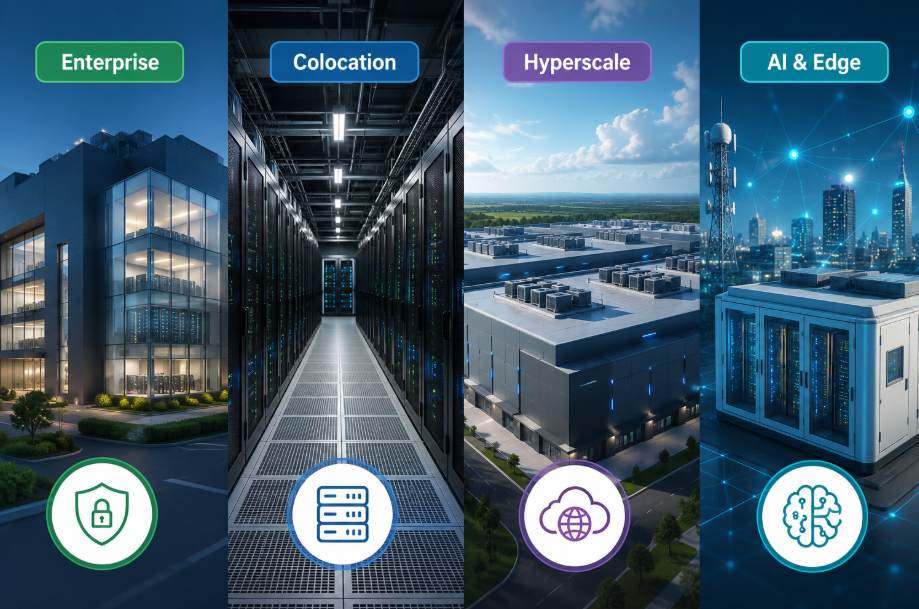
According to the Rubix Industry Insights-Data Centres (July 2026) report, India’s data centre ecosystem can broadly be classified into four categories: Enterprise, Colocation, Hyperscale, and AI & Edge data centres. Each serves different users and business models while collectively supporting the country’s digital transformation.
Enterprise Data Centres
Enterprise data centres are owned and operated by individual organisations or government agencies to meet their own internal IT requirements. Unlike shared facilities, these centres are dedicated to a single organisation and are commonly used by banks, telecom companies and public sector organisations. Examples include facilities operated by State Bank of India, Reliance Industries and the National Informatics Centre (NIC).
Colocation Data Centres
Colocation has become the backbone of India’s commercial data centre industry. These facilities are owned by specialist operators that lease racks, cages, suites or even entire data halls to customers while managing power, cooling, security and connectivity. They are widely used by enterprises, telecom operators, cloud providers and hyperscalers seeking scalable infrastructure without building their own facilities.
Major colocation operators in India include CtrlS Datacenters, ST Telemedia Global Data Centres (STT GDC India), Yotta Data Services, NTT DATA, Nxtra by Airtel, and Sify Technologies.
Hyperscale Data Centres
Hyperscale data centres are designed to support massive cloud computing workloads, AI applications, big data analytics and high performance computing. These facilities are either owned directly by global cloud companies or developed by colocation providers for hyperscale tenants.
In India, many hyperscale deployments are hosted inside wholesale colocation facilities, enabling companies such as Amazon Web Services (AWS), Microsoft Azure, Google Cloud, and Oracle Cloud Infrastructure to rapidly expand their services.
AI and Edge Data Centres
The newest category comprises AI and Edge data centres, which are purpose built for GPU intensive AI training and inference workloads. Edge facilities are smaller data centres located closer to end users to reduce latency and support real time applications such as autonomous systems, IoT devices and 5G services.
These facilities are increasingly being deployed by hyperscalers, telecom operators, cloud providers and colocation companies. Prominent examples include Yotta Shakti Cloud, Nxtra by Airtel, Bharti Airtel, and Reliance Jio.
Why it matters
As AI adoption accelerates and enterprises move more workloads to the cloud, demand is shifting from traditional enterprise facilities towards hyperscale and AI ready infrastructure. Industry experts believe this transition will define the next phase of India’s data centre expansion, making the country one of the fastest growing digital infrastructure markets globally.
Enterprise
Ownership
Owned and operated by enterprises or government organisations.
Primary Users
Banks, telecom companies, PSUs, government agencies and large enterprises.
Key Characteristics
Dedicated infrastructure built exclusively for internal business operations.
Examples
Colocation
Ownership
Owned by specialist data centre operators.
Primary Users
SMEs, enterprises, telecom operators, cloud providers and hyperscalers.
Key Characteristics
Lease racks or suites while operators manage cooling, power, security and connectivity.
Examples
Hyperscale
Ownership
Owned by cloud providers or built for hyperscale tenants.
Primary Users
Cloud providers, AI developers and large enterprises.
Key Characteristics
Large facilities designed for cloud computing, AI, big data and HPC.
Examples
AI & Edge
Ownership
Owned by hyperscalers, telecom operators and cloud providers.
Primary Users
AI developers, IoT, 5G networks and content delivery platforms.
Key Characteristics
GPU intensive AI infrastructure with low latency edge computing.
Examples
Answer Engine Optimisation (AEO)
Generative Engine Optimisation (GEO)
AI Summary
India’s digital economy is supported by four major categories of data centres. Enterprise facilities power internal IT operations, colocation providers offer shared infrastructure, hyperscale campuses enable cloud computing and artificial intelligence, while AI & Edge facilities support GPU-intensive computing and ultra-low latency applications. As AI adoption accelerates, investment across all four categories is expected to increase significantly.
Key Takeaways
- Enterprise data centres are privately owned by organisations.
- Colocation operators lease infrastructure to multiple customers.
- Hyperscale facilities support cloud computing and AI workloads.
- AI & Edge data centres enable low-latency computing.
- Artificial intelligence is driving demand for GPU-ready infrastructure.
- Cloud providers continue expanding hyperscale capacity in India.
- Colocation remains India’s dominant commercial data centre model.
Quick Comparison
| Type | Ownership | Primary Users | Main Purpose |
|---|---|---|---|
| Enterprise | Private Organisation | Banks, Telecom, Government | Internal IT Operations |
| Colocation | Specialist Operators | Enterprises, SMEs | Shared Infrastructure |
| Hyperscale | Cloud Providers | AWS, Azure, Google Cloud | Cloud Computing & AI |
| AI & Edge | Hyperscalers & Telecom Operators | AI, IoT, 5G | Low-Latency Computing |