

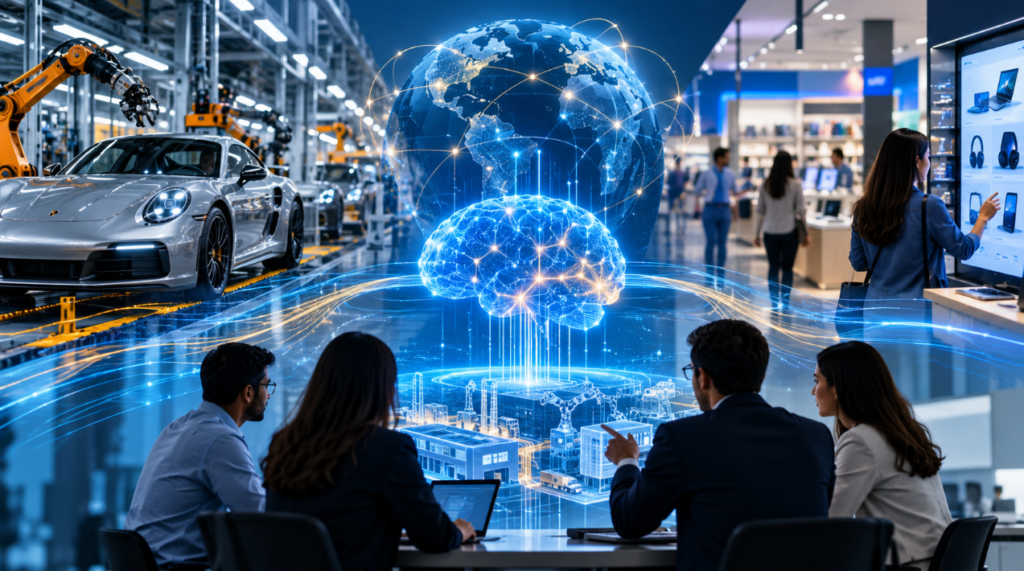
Tata Consultancy Services (TCS) is looking to move artificial intelligence beyond isolated pilots and experiments, building repeatable solutions that businesses can deploy at scale. The strategy is reflected in two significant partnerships announced in the September quarter, involving German luxury carmaker Porsche AG and US electronics retailer Best Buy.
“Together with our clients, we are building repeatable value platforms that will industrialize AI at scale,” TCS chief executive and managing director K Krithivasan said while announcing the company’s Q2 FY27 results.
The statement captured a growing shift in enterprise technology: businesses are increasingly looking to integrate AI into their core operations rather than treating it as a standalone technology project. The opportunity is already becoming material for TCS. Its annualised AI revenue reached $3.1 billion in the September quarter, crossing 10% of total revenue. The company reported consolidated revenue of Rs 73,188 crore and net profit of Rs 13,884 crore for the quarter.
From AI experiments to business transformation
The partnership with Porsche shows how AI could become embedded in industrial operations. TCS announced a five-year strategic partnership with the automaker and plans to establish a dedicated AI Mobility Centre of Excellence to drive innovation across manufacturing, engineering, operations and customer experience. TCS also plans to acquire MHP, Porsche’s Germany based management and IT consulting subsidiary, through its subsidiary. The proposed transaction and partnership remain subject to regulatory approvals.
The Best Buy agreement offers a different model. TCS will take over the US retailer’s Global Capability Centre in India and transform it into an AI Capability Centre. The initiative will combine Best Buy’s retail and enterprise knowledge with TCS’s technology, engineering and AI capabilities to redesign workflows and develop AI powered solutions.
Both engagements point towards a broader objective: connecting AI technology with industry specific knowledge, existing enterprise systems and measurable business outcomes.
Why repeatability matters
For large enterprises, deploying AI across an organisation involves more than selecting a model or building a chatbot. Companies must integrate AI into established workflows, manage data and security, and ensure that solutions work reliably across business functions. Repeatable platforms could help technology providers address these challenges by reusing established capabilities across multiple processes and clients, while adapting solutions to individual business requirements.
For TCS, this could create opportunities in manufacturing, retail, financial services and other sectors. The company’s Q2 announcements also included a global SAP S/4HANA transformation mandate from Honeywell Technologies and new AI engineering initiatives.
However, the commercial test will be whether these engagements translate into sustained revenue growth, improved productivity and tangible client benefits.
TCS’s $3.1 billion annualised AI revenue signals that the business is gaining scale. The next phase will depend on how effectively the company converts AI adoption into repeatable, profitable enterprise transformation. The emerging contest in enterprise AI may therefore be less about who can demonstrate the most impressive technology and more about who can deploy it reliably across real business operations.


