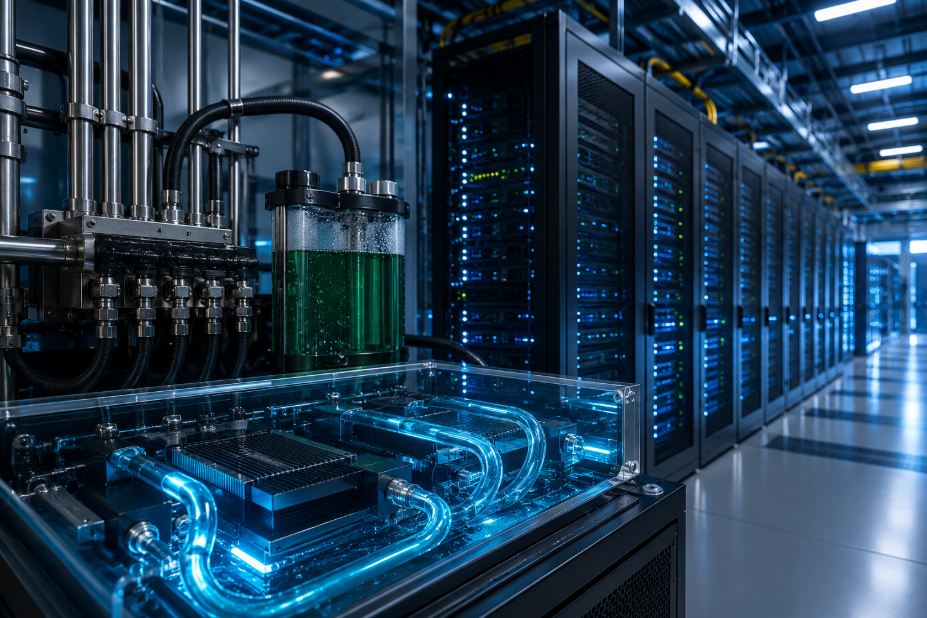
The country’s rapid expansion of artificial intelligence (AI) infrastructure is opening up new business opportunities beyond traditional technology companies. Lubricants maker Castrol India believes data centre cooling could emerge as one of its next growth engines, although the company says the market is still in its early stages and it is not yet ready to provide financial guidance.
Speaking during the company’s first quarter FY26 earnings call, Castrol’s management said it has moved beyond the pilot phase and is actively conducting trials for liquid cooling solutions with data centre developers in India. The company is also working closely with original equipment manufacturers (OEMs) that design cooling systems for hyperscale facilities.
“There is a lot happening in that space. A lot has been announced in terms of new data centres being developed or built in India. The team remains closely in touch with the people who are developing the data centres as well as OEMs who develop the cooling system solutions around those data centres. So it is beyond pilot. There are trials that are going on,” said Saugata Basuray, Whole Time Director and Interim CEO of Castrol India.
The comments come at a time when the countrys is witnessing a surge in investments in AI infrastructure, driven by cloud providers, hyperscalers and enterprise demand for high-performance computing. The increasing deployment of graphics processing units (GPUs) for AI workloads is expected to accelerate the adoption of liquid cooling technologies, which are significantly more efficient than conventional air cooling systems.
Castrol said the products currently being tested in India are already being used in data centres in overseas markets, giving the company confidence as the domestic ecosystem develops. However, management cautioned that commercial adoption will depend on the pace of construction and the cooling technologies ultimately selected by developers.
“As and when they scale up and the developers have firmed up on what is their path, what is the technology that they have chosen for the cooling system, then we would be able to see that flow through into our business. We can’t make a guidance at the moment because this is not something we are driving,” Basuray said.
The company highlighted that it has products for both major liquid cooling technologies currently emerging in the market—immersion cooling and direct to chip cooling.
“Within liquid cooling there are broadly two types of technology. There is the immersion coolant and the direct-to-chip. We have products for both. Depending on the technology which the developers choose, we will have options to participate in them,” Basuray said.
Explaining the industry’s evolution, Castrol noted that global data centres have progressively shifted from air cooling to liquid cooling as operators seek greater power efficiency and improved thermal management for AI servers.
“A few years back, a lot of the data centres were air cooled. They are then subsequently moving to liquid-cooled and beyond that going to direct to chip because all the data centre developers are scavenging for power efficiency. The products that we sell serve to meet that requirement of power efficiency. The more heat can you remove, the more efficient the data centre becomes,” Basuray said.
Despite the opportunity, Castrol believes the market remains too nascent to estimate its addressable size or future revenue contribution. The company said technology standards are still evolving, making it premature to provide market share or profitability guidance.
For investors, however, the commentary underscores an important trend: as India ramps up investments in AI and hyperscale data centres, opportunities are likely to extend well beyond IT companies to suppliers of specialised cooling fluids, thermal management systems and other supporting infrastructure. Castrol is positioning itself early in this emerging ecosystem, with the expectation that successful trials today could translate into commercial opportunities as India’s AI data centre capacity expands over the coming years.