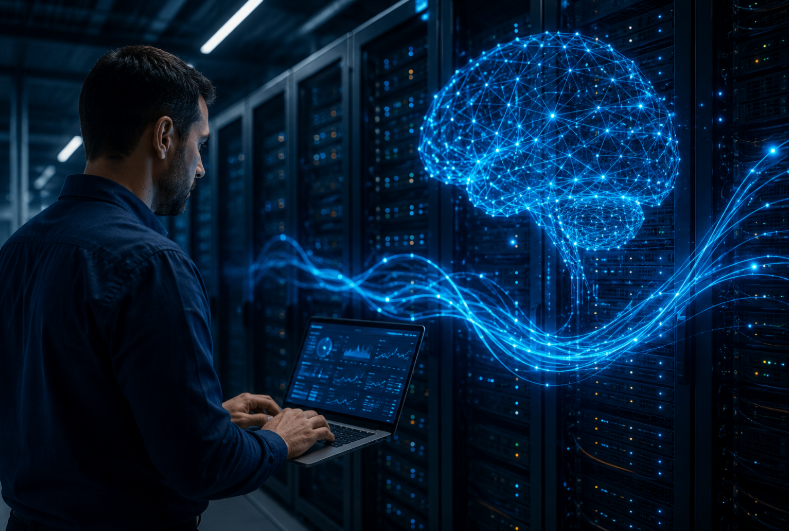
Artificial intelligence is transforming data centres faster than any technology before it. From predicting equipment failures to optimising cooling systems and balancing power consumption, AI is steadily becoming the brain behind digital infrastructure. Technology vendors promise self-healing facilities, autonomous operations and predictive maintenance that could dramatically reduce costs and improve efficiency.
Yet, beneath the excitement lies a more cautious reality.
The latest Uptime Institute Global Data Center Survey 2026 shows that while AI adoption is accelerating, operators are becoming more measured about what the technology can actually achieve. Confidence in AI remains strongest for lower risk operational tasks, while trust declines sharply when decisions could directly affect uptime, resilience or mission critical infrastructure. Rather than replacing engineers, AI is increasingly emerging as a powerful assistant that still depends on human expertise.
For an industry where even a few minutes of downtime can cost millions of dollars, this distinction matters.
From automation to intelligence
Data centres have always embraced automation. Building management systems, Data Center Infrastructure Management (DCIM) platforms and predictive maintenance software have been used for years to monitor temperatures, airflow, electrical systems and server performance. Generative AI has raised expectations further.
Today’s AI powered platforms can analyse thousands of sensors simultaneously, detect anomalies before humans notice them and recommend operational changes in real time. Vendors are embedding large language models into infrastructure software, enabling operators to query systems using natural language while machine learning algorithms optimise cooling, energy usage and maintenance schedules.
On paper, the vision is compelling: autonomous data centres capable of managing themselves with minimal human intervention.
Reality, however, is proving more nuanced.
Trust remains the biggest hurdle
According to the Uptime survey, operators’ expectations regarding AI’s operational benefits have actually softened in 2026. The decline does not represent rejection of AI but rather reflects growing awareness of its limitations following well publicised AI errors across enterprise environments.
This cautious approach makes sense.
Unlike consumer applications, data centres cannot tolerate hallucinations, incorrect recommendations or unpredictable behaviour. A mistaken decision involving cooling systems, electrical distribution or power loads could trigger outages affecting banks, hospitals, cloud platforms or government services.
Operators therefore continue to place greater trust in AI when it supports decisions rather than makes them independently.
AI excels at prediction, not accountability
One area where AI is already proving valuable is predictive maintenance.
Modern facilities generate enormous volumes of telemetry from cooling equipment, UPS systems, transformers, power distribution units and thousands of environmental sensors. AI can identify patterns that would remain invisible to human operators, allowing maintenance teams to replace components before failures occur.
The report notes that operators increasingly rely on high quality operational data across multiple distributed environments to identify spare capacity and adapt operations for AI infrastructure. Confidence in operational data quality is generally high, provided it is supported by effective governance, validation and maintenance processes.
Yet prediction alone does not eliminate responsibility.
When AI flags a possible failure, engineers must still verify the diagnosis, assess operational risks, coordinate maintenance windows and determine whether intervention is justified.
Machines may identify problems.
Humans decide what to do about them.
Critical infrastructure demands human judgement
As AI workloads expand, data centres are becoming significantly more complex.
Average rack densities continue to rise as GPU clusters consume dramatically more power than traditional enterprise servers. Some new facilities now deploy racks exceeding 30 kilowatts, placing unprecedented demands on electrical systems and cooling infrastructure.
Managing these environments involves countless engineering decisions:
- balancing electrical loads
- maintaining redundancy
- planning cooling strategies
- responding to unexpected equipment behaviour
- coordinating emergency procedures
These are situations where experience often outweighs algorithms.
Human engineers understand operational context, commercial priorities, regulatory obligations and unforeseen interactions between interconnected systems in ways that AI currently cannot replicate.
The cost of getting it wrong
The survey offers another reminder of why operators remain cautious.
Although outage frequency has declined over recent years, nearly half of respondents still experienced at least one impactful outage during the previous three years. Among those incidents, one in ten was classified as serious or severe, while the financial cost of outages continues to rise.
As digital infrastructure becomes increasingly central to economies, even small operational mistakes can have enormous consequences.
No operator is likely to delegate final authority over mission critical infrastructure entirely to an AI model whose reasoning may not always be transparent.
The human skills shortage may become AI’s biggest challenge
Ironically, as AI becomes more capable, the industry needs skilled engineers more than ever.
The Uptime survey finds that 53 per cent of operators now struggle to recruit qualified professionals, up from 46 per cent a year earlier. AI driven facilities require expertise in electrical engineering, thermal management, software systems and increasingly, AI enabled infrastructure itself.
This creates a paradox.
AI is often promoted as a solution to labour shortages.
But implementing, supervising and validating AI systems requires even more specialised human expertise.
Rather than eliminating engineers, AI is changing the skills engineers need.
India’s opportunity
India is rapidly expanding its digital infrastructure through large scale investments in hyperscale campuses, AI cloud platforms and enterprise data centres. The next generation of facilities will increasingly depend on AI driven monitoring, predictive maintenance and intelligent energy management.
However, India’s competitive advantage may ultimately depend less on software than on talent.
The country will require engineers capable of combining traditional electrical and mechanical expertise with data analytics, automation and AI operations. Universities, infrastructure companies and technology vendors will need to collaborate to develop this new generation of specialists.
The future is collaborative, not autonomous
For all the excitement surrounding artificial intelligence, one lesson from the Uptime survey stands out.
The future of data centre operations is unlikely to be fully autonomous.
Instead, it will be collaborative.
AI will continue to process data faster than humans, detect anomalies earlier and recommend smarter operational decisions. Human engineers will continue to provide judgement, accountability, contextual understanding and crisis management when systems behave unpredictably.
In other words, AI is becoming an indispensable co-pilot rather than the pilot itself.
For an industry built on reliability, resilience and trust, that partnership may prove far more valuable than complete automation.