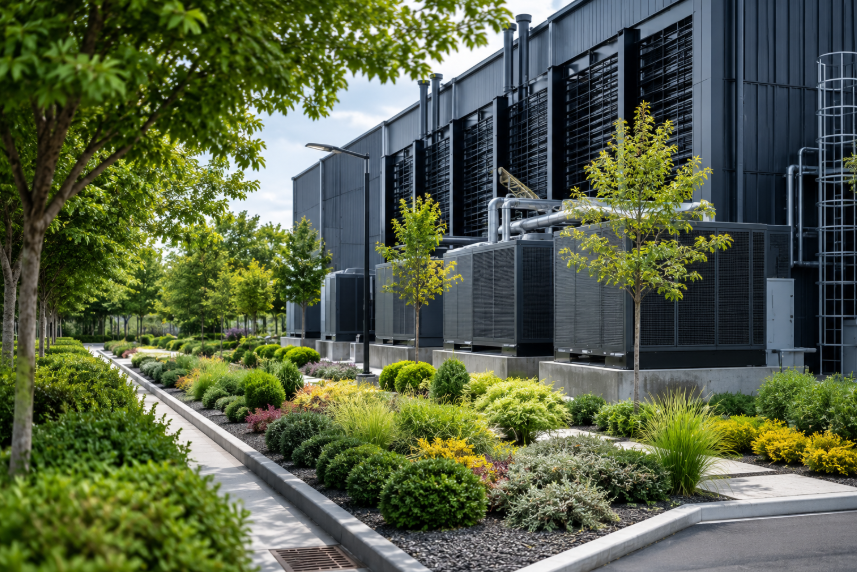
Talk to anyone about what goes into building a data centre, and you’ll hear about servers, cooling systems, substations, generators, fire suppression. Almost nobody mentions the plants outside. But what grows on a data-centre campus can quietly cause problems for drainage, underground cables, fire safety and day-to-day maintenance.
A data centre can’t afford disruption the way an ordinary commercial building can. That’s why landscaping here needs to be part of site planning, not an afterthought added for looks. What matters is which species get planted, how their roots behave, how much water they need, how big they eventually grow, and how much organic debris they shed.
None of this means a particular plant is off-limits everywhere. Climate, soil and site layout all play a role. But a few plants are worth extra caution near buildings, utility corridors, cooling equipment and drainage lines.
Bamboo
Bamboo grows fast and makes a good screen, but the running varieties spread underground through rhizomes that are hard to contain. On a data-centre site, that’s a problem wherever future digging near utility corridors might be needed. Clumping varieties, planted within clearly marked zones, are the safer bet if bamboo is used at all.
The underlying point holds for any planting decision: roots shouldn’t be allowed anywhere near buried infrastructure. Landscape extension guidance makes the same point when it comes to placing trees near underground utilities.
Willow
Willows grow fast and love water, which is exactly the problem. Their roots chase moisture, so where you plant them relative to drains and water lines matters a lot. Research shows roots can grow toward water sources and, in some cases, work their way into pipes through weak joints.
Put a willow too close to a data centre’s drainage network, and you’re setting up a maintenance headache down the line. These trees belong somewhere their root spread and canopy can grow without hitting anything important.
Ficus and other large fig species
Ficus looks great in tropical and subtropical landscaping, but several of the larger species send out extensive surface or aerial roots. The University of Florida’s IFAS extension notes that weeping fig, for instance, can lift sidewalks, patios and driveways as it matures, eventually becoming a large, spreading tree.
Some species go further. Banyan and strangler fig develop substantial surface and aerial root systems, and UF/IFAS points out that certain Ficus roots can damage infrastructure outright. That rules out large Ficus anywhere near buildings, paved areas, underground services or drainage — though smaller cultivars behave differently, so it’s worth checking the exact species before planting.
Poplar and cottonwood
Poplars grow fast and throw good shade, but several species and cultivars sucker aggressively from the roots. Utah State University describes white poplar as fast-growing with heavy root suckering, and recommends it only for large open spaces where that habit won’t cause trouble.
That’s exactly what a data centre campus doesn’t have much of — most of the land is paved, cabled, piped or fenced off for maintenance access. A tree that keeps sending up suckers or spreading its roots wide just adds to the maintenance load over time. And trees that look reasonably sized at planting can turn into real obstructions a few years later once their mature dimensions catch up.
Highly flammable species — some eucalyptus and conifers
Fire risk might be the strongest argument for treating landscaping as an infrastructure decision rather than a design one.
Plants themselves can act as fuel. Oregon State University Extension lists moisture content, dead material, plant volume and chemical makeup as the main drivers of flammability, with volatile oils, resins and fine dry material flagged as particularly risky traits.
Eucalyptus is a good example wherever it’s grown, since some species carry volatile oils that can intensify a fire under the right conditions. The same caution applies to resinous conifers generally — they shouldn’t sit close to critical buildings or equipment. It’s not only about whether a plant burns; dried leaves, twigs and bark pile up around a site and add fuel of their own. Fire-wise landscaping guidance calls for spacing plants out, clearing dead material regularly, and keeping vegetation away from vulnerable structures — all of which becomes part of a data centre’s fire-risk strategy.
It’s not the plant — it’s where you put it
None of this is an argument against landscaping. Good landscaping does real work: it shades buildings, manages stormwater, and makes a campus more pleasant for the people working there. The difference for a data centre is that the landscaping has to be designed around the infrastructure, not the other way round.
That means choosing trees for their mature size and root spread, not how they look on planting day. It means keeping vegetation clear of air intakes, generators, substations, electrical equipment, access routes and fire-safety systems. It means mapping drainage channels and utility corridors before a single tree goes into the ground, and designing irrigation so it doesn’t create unwanted moisture near buildings.
Water use matters too. Large, thirsty landscapes push up both operating costs and pressure on local water supplies — drip irrigation and the right plant choices go a long way toward avoiding that.
In the end, the same principle that governs the rest of a data centre applies outside its walls: design for reliability and long-term operation, not appearance.
The best data-centre landscape isn’t the one with the biggest trees or the most elaborate gardens. It’s the one that looks good without putting underground utilities, drainage, fire safety, equipment access or operational uptime at risk. As campuses keep growing, landscaping is turning into part of the critical-infrastructure conversation — not a footnote to it.