

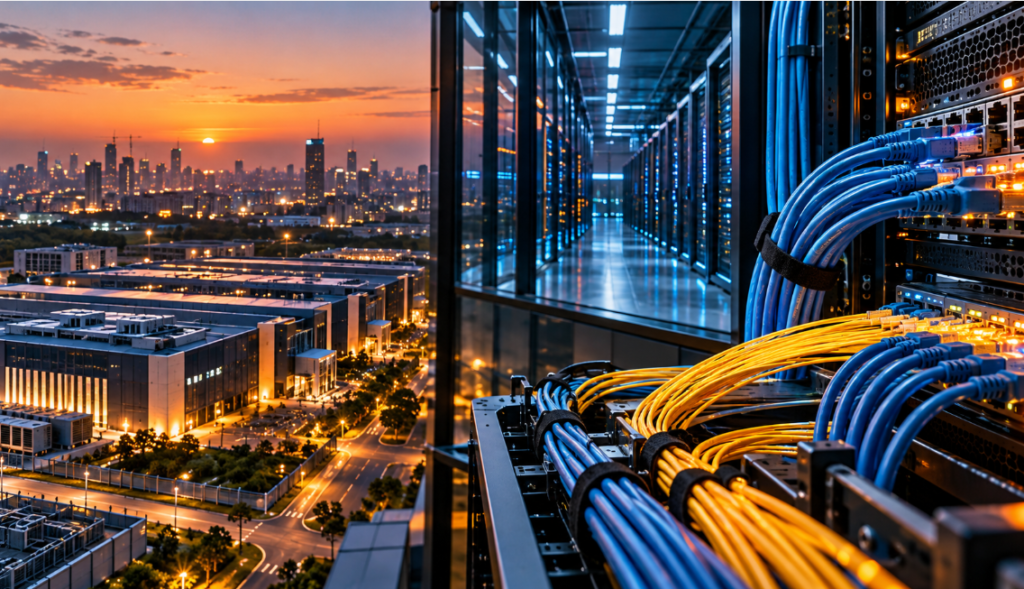
India’s rapidly expanding data centre ecosystem is creating opportunities beyond the operators building large campuses and the companies supplying power, cooling and servers. A less visible part of the infrastructure stack is also set to benefit: networking cables, optical fibre and connectivity products.
A recent IPO research report by SBI Securities on Orient Cables (India) Ltd. highlighted how the growth of data centres, broadband and telecom is translating into demand for the physical connectivity infrastructure required to link servers, networks and equipment.
Orient Cables manufactures networking cables and allied connectivity products, including LAN cables, patch cords, CCTV and coaxial cables, control and instrumentation cables, optical fibre cables, power cords and EV charging cable assemblies. The company caters to broadband, telecom, smart building automation and security, data centres, renewable energy, automotive and other industrial sectors.
Data centres emerge as a growing end market
Data centres accounted for Rs 54 crore, or 4.6% of Orient Cables’ revenue, in FY26, up from Rs 23 crore, or 2.8%, in FY25. In the first quarter of FY27, the company generated another Rs 15 crore from data centres.
The numbers also need to be viewed in the context of the company’s broader product mix. Networking cables and solutions remained its largest business, generating Rs 917 crore in FY26, or 78.2% of revenue. The report describes Orient Cables as a specialised manufacturer with exposure to “high-growth sectors such as telecom, broadband, data centres and renewable energy”.
For India’s data centre industry, this points to an important part of the infrastructure equation. A data centre does not only require land, electricity, cooling systems and servers. It also requires extensive physical connectivity between equipment and networks.
The cable market itself is expanding
The opportunity extends beyond data centres. According to the SBI Securities report, India’s wires and cables market increased from Rs 53,300 crore in FY19 to Rs 1,12,200 crore in FY26. It is projected to reach Rs 2,10,400 crore by FY31, representing a 13.4% CAGR between FY26 and FY31. At the same time, the market is becoming increasingly organised.
The organised segment accounted for 79.5% of India’s wires and cables market in FY26, compared with 67.2% in FY19. The report projects this share to rise to 87.5% by FY31, while the unorganised segment’s share is expected to decline from 20.5% to 12.5%.
This shift could be significant for companies manufacturing specialised cables and connectivity products, particularly as customers increasingly require customised products, certifications and technical approvals.
Optical fibre adds another layer
The opportunity is not limited to copper-based networking cables. Orient Cables’ speciality power, optical fibre cables and solutions business increased sharply to Rs 250 crore in FY26 from Rs 98 crore in FY25. Its contribution to total revenue consequently rose from 11.9% to 21.4%. In 1QFY27, the segment contributed Rs 153 crore, or 31.2% of revenue.
The company also manufactures fibre patch cords and optical fibre cables, alongside LAN cables and other networking products. This matters as India’s digital infrastructure expands because connectivity requirements extend across telecom networks, broadband infrastructure and data centre facilities.
Broadband could provide another demand driver
The SBI Securities report also pointed to strong growth in India’s broadband market. The market stood at Rs 14,100 crore in FY26 and is projected to reach Rs 31,800 crore by FY31, implying a 17.6% CAGR.
Globally, the broadband market is projected to increase from $29 billion in CY25 to $48 billion by CY30, according to the report. For cable manufacturers, the combination of broadband expansion, telecom infrastructure and data centre construction creates multiple demand pools rather than dependence on a single end market.
Orient Cables is already expanding its capacity
The company operates two manufacturing facilities in Bhiwadi, Rajasthan, and a facility in Bengaluru that commenced operations in May 2026. The Bengaluru facility is intended to improve access to customers in South India.
Its total cable manufacturing capacity stood at 794,976 km in FY26, with overall utilisation at 69.9%. In 1QFY27, total installed capacity was 223,944 km for the three-month period, with utilisation at 71%.
The company is also looking to diversify into products such as E-beam irradiated cables, solar junction boxes and tethered-drone systems, targeting applications in renewable energy, e-mobility, defence, aerospace and railways.
A physical infrastructure story behind the digital economy
The broader takeaway is that India’s digital infrastructure buildout is creating demand across several layers of the supply chain. Data centre operators may attract the headlines with multi-billion-rupee investments, but those facilities also require the underlying connectivity infrastructure to move data between servers, networks and external systems. The Orient Cables report provides an early look at this less visible segment. Its data centre business remains relatively small at present, but the company’s exposure to networking cables, optical fibre and speciality connectivity products places it within the wider infrastructure ecosystem supporting India’s digital economy.
There are also risks. The report flags raw material volatility, customer concentration and rising working-capital requirements. Copper accounts for around 80% of key raw materials, while the company’s top five customers contributed 65% of FY26 revenue.


