

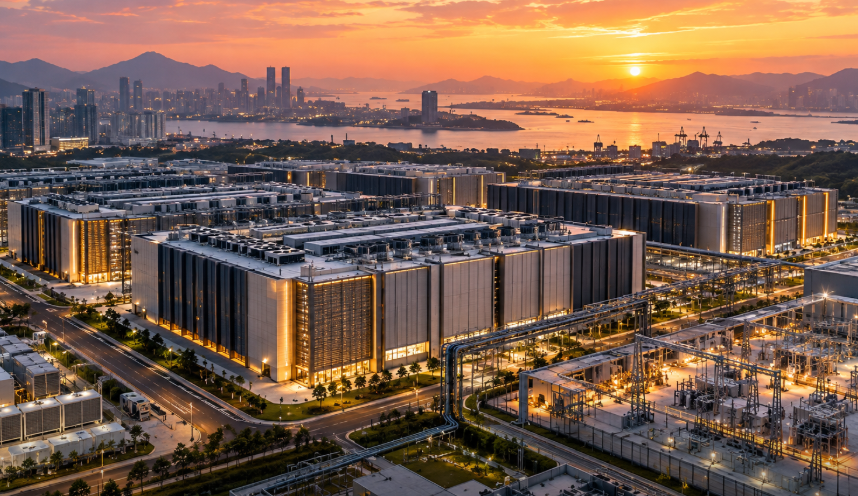
Asia Pacific’s data centre industry is entering a massive investment cycle, with more than $280 billion in capital expenditure expected to be required through 2030, according to Cushman & Wakefield. The investment will be driven by the rapid adoption of artificial intelligence, cloud computing and rising data consumption. Cushman & Wakefield expects the value of operational data centre assets across APAC to exceed $950 billion by 2030.
APAC’s data centre capacity is projected to increase 2.7 times by 2030. The region currently has around 15,135 MW of operational capacity, with another 26,455 MW in the development pipeline.
Five markets to drive investment
Around 77% of APAC’s projected data centre capex through 2030, or around $215 billion, is expected to be deployed across Japan, Malaysia, Australia, India and Indonesia. India is set to be one of the region’s major investment markets. Cushman & Wakefield estimates that the country will require around $29.9 billion in development capital through 2030. The investment comes as India’s own data centre market expands rapidly.
India crosses 1.7 GW
India’s top seven data centre markets added 178 MW of capacity during H1 2026, taking total operational capacity to 1,789 MW, according to Cushman & Wakefield’s India Data Centre H1 2026 Update. The country now has 147 data centre facilities operated by 33 providers across these markets. But the pipeline is considerably larger. India has another 3,860 MW of supply expected by 2030, including 509 MW under construction and 3,351 MW in the planning stage.
Mumbai remains India’s largest data centre market, with 890 MW of operational capacity and another 1,726 MW in the pipeline. Hyderabad has 151 MW operational capacity and 710 MW upcoming supply, while Chennai has 214 MW and 368 MW, respectively. Delhi NCR has 183 MW operational capacity and 387 MW in the pipeline.
AI is raising the cost of infrastructure
Artificial intelligence is changing the economics of data centres. AI-ready facilities require higher power densities and more advanced cooling systems. Cushman & Wakefield estimates that AI-ready data centres can require 25% to 35% more capital expenditure than traditional facilities. Andrew Green, Head of Data Centre Group, APAC at Cushman & Wakefield, said, “We are entering a phase where infrastructure readiness will become a key determinant of capital allocation.”
He added that investors are increasingly looking for “long-term power availability, scalability and the capability to support future AI requirements”.
Demand is already being locked in
The expansion is also being supported by strong pre-leasing activity. Pre-leasing volumes across APAC jumped 115% year-on-year between H1 2025 and H1 2026, with around 7.8 GW of future capacity already secured. Gordon Marsden, Head of Global Capital, APAC & EMEA at Cushman & Wakefield, said, “Data centres are no longer a niche alternative asset class but a critical component of modern infrastructure portfolios.”
He said strong financing activity, increasing demand visibility and long-term revenue growth were supporting continued capital deployment.
Next phase
India’s data centre expansion is expected to remain closely linked to AI, cloud adoption and the broader digital economy. Gautam Saraf, Executive Managing Director, Mumbai & New Business, Cushman & Wakefield, said, “India’s data centre ecosystem is expanding in both scale and depth.”
He pointed to nearly 3.9 GW of additional capacity expected across India’s leading markets by 2030, saying this would be critical for the next phase of cloud adoption, AI deployment and data-driven growth. “The significance of India’s data centre market today lies not just in the scale of capacity being added, but in the confidence that this level of investment reflects.”
Cushman & Wakefield expects annual colocation revenue across APAC to exceed $66 billion by 2030. For India, the numbers point to a significant infrastructure opportunity: around $29.9 billion of development capital and nearly 3.9 GW of additional capacity by 2030. The next phase of the data centre boom, however, will depend increasingly on access to power, land, connectivity and infrastructure capable of supporting the rising demands of AI.


